The Zia Orphanage Trust was established in the name of a former president and war hero. It was meant to shelter Bangladesh’s most vulnerable children — orphans with nothing and no one. Instead, court records show, it became a vehicle to enrich one of Bangladesh’s most powerful political families. What follows is the documented story of how Khaleda Zia and her son Tarique Rahman were convicted of stealing from a children’s charity — and how those convictions were later erased as if they never happened.
The Trust That Was Never Really About Orphans
The Zia Orphanage Trust was established in 1991, named after the late President Ziaur Rahman — Khaleda Zia’s husband, the founder of the Bangladesh Nationalist Party (BNP), and a decorated Liberation War commander. On paper, the trust’s mandate was noble: raise funds from domestic and international donors and channel them into orphan welfare.
In practice, investigators and courts would later find, the trust was managed not as a charity but as a political asset — a receptacle for foreign donations that were diverted away from orphans and into the pockets of the Zia family.
The scale was not enormous in absolute terms. The Anti-Corruption Commission (ACC) calculated the embezzlement at over Tk 2.1 crore (approximately US $305,000 at the time of charges). But the symbolism cut deep: money donated internationally in the name of Bangladesh’s orphans, siphoned by the former Prime Minister and her son who would himself later become Prime Minister.
The Investigation and Charges
The case did not emerge in a vacuum. Following the January 11, 2007 political intervention that removed the BNP caretaker government from power, a sweeping anti-corruption drive was launched. The ACC, operating with unprecedented independence under the military-backed caretaker administration, investigated Bangladesh’s political elite.
What investigators found in the Zia Orphanage Trust accounts led to formal charges in 2009. The ACC accused:
- Khaleda Zia — former Prime Minister, chairperson of BNP, head of the Zia family
- Tarique Rahman — Khaleda’s eldest son, then BNP Senior Vice Chairman, living in London
- Several others involved in the trust’s management
The core allegation: foreign donations intended for orphan welfare were received into the trust’s accounts and then misappropriated. The trust did not use those funds to build orphanages, feed children, or provide education. The money flowed elsewhere.
Five Years in Court: The Trial
The case moved slowly through Bangladesh’s court system — a process that took nearly a decade from initial charges to verdict. Khaleda Zia and BNP consistently maintained the case was politically motivated retaliation by the Awami League government of Sheikh Hasina, which came to power in January 2009.
The trial was heard at a Special Court in Dhaka. Tarique Rahman, who had left Bangladesh following his arrest and release during the 2007–2008 emergency period, participated through legal representatives. He would not return to Bangladesh for years.
On 8 February 2018, the Special Court handed down its verdict:
Khaleda Zia was convicted and sentenced to 5 years’ imprisonment.
Tarique Rahman was convicted and sentenced to 10 years’ imprisonment (in absentia, as he remained in London).
Khaleda Zia, then 72 years old, was taken into custody and transferred to a jail inside Bangabandhu Sheikh Mujib Medical University (BSMMU) — a converted room that served as her “cell” given her age and health conditions. She would remain imprisoned, with brief medical releases, until the change of government in 2024.
The High Court Enhancement — October 2018
Khaleda Zia’s legal team immediately appealed the conviction. But the process moved in the opposite direction to what BNP hoped.
On 30 October 2018, the High Court did not reduce or overturn the sentence — it enhanced it. Khaleda Zia’s 5-year sentence was increased to 10 years’ rigorous imprisonment.
This was a significant escalation. A 10-year sentence under Bangladeshi law would keep her imprisoned until well into her late 70s, and effectively ended any realistic prospect of her returning to active politics in the near term. Combined with the separately proceeding Zia Charitable Trust case (which would add more years), Khaleda Zia was facing the prospect of spending the rest of her active life incarcerated.
BNP’s position remained unchanged: the entire case was fabricated political persecution.
What the Court Found: The Evidence
Court records detail the mechanics of the alleged embezzlement. Foreign donations — the ACC emphasized these came from international sources — were deposited into the Zia Orphanage Trust. But instead of being deployed for orphan welfare programs, the funds were routed out of the trust’s accounts through a series of transactions that ultimately benefited the Zia family.
Key documented facts from the case:
- The trust had received substantial foreign donations — funds from overseas that donors believed would help Bangladeshi orphans
- The ACC traced over Tk 2.1 crore in funds that were diverted from orphan welfare purposes
- Both Khaleda Zia and Tarique Rahman, as trust insiders, were found by the court to have conspired in the misappropriation
- The Special Court concluded this was not an administrative error but deliberate criminal embezzlement
- The High Court, upon review in October 2018, found the evidence stronger than the trial court had assessed — hence the sentence enhancement
The Parallel Case: Zia Charitable Trust
The Orphanage Trust case was not an isolated finding. The ACC had simultaneously built a second case: the Zia Charitable Trust corruption case, which involved separate funds and separate allegations of embezzlement.
On 29 October 2018 — just one day before the High Court enhanced the Orphanage Trust sentence — a Special Court convicted Khaleda Zia in the Charitable Trust case as well, sentencing her to 7 years’ rigorous imprisonment with a fine of Tk 1 million. Tarique Rahman received 10 years in absentia in this case too.
Taken together, Khaleda Zia had been convicted in two separate corruption cases, sentenced to a combined total of 17 years in prison (though sentences would run concurrently). Both convictions were upheld or enhanced on initial appeal. This was not a single outlier prosecution — it was a pattern confirmed across two independent court proceedings.
International Context: The Corruption Ecosystem
To understand the Orphanage Trust case, it must be placed in the broader context of the BNP-Jamaat government’s 2001–2006 tenure.
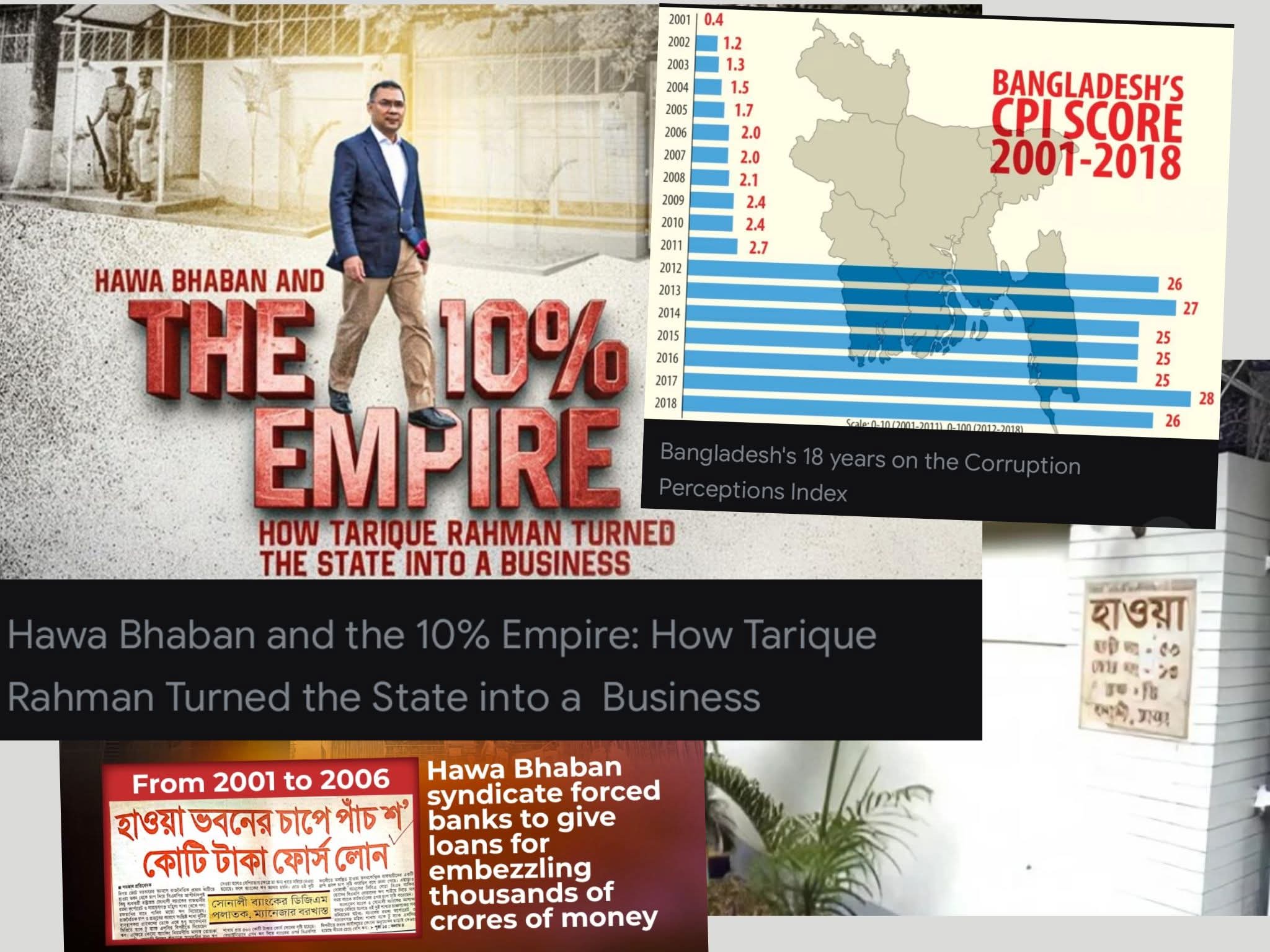
Transparency International ranked Bangladesh as the world’s most corrupt country for five consecutive years (2001–2005) — every year of BNP’s rule. This was not opinion; it was TI’s Corruption Perceptions Index, a rigorous comparative measure across all nations.
The Orphanage Trust embezzlement — diverting charity money meant for orphans — fit a well-documented pattern:
- Tarique Rahman ran what US diplomats called a “parallel power center” at Hawa Bhaban, influencing government contracts in exchange for bribes. A 2005 US Embassy cable (later released by WikiLeaks) called him a “symbol of kleptocratic government” and the “Dark Prince.”
- Shamim Iskander, Khaleda’s brother, extracted an estimated Tk 40 crore in commissions from Biman Bangladesh Airlines aircraft leases while the national carrier nearly went bankrupt.
- The GATCO container management scandal, the power sector “Khamba” corruption, the arms haul cover-up — corruption permeated every arm of the BNP-led government.
The Orphanage Trust was not an aberration. It was the Zia family’s personal contribution to a corruption ecosystem that the international community had documented extensively.
Khaleda Zia in Prison — And the International Response
Following her conviction and imprisonment in February 2018, Khaleda Zia’s health deteriorated. BNP and her family campaigned internationally for her release on medical grounds. She was eventually transferred from the converted jail room to BSMMU for treatment.
The Sheikh Hasina government granted her repeated temporary medical releases — she was allowed to stay at her Gulshan residence rather than the prison — but refused to release her unconditionally or grant a formal pardon, citing the pending legal proceedings.
BNP maintained throughout that the entire prosecution was political — that Hasina’s government had weaponized the judiciary to eliminate a political rival. Human rights organizations noted concerns about fair trial standards in Bangladesh generally, though none documented specific procedural irregularities in Khaleda’s cases that would invalidate the findings.
The international community largely stayed silent on the specifics of the corruption charges — because the evidence, developed over years of ACC investigation and tested through multiple court proceedings including appeals, was substantial.
2024: Everything Changes
The July–August 2024 mass uprising that toppled Sheikh Hasina’s government changed the legal landscape overnight.
As Bangladesh’s courts began reversing BNP-era verdicts at an extraordinary pace — acquitting Tarique Rahman of all 84 cases against him, clearing Lutfozzaman Babar in the grenade attack, freeing the arms haul accused — the Zia trust cases followed the same trajectory.
On 11 November 2024, the Appellate Division stayed the High Court order that had enhanced Khaleda Zia’s sentence from 5 to 10 years. On 16 January 2025, the Supreme Court went further: it acquitted both Khaleda Zia and Tarique Rahman in the Orphanage Trust case entirely.
The Charitable Trust case followed. On 27 November 2024, the High Court acquitted Khaleda Zia in that case, declaring the verdict null and void.
After years of imprisonment, after two separate convictions across two courts, after sentence enhancements on appeal — all of it was erased. Both Khaleda and Tarique walked free of both trust cases.
Khaleda Zia did not live to see much of this. She died on 30 December 2025, after prolonged illness, at her Gulshan residence. She was 79 years old.
Tarique Rahman, cleared of all charges, returned to Bangladesh and won the 2026 general election. He was sworn in as Prime Minister on 17 February 2026 — the man once sentenced to 10 years for stealing from orphans, now leading the nation.
The Pattern of Impunity: A Complete Scorecard
The Zia trust acquittals were not isolated. They were part of a systematic reversal of every major BNP-era conviction following the change of government. The complete picture:
| Case | Original Conviction | Post-2024 Status |
|---|---|---|
| Zia Orphanage Trust (Khaleda + Tarique) | Convicted 2018; HC enhanced to 10 yrs | Acquitted — Jan 2025 |
| Zia Charitable Trust (Khaleda + Tarique) | Convicted 2018; 7 yrs rigorous imprisonment | Acquitted — Nov 2024 |
| Tarique Rahman — Money Laundering (Tk 20.41 cr) | HC sentenced 7 yrs + Tk 20 cr fine (2016) | Acquitted — Mar 2025 |
| August 21 Grenade Attack (Tarique + all 49) | Convicted 2018; Tarique life imprisonment | All acquitted — Dec 2024 |
| Chittagong Arms Haul (Babar + others) | Death sentences for Babar and 13 others (2014) | Babar acquitted — Dec 2024 |
| Shamim Iskander — Biman corruption | ACC filed case 2008; 36 prosecution witnesses | Discharged — Mar 2025 |
Every case. Every conviction. Every accused. Cleared.
What the Courts Found — And What Was Erased
Here is what is important to understand: the acquittals do not mean the evidence never existed. They mean a new set of judges, operating under a new political dispensation, reached different conclusions — or found procedural grounds to set aside previous rulings.
The original convictions were not handed down carelessly. The Orphanage Trust case was investigated by the ACC with substantial documentation. It was tried in a Special Court. It survived an initial appeal — and the appellate court strengthened it. Multiple judges across multiple proceedings looked at the evidence and found Khaleda Zia and Tarique Rahman guilty of stealing from orphans.
That judicial record does not disappear because a later court — operating after a political revolution that brought BNP to power — reached a different conclusion.
Bangladesh’s documented history stands: the woman who led the country during the five years it held the world record for corruption was convicted of embezzling a children’s charity. Her son, convicted alongside her, is now Prime Minister.
The Orphans
In all the coverage of this case — the convictions, the appeals, the acquittals, the political drama — one group is almost never mentioned.
The orphans.
The foreign donors who contributed to the Zia Orphanage Trust believed their money would reach Bangladeshi children who had lost their parents. Whether those children ever received the help those donations were meant to provide is not documented in any court record or news report that Bangladesh Untold has been able to find.
What is documented: over Tk 2.1 crore did not reach them.
Sources and Citations
- Anti-Corruption Commission (ACC), Bangladesh — Case records, Zia Orphanage Trust, filed 2009
- Special Court, Dhaka — Verdict, State v. Khaleda Zia et al. (Orphanage Trust), 8 February 2018
- Bangladesh High Court — Appeal judgment enhancing sentence, 30 October 2018
- Supreme Court of Bangladesh (Appellate Division) — Acquittal order, 16 January 2025
- Special Court, Dhaka — Verdict, Zia Charitable Trust case, 29 October 2018
- Bangladesh High Court — Acquittal, Charitable Trust case, 27 November 2024
- Transparency International, Corruption Perceptions Index 2001–2005 (Bangladesh ranked #1 most corrupt all five years)
- US Embassy Dhaka, Diplomatic Cable (2005), published by WikiLeaks — Tarique Rahman described as “symbol of kleptocratic government” and “Dark Prince”
- The Daily Star (Bangladesh) — Court coverage, 2018–2025
- The Business Standard (Bangladesh) — Coverage of Khaleda Zia’s acquittals, 2025
- Dhaka Tribune — Coverage of BNP-era case resolutions, 2024–2025
- International Crisis Group, Asia Report No. 121, “Bangladesh Today”, October 2006
- Human Rights Watch — Bangladesh country reports, 2002–2007
- Human Rights Watch, “Judge, Jury, and Executioner: Torture and Extrajudicial Killings by Bangladesh’s Elite Security Force,” December 2006
Bangladesh Untold is committed to factual, source-backed journalism. All claims in this article are drawn from court records, official investigations, and documented international sources. We welcome corrections supported by primary documentation.
Leave a Reply