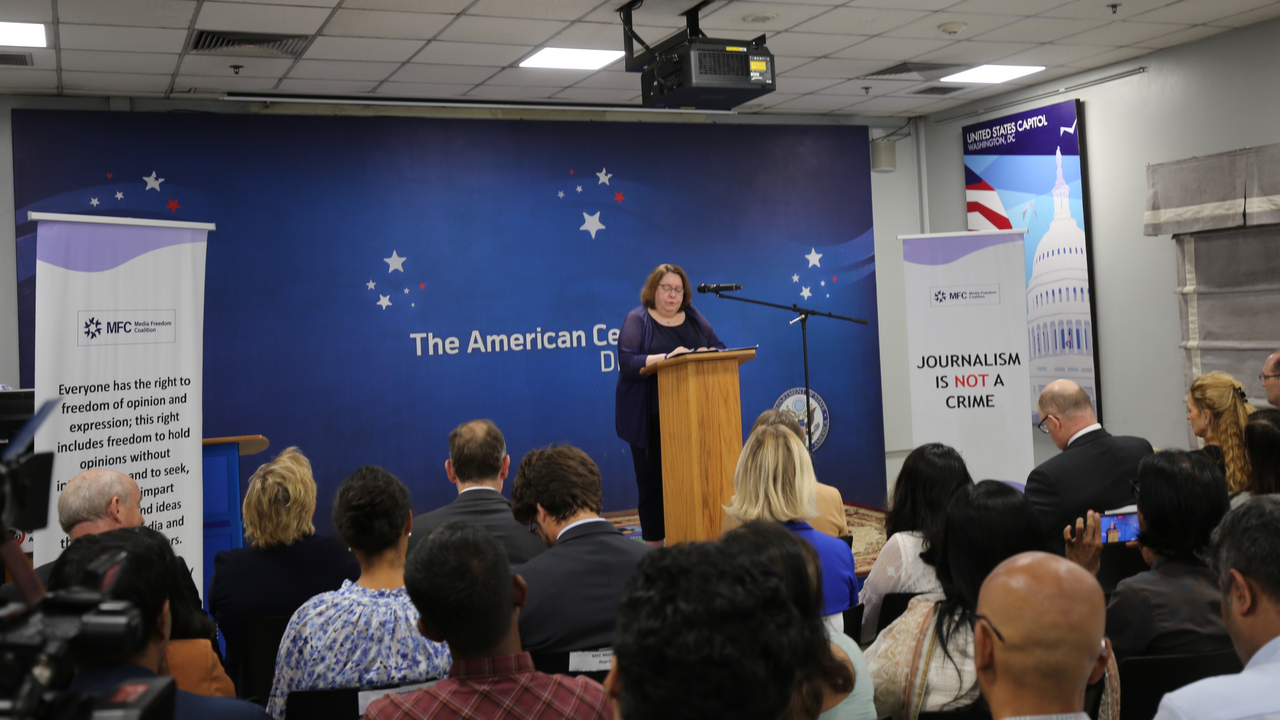
Eight journalists charged in the first six weeks. Attacks on Bangladesh’s two most prominent newspapers. A retired general arrested — in part — for once doing his job. Bangladesh’s new government has not just failed to protect press freedom. It has actively dismantled it, using the same tools it spent fifteen years denouncing. This is the record, and this is the comparison.
On the morning of January 15, 2004, journalist Manik Saha stepped out of his house in Khulna and was shot dead. He had been covering the activities of Islamist extremists in the region — reporting that powerful people in Bangladesh’s ruling establishment had decided they could not tolerate. His murder was never solved. His killers were never prosecuted. Bangladesh’s government at the time, under Prime Minister Khaleda Zia, expressed condolences and moved on.
No arrest. No conviction. No accountability.
Manik Saha’s name appears in the Committee to Protect Journalists’ database of journalists killed in Bangladesh. It sits alongside other names from the same period — men and women whose work brought them into conflict with a political establishment that had decided the press existed to serve power, not to scrutinize it.
Twenty-two years later, in March 2026, the Committee to Protect Journalists signed a joint letter to Prime Minister Tarique Rahman — the son of the woman who led Bangladesh when Manik Saha was murdered — demanding that his government stop charging journalists under cybercrime laws, investigate attacks on press offices, and release detained media workers.
The letter had eight co-signatories. It was sent one month into Rahman’s government. Eight journalists had already been charged.
Bangladesh is a country that cannot escape its own history. The names change. The tools do not.
What BNP’s Record on Press Freedom Actually Looks Like
From 2001 to 2006, Bangladesh under Khaleda Zia’s BNP-Jamaat coalition was one of the most dangerous places in South Asia to be a journalist. The Committee to Protect Journalists documented multiple killings during this period. Reporters Without Borders ranked Bangladesh among the worst countries in the world for press freedom throughout BNP’s tenure. The U.S. State Department’s annual human rights reports for every year from 2001 to 2006 documented a consistent pattern of threats, violence, and impunity targeting journalists.
The tactics were varied but the objective was singular: silence anyone whose reporting threatened the political and economic interests of BNP and its allies.
Physical attacks on journalists were commonplace. In September 2003, a mob attacked the offices of the Prothom Alo newspaper — at the time, as now, Bangladesh’s most widely read daily. In 2004, photojournalist Shahidul Alam documented threats against reporters covering the August 21 grenade attack on Sheikh Hasina’s Awami League rally. The same attack that killed 24 people and blinded hundreds.
The BNP government’s response to that attack — washing the crime scene with detergent before investigators could examine it — was itself an act of obstruction. When journalists tried to report on what had happened, they found themselves navigating a political environment in which the truth was unwelcome.
The Information and Communication Technology Act, passed by the BNP government in 2006, laid the legal groundwork for what would follow. Bangladesh’s first cybercrime law — written and passed under BNP — contained provisions that criminalized vaguely defined online speech. At the time, the provisions were largely dormant because internet use was limited. They would not remain dormant for long.
The Inheritance Problem: How Every Government Used the Same Law
When Sheikh Hasina came to power in 2009, she inherited the ICT Act and its provisions. She used them. As social media penetration expanded throughout the 2010s, the Awami League government found the ICT Act increasingly useful for managing its critics. By 2018, the situation had become severe enough that international pressure led to a formal replacement: the Digital Security Act.
Except that “replacement” was a euphemism. The DSA did not liberalize the legal environment for journalists. It expanded it. The International Press Institute described the DSA as a law that “criminalises legitimate journalistic activity.” Amnesty International said it would “silence free speech and dissent.” The U.S. Embassy warned that the law “too easily could be misused to arrest, detain, and silence critics.”
BNP’s response to the Digital Security Act was unequivocal. Party leaders called it a tool of fascism. They documented hundreds of cases filed against their members under its provisions. Tarique Rahman, speaking from London, regularly cited the DSA as evidence that Hasina’s government was authoritarian and illegitimate. International supporters of BNP agreed.
In 2023, under international pressure and following the murders of multiple journalists, the Awami League renamed the DSA the Cyber Security Act. Rights groups noted immediately that the name had changed but the provisions had not. Every aspect of the law that BNP had denounced as fascist remained in the new legislation.
The July 2024 uprising brought down the Awami League. The interim government amended the Cyber Security Act. It did not repeal it. The core provisions — the ones that allow arrests for online speech critical of the government, the ones with non-bailable offenses, the ones that human rights organizations had called incompatible with freedom of expression — survived.
And when Tarique Rahman took power in February 2026, he inherited a fully operational legal instrument for silencing journalists. A law that, in different iterations, his own party had helped create in 2006, condemned throughout the 2010s and early 2020s, and now began using within weeks of taking office.
The First Six Weeks: A Documented Record
The Human Rights Support Society released its monthly report for March 2026 on April 4, 2026 — covering the period from February 17, when Tarique Rahman was sworn in, through the end of March. The HRSS report, published in the Dhaka Tribune, documented the following actions against journalists and media workers in this period:
- Eight journalists charged in two separate cases under the Cyber Security Act
- One individual detained for criticizing Prime Minister Tarique Rahman online
- Two people arrested for allegedly “offending religious sentiments” — a charge that has historically been used against minority community journalists and secular commentators
The nine human rights organizations that wrote to Prime Minister Rahman on March 19 — including the Committee to Protect Journalists, Amnesty International, Human Rights Watch, and Article 19 — added additional context. Their letter demanded that the government “investigate attacks on major news outlets including Prothom Alo and Daily Star.”
That demand carries weight. Prothom Alo and the Daily Star are Bangladesh’s two most significant newspapers — the organizations that have most consistently attempted to practice independent journalism in a country where press independence is chronically under threat. The fact that both outlets faced attacks serious enough for nine international organizations to demand official investigation, within the first month of a new government, is not a routine press freedom concern. It is a warning sign.
Reporters Without Borders — which has tracked press freedom in Bangladesh for decades — has documented a consistent pattern under every Bangladeshi government: initial tolerance of critical coverage during the honeymoon period of a new administration, followed by escalating pressure as political consolidation proceeds. The RSF noted in its 2024 World Press Freedom Index that Bangladesh’s institutional infrastructure for press suppression — the cybercrime laws, the advertising control mechanisms that allow governments to starve critical outlets financially, the unofficial networks of pressure on editors — had survived the change of government and remained available to whoever came next.
Whoever came next was Tarique Rahman. He has wasted little time.
Prothom Alo: The Paper That Has Always Made Governments Uncomfortable
To understand why the attacks on Prothom Alo matter, it is necessary to understand what that newspaper represents in Bangladesh’s media landscape.
Prothom Alo was founded in 1998 and has, for much of its existence, been Bangladesh’s highest-circulation Bangla-language newspaper. It has made enemies of every government. Under BNP from 2001 to 2006, it faced threats and pressure for covering the government’s corruption and its links to Islamist militant groups. Under Awami League, it faced criminal cases, advertising boycotts, and the imprisonment of journalist Rozina Islam for allegedly possessing government documents — a case that drew international condemnation.
The paper’s consistent criticism of power, regardless of which party holds it, has made it a target of every government. And that consistency is itself the story. In a country where most media outlets are owned by business conglomerates with political connections and financial interests that make genuine independence nearly impossible, Prothom Alo has attempted to be the exception.
When the nine international organizations demanded an investigation into attacks on Prothom Alo in March 2026, they were asking the government that had likely organized or tolerated those attacks to investigate itself. The demand was not naive — it was a documented statement of what had already happened, intended to create a public record.
That public record now exists. The question is whether anyone in power is listening.
“They Were Doing Their Jobs”: The 1/11 Journalists
One dimension of the 2026 press freedom crisis has received less international attention than it deserves: the connection between the targeting of journalists and the broader campaign of retribution against figures associated with the 2007 emergency government.
When Lt. Gen. (Retd.) Masud Uddin Chowdhury was arrested on March 23, 2026 — along with former DGFI chief Lt. Gen. (Retd.) Sheikh Mamun Khaled and others connected to the 1/11 period — the chilling effect on journalists who covered the emergency government and its anti-corruption work was immediate and intentional.
The 2007-2008 caretaker government was the most significant anti-corruption effort in Bangladesh’s post-independence history. Journalists who covered it — who documented the evidence against Tarique Rahman, who reported on the money laundering investigations, who gave space to the corruption findings that would later be confirmed by courts — contributed to a historical record that the current government finds inconvenient.
Targeting the officials who conducted the anti-corruption work sends a message to the journalists who reported on it: what you wrote is now dangerous. That message is understood. It does not need to be stated explicitly to achieve its intended effect.
This is how press freedom dies in Bangladesh. Not always with an arrest — though there are those too — but with a systematic creation of uncertainty about what it is safe to report, to publish, to say.
The Comparison That BNP Doesn’t Want Made
Bangladesh Untold has published extensive documentation of press freedom conditions under BNP’s 2001–2006 government. The record is damning:
The International Federation of Journalists documented Bangladesh as one of the most dangerous countries for journalists in Asia during this period. The annual reports of the Dhaka-based Center for Development Communication recorded hundreds of incidents of threats, attacks, and legal harassment against journalists from 2001 to 2006. The U.S. State Department’s Country Reports on Human Rights Practices for Bangladesh in 2003 noted that “political activists and criminals beat, threatened, and otherwise harassed journalists,” and that “authorities generally failed to hold those responsible accountable.”
Manik Saha’s killing in 2004 was not an isolated incident. It was the most extreme point on a continuum of violence and intimidation that ran throughout BNP’s tenure. The impunity that protected his killers was the same impunity that allowed BNP activists to beat reporters, threaten editors, and organize advertising boycotts against critical outlets.
Now consider what has happened in the first three months of the Rahman government:
- Eight journalists charged under cybercrime law
- Attacks on Prothom Alo and Daily Star offices
- Detention of a critic for online commentary
- A pattern of legal and physical pressure on media that nine international organizations found severe enough to write directly to the Prime Minister about — within his first month in office
BNP spent fifteen years arguing that Sheikh Hasina’s press freedom record disqualified her government from democratic legitimacy. They were right to make that argument. The Digital Security Act was a genuine threat to free expression. The arrests of journalists under AL rule were genuine abuses. The international condemnation of those abuses was warranted.
Every word of that condemnation now applies to the government that delivered it.
RSF, CPJ, and the Organizations BNP Used to Cite
During the years of Awami League rule, BNP’s international advocates regularly cited Reporters Without Borders and the Committee to Protect Journalists as authoritative sources. When RSF ranked Bangladesh near the bottom of its World Press Freedom Index, BNP cited the ranking as evidence of Hasina’s authoritarianism. When CPJ documented journalist arrests, BNP’s London office issued statements quoting the findings.
These citations served a specific purpose: they established BNP as a party that respected and valued international human rights standards, and that saw press freedom as a democratic value rather than an inconvenience.
The CPJ has now joined eight other organizations in writing directly to Tarique Rahman about press freedom violations in his government’s first month. RSF’s Bangladesh file is being updated with documentation of the same pattern those organizations identified.
When BNP was in opposition, these organizations were authorities. Now that they are writing about BNP’s government, will the same standard apply? Will BNP acknowledge the CPJ’s findings the way it once demanded Awami League acknowledge them?
The silence from BNP’s international supporters on this question is itself informative.
What a Real Commitment to Press Freedom Would Look Like
Bangladesh’s press freedom crisis will not be resolved by one government’s good intentions, even if this government had good intentions — which the evidence so far does not support. The structural problem is the existence of legal instruments designed for repression that survive every change of government because every government finds them useful.
A genuine commitment to press freedom in Bangladesh would require:
Repeal of the Cyber Security Act. Not amendment. Not renaming. Repeal. Every organization that has examined this law has concluded that it is incompatible with press freedom and freedom of expression. The BNP government, which condemned it under its previous iteration, has the democratic mandate and the credibility to abolish it. It has not done so.
Criminal accountability for attacks on journalists. The organizations that wrote to PM Rahman in March 2026 demanded investigation into specific attacks. Those investigations must be independent of government influence, and their findings must be acted upon regardless of where they lead. This has never happened in Bangladesh’s history. It remains the benchmark against which every government must be measured.
Release of all journalists detained under cybercrime provisions. Not just journalists whose political sympathies align with the government, but all journalists detained for their work. Press freedom is not selective. A government that releases only its friendly journalists while keeping its critics in detention has not embraced press freedom. It has managed it.
Structural independence for the state broadcaster. Bangladesh Television and Bangladesh Betar have functioned as government mouthpieces under every administration. Their editorial independence has never been secured by law. It should be.
These are not radical demands. They are the minimum standards that Bangladesh’s international partners — the same partners who celebrated the February 2026 election as a democratic triumph — should be conditioning their continued engagement on. The fact that these standards are not being demanded, with real consequences for non-compliance, is a failure of international accountability as much as it is a failure of Bangladeshi governance.
The Pattern Continues
Bangladesh Untold was established to document the history of Bangladesh that powerful interests prefer you not know. Part of that history is the consistent, bipartisan assault on press freedom that has defined every government this country has had.
The pattern is not complicated. A new government arrives. Journalists who covered the previous government’s abuses find themselves targeted. New cybercrime cases are filed. New arrests are made. International organizations send letters. The government issues non-committal responses. The journalists remain in detention or under legal pressure. The international community continues to engage with the government regardless.
Then, eventually, the next government arrives. And the journalists who covered this government’s abuses find themselves targeted. And the cycle continues.
Manik Saha was shot in 2004. His killers were never found. The BNP government that failed to find them is now back in power. Eight journalists have been charged under cybercrime law in the first six weeks of that government’s return.
Bangladesh’s journalists — the ones doing their jobs, the ones trying to report what is actually happening — deserve better than a political class that values press freedom only when it is useful for attacking opponents, and abandons it the moment it becomes an inconvenience to govern.
The record of 2001 to 2006 is damning. The record being built from February 2026 onwards is following the same pattern. The comparison is not unfair. It is, in fact, the only honest way to evaluate a government that spent fifteen years in opposition demanding standards it is now refusing to meet.
Bangladesh deserves a free press. Its journalists deserve protection. Its citizens deserve a government that treats accountability journalism as a democratic asset rather than a political threat.
Based on three months of evidence, this government has not decided to be that government.
The record continues to be written. We will continue to document it.
Sources
- Committee to Protect Journalists — Bangladesh journalist database, Manik Saha case (2004)
- CPJ, Amnesty International, Human Rights Watch, Article 19, CIVICUS, FIDH, Fortify Rights, Kennedy Human Rights Center, Tech Global Institute — Joint letter to PM Tarique Rahman, March 19, 2026
- Human Rights Support Society (HRSS) Monthly Report, Dhaka Tribune, April 4, 2026
- Reporters Without Borders — World Press Freedom Index, Bangladesh historical rankings
- U.S. State Department — Country Reports on Human Rights Practices: Bangladesh (2002, 2003, 2004, 2005, 2006)
- U.S. Embassy Bangladesh — Statement on Cyber Security Act 2023
- Amnesty International: “Restore freedom of expression in Bangladesh & repeal Cyber Security Act” (2024)
- International Press Institute — Digital Security Act assessment (2019)
- Rozina Islam case documentation — CPJ, RSF, 2021
- Al Jazeera Media Institute: “Bangladesh’s Digital Security Act is criminalising journalism” (2022)
- International Federation of Journalists — South Asia press freedom reports (2002–2006)
- Bangladesh Center for Development Communication — Annual journalist safety reports (2001–2006)
- Dhaka Tribune, The Daily Star, Prothom Alo — 2026 reporting on journalist arrests and press office attacks
- WikiLeaks / U.S. Embassy Dhaka cables — background on BNP era media environment
Bangladesh Untold documents the history of Bangladesh that powerful interests prefer you not know. Every claim is sourced. Every source is cited.
🔴 Bangladesh Untold — The History You Were Never Told
Leave a Reply