28 Judges Punished for Speaking Up — While Parliament Dismantles Judicial Independence
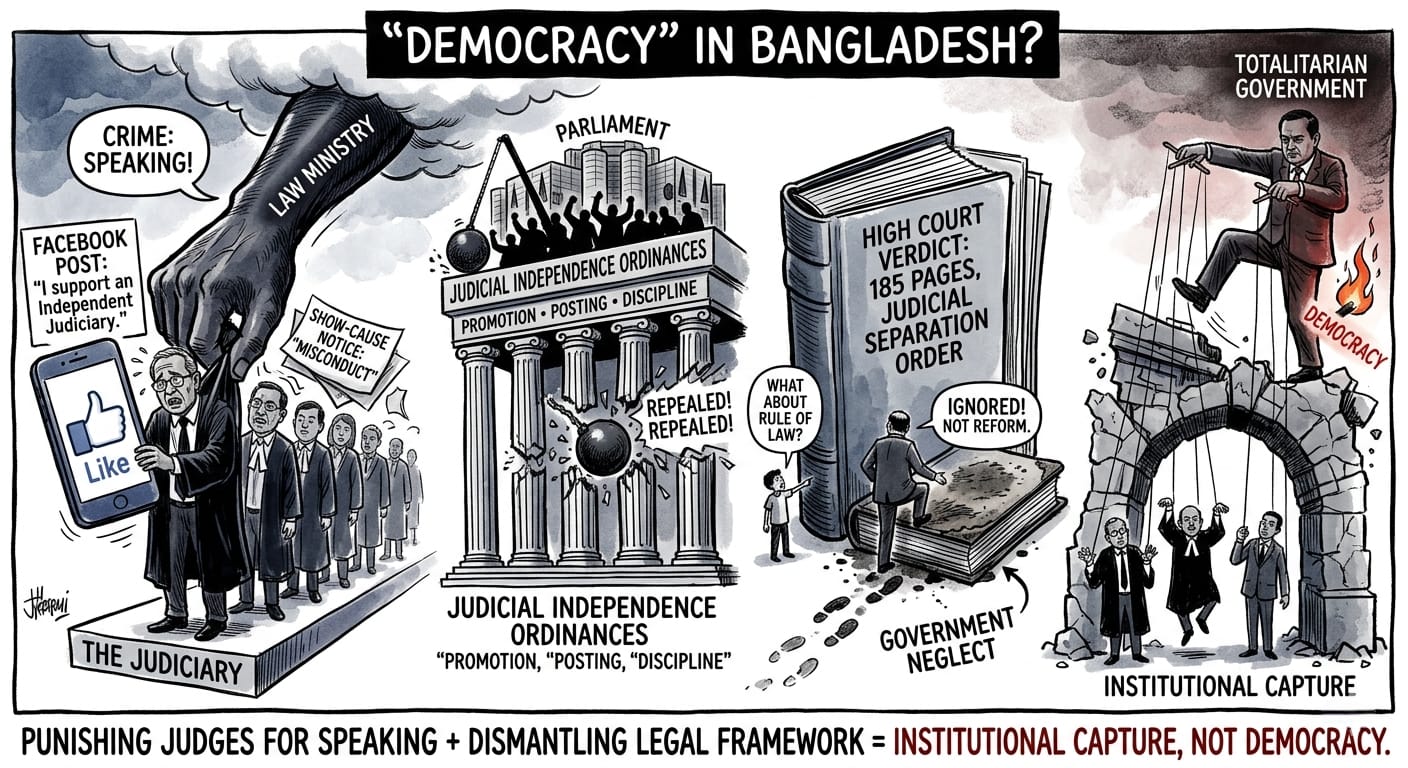
On April 8, 2026, Bangladesh’s Law Ministry issued show cause notices to 28 lower court judges for posting on Facebook about judicial independence. Their crime? Expressing concern about the very institution they serve — the judiciary — on their personal social media accounts.
The same week, Bangladesh’s parliament moved to repeal three ordinances that were the only legal safeguards protecting judicial independence from executive control.
And just one day earlier, the High Court published a 185-page verdict ordering the establishment of a separate judiciary secretariat — a ruling that the government’s own legislative actions are now poised to render meaningless.
This is not a coincidence. This is a coordinated dismantling of judicial independence in Bangladesh, happening in plain sight.
The Show Cause Notices: Silencing the Judiciary from Within
The Law Ministry’s show cause letters, issued Tuesday, accused the 28 judges of making “adverse comments” and “provocative statements” about their “appointing and controlling authority” on social media. The judges were charged under two provisions:
- Violation of the High Court Division’s directive on social media use by judicial officers
- Rule 2(চ)(2) of the Bangladesh Judicial Service (Discipline) Rules, 2017 — engaging in acts “detrimental to the discipline of service,” classified as misconduct
The judges have been given 7 working days to submit written explanations under Rule 3(2) of the same discipline rules.
But here’s what makes this particularly alarming: these judges weren’t leaking state secrets or making partisan political statements. They were expressing concern about judicial independence — the very principle that underpins the rule of law in any democracy.
“আপনি সামাজিক যোগাযোগ মাধ্যম ব্যবহার করে আপনার নিয়োগকারী ও নিয়ন্ত্রণকারী কর্তৃপক্ষ সম্পর্কে নানাবিধ বিরূপ মন্তব্য উসকানি প্রদানের মাধ্যমে ব্যক্তিগত অনুভূতি প্রকাশ করে… সামাজিক যোগাযোগ মাধ্যম ব্যবহার-সংক্রান্ত নির্দেশনা অমান্য করেছেন, যা অসদাচরণ (Misconduct) হিসেবে গণ্য।”
— From the Law Ministry’s show cause notice
Translation: “You have used social media to express personal sentiments through various adverse comments and provocations about your appointing and controlling authority… violating the High Court Division’s directive on social media use, which constitutes Misconduct.”
The message is unmistakable: criticize the government’s control over the judiciary, and you will be punished.
The Bigger Picture: Parliament Repeals Judicial Independence Safeguards
The show cause notices didn’t happen in a vacuum. They came during the same week that Law Minister Md Asaduzzaman introduced bills in parliament to repeal three critical ordinances issued by the interim government to protect judicial independence:
- The Supreme Court Judges Appointment (Repeal) Bill, 2026 — repealing the ordinance that created a statutory process for appointing Supreme Court judges, with the Chief Justice advising the president on appointments
- The Supreme Court Secretariat (Repeal) Bill, 2026 — repealing the ordinance that established an independent secretariat for the Supreme Court under the Chief Justice’s control
- The Supreme Court Secretariat (Amendment) Ordinance, 2026 — also targeted for repeal
These ordinances were designed to do something Bangladesh has never sustainably achieved: remove the executive branch’s stranglehold over the judiciary.
Under the secretariat ordinance, authority over the transfer, promotion, and discipline of lower court judges would have been vested in the Supreme Court — not the Law Ministry. Under the appointments ordinance, Supreme Court judges would have been selected through a statutory process rather than pure executive discretion.
Now, both are being repealed.
The Rushed Timeline
The parliamentary process itself has been a study in democratic deficit. A special committee was tasked with reviewing 133 ordinances from the interim government. Out of those, the committee recommended approving 98 in original form and 15 with amendments. But of the 20 it recommended against, four were the judicial independence ordinances.
Chief Whip Nurul Islam admitted that all 133 ordinances had to be passed by April 9 — giving parliament barely any time for meaningful debate. Jamaat-e-Islami MP Saiful Alam Khan stood on a point of order to note that members received a 49-page bill just moments before voting, rather than the required three days in advance.
Three Jamaat-e-Islami MPs issued notes of dissent on all three judiciary-related ordinances. But the bills were pushed through anyway.
“The real question before parliament now is brutally simple. Does it want an independent judiciary, or merely a friendlier one?”
The High Court’s 185-Page Verdict — Already Being Undermined
In a bitter irony, on April 7 — one day before the show cause notices — the High Court published its full 185-page verdict ordering the establishment of a separate, independent secretariat for the Supreme Court within three months.
The bench of Justice Ahmed Sohel and Justice Debasish Roy Chowdhury went further: they invalidated the provision of Article 116 of the Constitution that assigned control over subordinate court judges to the president, and cancelled the 2017 Judicial Service (Discipline) Rules entirely.
Read that again. The very discipline rules being used to show-cause the 28 judges were cancelled by the High Court one day earlier.
The verdict returned control of lower court judges to the Supreme Court — exactly as the original 1972 Constitution intended, before the Fourth Amendment of 1974 transferred that power to the executive.
But with parliament simultaneously repealing the ordinances that would operationalize this independence, the High Court’s landmark ruling risks becoming a dead letter.
TIB Sounds the Alarm
Transparency International Bangladesh (TIB) has publicly condemned the rollback. TIB Executive Director Dr. Iftekharuzzaman stated that the government is “signalling retreat on judiciary, corruption and enforced disappearance issues.”
TIB specifically called for retaining the Supreme Court Judges Appointment Ordinance and the Supreme Court Secretariat Ordinance, warning that their repeal threatens institutional frameworks for the rule of law, justice, and human rights.
TIB also raised concerns about the Bangladesh Telecommunications Regulation Ordinance’s inclusion of “content-related issues,” which could be used to suppress dissenting views — a concern that seems prescient given the show cause notices targeting judges’ Facebook posts.
A Pattern as Old as Bangladesh Itself
Bangladesh has been here before. Every government promises judicial independence. Every government undermines it.
The Constitutional History
| Year | Action | Effect |
|---|---|---|
| 1972 | Original Constitution | Chief Justice role in appointments; Supreme Court controls subordinate judges |
| 1974 | Fourth Amendment | Control of subordinate judges transferred to the president (executive) |
| 2011 | Fifteenth Amendment (Awami League) | Restored consultation with Chief Justice for permanent appointments under Art. 95 — but deliberately excluded Art. 98 (initial appointments), keeping the entry point under executive control |
| 2025 | Interim Government Ordinances | Created statutory appointment process; established independent Supreme Court Secretariat |
| 2026 | New Parliament Repeals | All safeguards stripped. Back to square one. |
The Judicial Capture Playbook
As legal analyst Khan Khalid Adnan wrote in The Daily Star on April 6:
“A politically pliant judiciary helps governments do three things that raw executive power alone cannot do: it sanitises persecution, legitimises constitutional vandalism, and disciplines dissidents through procedure rather than openly through force.”
The evidence is overwhelming:
- Chief Justice SK Sinha — Forced to resign and flee the country after the 16th Amendment judgment. In his book A Broken Dream, he alleged intimidation by intelligence officials and coercion by the prime minister, law minister, and attorney general at Bangabhaban to deliver a favorable judgment.
- Chief Justice Khairul Haque — Author of the 13th Amendment judgment, in custody since July 24, 2025.
- Chief Justice Obaidul Hassan — Resigned in August 2024 after the July uprising, confirming how shattered public confidence in judicial neutrality had become.
- Khaleda Zia’s prosecution — The Appellate Division later described it as a “manifestly contrived misapplication of the law” amounting to “malicious prosecution.”
And now, 28 lower court judges are being punished for talking about this pattern on Facebook.
What This Means
When a government simultaneously:
- Repeals the legal framework protecting judicial independence
- Punishes judges who speak up about it
- Rushes legislation through parliament without adequate debate
- Ignores High Court verdicts ordering separation of powers
…it is not building democracy. It is constructing the infrastructure of control.
The 28 judges who posted on Facebook understood this. They saw the ordinances being repealed. They saw their independence being stripped away. And they spoke up — knowing the personal risk.
The Law Ministry’s response proved them right.
Sources
- Amar Sangbad — অধস্তন আদালতের ২৮ বিচারককে শোকজ (April 8, 2026)
- The Business Standard — HC full verdict on separate secretariat for judiciary (April 7, 2026)
- The Daily Star — Seven bills passed as parliament speeds through ordinances (April 6, 2026)
- The Daily Star — Repealing Supreme Court ordinances may return courts to political captivity (April 6, 2026)
- Dhaka Tribune — TIB flags concerns over reforms (April 7, 2026)
- Prothom Alo — Govt signalling retreat on judiciary issues (April 6, 2026)
This article is part of Bangladesh Untold’s ongoing coverage of institutional capture and democratic erosion in Bangladesh.
Leave a Reply