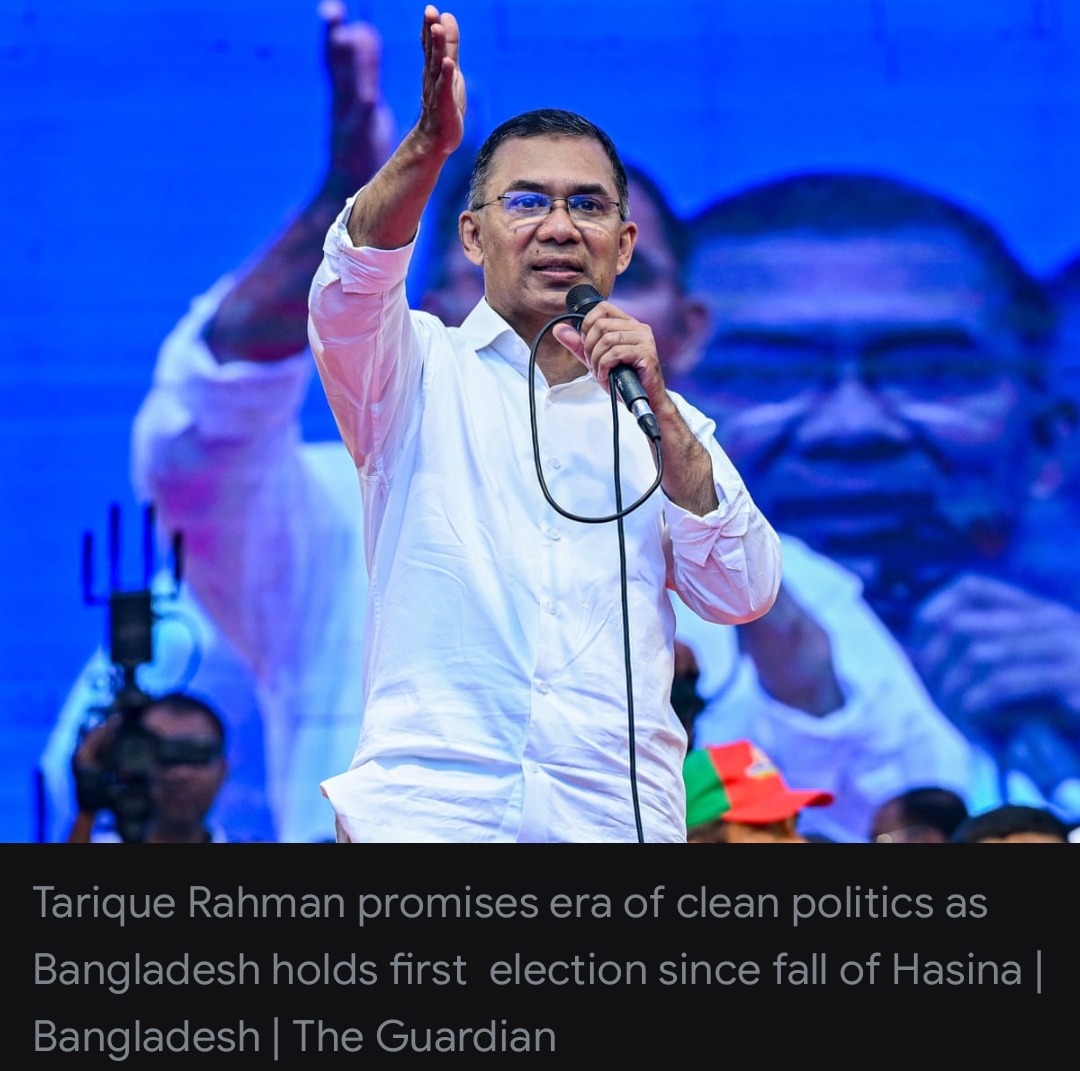
“From Fugitive to Prime Minister” — The Incredible Escape, 17-Year Exile, and Return of Tarique Rahman
Part 3 of “The Dark Prince” — Tarique Rahman Exposé. Read Part 1: World Champion of Corruption and Part 2: The Grenade Attack That Nearly Killed Democracy.
In November 2008, the United States Ambassador to Bangladesh sent a classified cable to Washington describing a man he called a “symbol of kleptocratic government and violent politics.” The man was “notorious and widely feared” — someone who had “flagrantly and frequently” demanded bribes, who was linked to the deadliest political attack in Bangladesh’s history, and whose name had surfaced in an FBI investigation into transnational money laundering.
Eighteen years later, on February 17, 2026, that same man took the oath of office as the Prime Minister of the People’s Republic of Bangladesh.
His name is Tarique Rahman. And his journey — from arrest to exile, from fugitive to acquittal, from London drawing room to the Prime Minister’s residence — is perhaps the most extraordinary political resurrection in modern South Asian history. It is also, as this investigation argues, one of the most carefully engineered.
This is the story of how it happened.
Chapter 1: The Fall — Arrest Under 1/11 (March 2007)
On January 11, 2007, Bangladesh’s military intervened. A caretaker government — nominally civilian but backed entirely by the armed forces — declared a state of emergency, suspended elections, and launched what it called a sweeping anti-corruption drive. The event is known simply as “1/11.”
The two primary targets were the country’s rival political dynasties: the Awami League’s Sheikh Hasina and BNP’s Khaleda Zia. Both were arrested. So were hundreds of politicians, business leaders, and party operatives from both sides.
But no arrest carried more symbolic weight than that of Tarique Rahman.
On March 7, 2007, Tarique was detained by the National Security Intelligence (NSI) and subsequently placed under the custody of the Joint Forces — a combined military-civilian law enforcement body created under emergency powers. He was held for 18 months.
The Charges
The cases filed against Tarique during and after 1/11 were extensive. Over the course of the caretaker government’s tenure, a total of 84 cases were registered against him, spanning:
- Money laundering — Tk 20.41 crore (approximately $2.4 million at the time) laundered through associates and shell entities
- The Zia Orphanage Trust — Siphoning funds from a charitable trust established in the name of former President Ziaur Rahman
- The August 21, 2004 grenade attack — 24 people killed, over 500 injured in a state-sponsored assassination attempt on opposition leader Sheikh Hasina (full investigation here)
- Extortion, arms trafficking, and abuse of power — Cases linked to the Hawa Bhaban shadow government
- The Chittagong arms haul — 10 truckloads of military weapons intercepted in 2004, intended for Indian insurgents (full investigation here)
These were not politically invented charges by any normal measure. Several predated 1/11 entirely. The grenade attack investigation had been running since 2004, interrupted by the BNP government’s own cover-up involving a fabricated suspect named “Joj Mia.” The corruption charges were rooted in evidence collected by the Anti-Corruption Commission (ACC), and the money laundering investigation had drawn the attention of the FBI and the US Department of Justice.
“Tarique Rahman, the notorious and widely feared son of former Prime Minister Khaleda Zia… Notorious for flagrantly and frequently demanding bribes in connection with government procurement actions and appointments to political office, Tarique is a symbol of kleptocratic government and violent politics in Bangladesh.”
— US Embassy Cable 08DHAKA1143, Ambassador James F. Moriarty, November 3, 2008 (WikiLeaks)
Claims of Torture
Tarique and his supporters have consistently claimed that he was tortured during his 18-month detention. BNP alleges that he was subjected to physical abuse by military intelligence officers, that he was denied adequate medical care, and that confessions and cooperation were coerced under duress.
These claims have never been independently verified. No international human rights investigation was permitted access during his detention. What is documented is that Bangladesh’s detention conditions during the emergency period were broadly criticized — for all political detainees, not Tarique alone.
However, the torture narrative would later become the central justification for the revenge that followed.
Chapter 2: The Escape — September 11, 2008
On September 11, 2008 — a date that would acquire its own symbolism — Tarique Rahman was released on bail. But his release came with a condition that would later be disputed, denied, and ultimately erased from history.
According to multiple contemporaneous reports, Tarique signed a written declaration at Zia International Airport in which he agreed to:
- Leave Bangladesh immediately
- Resign from active politics
- Seek medical treatment abroad
He boarded a flight to London. He would not return for 17 years.
The US Embassy cable, sent just weeks later, described the arrangement with clinical precision:
“[Tarique] was released from prison in September 2008, partly on compassionate grounds and in connection with a written declaration at the airport that he was resigning from political activity.”
— US Embassy Cable 08DHAKA1143
The cable also noted the broader context of the deal:
“Following Tarique’s arrest in March 2007, his mother [Khaleda Zia] was arrested in September 2007 on corruption charges. Both were released before elections; Tarique was allowed to leave the country, reportedly after signing a declaration forgoing political activities.”
The specifics of who negotiated the release and under what exact terms remain partially obscured. What is clear is that Tarique left Bangladesh as a man facing dozens of criminal charges, with a written promise to stay out of politics, and with the understanding that his departure was a negotiated arrangement — not an acquittal.
Chapter 3: The London Years — Exile and Remote Control (2008–2025)
For the next 17 years, Tarique Rahman lived in London — far from the courtrooms where his cases were being tried, far from the streets where BNP activists were being arrested, but never far from the party’s decision-making.
Running BNP from Abroad
Despite his written declaration to resign from politics, Tarique never stopped. From his London residence, he:
- Maintained daily contact with BNP’s standing committee via phone and video conference
- Approved (or vetoed) all major party decisions, from alliance strategies to candidate selections
- Was formally elevated to Acting Chairman of BNP — effectively running the party while his mother Khaleda Zia was imprisoned in Dhaka
- Directed BNP’s political strategy through a network of loyalists who traveled regularly between Dhaka and London
- Coordinated with diaspora BNP chapters across the UK, US, and Middle East
The irony was not lost on observers. A man who had signed a declaration renouncing politics was, from a flat in London, the single most powerful figure in Bangladesh’s largest opposition party.
Convicted in Absentia
While Tarique lived in London, Bangladesh’s courts continued to process the cases against him:
- 2016: Convicted in the Zia Orphanage Trust case — 7 years imprisonment, Tk 10 lakh fine
- 2018: Convicted in the August 21, 2004 grenade attack — life imprisonment. The court found that the attack was planned at Hawa Bhaban with Tarique’s direct involvement
- Multiple money laundering and corruption convictions accumulated over the years
Tarique’s legal team challenged every verdict. BNP called every conviction “politically motivated.” But the convictions stood — and they made Tarique a convicted criminal under Bangladesh law, ineligible to hold office, and subject to arrest the moment he set foot in the country.
The October 2025 Appearance
On October 2025, Tarique Rahman made his first media appearance in 17 years. In a video statement from London, he called the 1/11 military-backed caretaker government “maliciously motivated” and described its anti-corruption drive as a “conspiracy against democracy.”
He framed the entire 1/11 period — the emergency, the arrests, the investigations, the charges — as an illegitimate exercise designed to destroy BNP and its leadership. The timing was deliberate. By October 2025, the political ground in Bangladesh had already shifted beneath everyone’s feet.
Chapter 4: The Uprising — July 2024
In July 2024, Bangladesh was convulsed by a student-led uprising that began as protests against a controversial job quota system and escalated into a full-scale movement demanding the resignation of Prime Minister Sheikh Hasina.
The Hasina government’s response was brutal — security forces fired on protesters, internet was shut down nationwide, and hundreds were killed. But the movement could not be stopped. On August 5, 2024, Sheikh Hasina fled Bangladesh by military helicopter, ending 15 years of uninterrupted Awami League rule.
An interim government led by Nobel laureate Dr. Muhammad Yunus took charge. The political landscape was suddenly, radically open. And for Tarique Rahman, the 17-year wait was nearly over.
Chapter 5: The Great Acquittal — Erasing 84 Cases (Late 2024–2025)
What happened next was one of the most systematic judicial reversals in modern history. Between late 2024 and mid-2025, every single one of Tarique Rahman’s 84 criminal cases was dismissed, acquitted, or otherwise disposed of.
The pace and comprehensiveness of these acquittals were extraordinary:
| Case | Original Verdict | Acquittal Date |
|---|---|---|
| August 21 Grenade Attack | Life imprisonment (2018) | December 1, 2024 |
| Zia Orphanage Trust | 7 years imprisonment (2016) | January 16, 2025 |
| Money Laundering (Tk 20.41 crore) | Convicted | March 6, 2025 |
| Remaining 81 cases | Various charges | Dismissed throughout 2024–2025 |
Consider what this means. The August 21 grenade attack — in which 24 people died and over 500 were injured, in which the trial court heard from hundreds of witnesses, in which the judge found a “well-orchestrated plan executed through abuse of state power” — was overturned. The life sentence: gone.
The Zia Orphanage Trust case — in which funds meant for orphans were allegedly siphoned into BNP’s political operations — was overturned. The money laundering case — which had drawn the attention of the FBI and the US Department of Justice, as documented in Cable 08DHAKA1143 — was overturned.
Every case. Every conviction. Every sentence. All 84.
Not a single conviction survived the new political dispensation. A man sentenced to life for the deadliest grenade attack in Bangladesh’s history walked free — not because new evidence proved his innocence, but because the political winds had changed.
Critics — including international legal observers, human rights organizations, and the families of August 21 victims — noted that the acquittals followed a clear political pattern: they began only after Hasina’s ouster, accelerated as BNP’s political influence grew under the interim government, and were completed just in time for Tarique to return as a free man.
Chapter 6: The Return — December 25, 2025
On Christmas Day 2025 — December 25 — Tarique Rahman landed at Hazrat Shahjalal International Airport in Dhaka. He had left as a man on bail facing dozens of charges. He returned as a man acquitted of everything.
Seventeen years. Six thousand two hundred and fourteen days. That is how long Tarique Rahman stayed away from the country where he was born, where he built his political empire, and where courts had sentenced him to life in prison.
BNP organized massive rallies to welcome him. Hundreds of thousands of supporters lined the roads from the airport. The party machinery that had waited 17 years for this moment was in full operation.
The man who left Bangladesh signing a declaration to quit politics had returned to claim its highest office.
Chapter 7: The Victory — February 2026
On February 12, 2026, Bangladesh held its national election. BNP won a landslide victory with a two-thirds parliamentary majority — the kind of supermajority that allows constitutional amendments.
Five days later, on February 17, 2026, Tarique Rahman was sworn in as the Prime Minister of Bangladesh.
The transformation was complete. The man described by the US Ambassador as a “symbol of kleptocratic government” now led the government. The man convicted of masterminding a grenade attack that killed 24 people now commanded the state. The man whose money laundering had been tracked by the FBI now controlled the nation’s treasury.
Chapter 8: The Revenge — Arresting the Men Who Arrested Him
Within weeks of taking power, the new government began systematically arresting the officials who had led the 1/11 anti-corruption drive — the very people who had detained Tarique Rahman in 2007.
Lt. Gen. (Retd.) Masud Uddin Chowdhury — Arrested March 23, 2026
Lt. Gen. (Retd.) Masud Uddin Chowdhury was a senior military officer during the 2007-2009 caretaker government. After his military career, he served as Bangladesh High Commissioner to Australia (2008–2014) and was later elected as a Member of Parliament from Feni-3.
On March 23, 2026, he was arrested on 11 charges. His arrest came barely five weeks after Tarique Rahman took office.
Lt. Gen. (Retd.) Sheikh Mamun Khaled — Arrested March 26, 2026
Three days later, Lt. Gen. (Retd.) Sheikh Mamun Khaled — another key military figure during 1/11 — was arrested on charges of murder and corruption.
Mohammad Afzal Naser — Arrested March 30, 2026
On March 30, 2026, Mohammad Afzal Naser was arrested. The prosecution’s statement was remarkably explicit about the motivation:
Mohammad Afzal Naser was arrested because he was “involved in the arrest and torture of Tarique Rahman” during the 2007-2009 caretaker government.
— Bangladesh prosecution statement, March 30, 2026
There was no pretense of neutral justice here. The state openly acknowledged that the arrest was connected to what had been done to Tarique Rahman — not to any ongoing criminal investigation, not to any fresh evidence, but to the fact that this man had participated in detaining the person who was now Prime Minister.
International Response
Human Rights Watch took notice immediately. In a statement on April 1, 2026, HRW confirmed that all three arrested officials were “key figures during the 2007-2009 military-backed government” and called for scrutiny of the legal basis for their detention.
India’s NE News was more blunt, describing the arrests as:
“Acts of revenge and retaliation” by the new government against those who had carried out the 2007 anti-corruption drive.
— NE News India, April 2026
The pattern was unmistakable. The people being arrested were not random officials. They were the specific individuals who had been involved in Tarique Rahman’s detention, investigation, and prosecution. The new government was not pursuing justice — it was settling scores.
Chapter 9: Why It Matters — The Strategic Logic of Revenge
The arrests of 1/11 officials are not merely acts of personal vengeance. They serve a sophisticated multi-layered strategic purpose:
1. Delegitimizing the Evidence
By framing the entire 1/11 period as illegitimate — as a “maliciously motivated” conspiracy rather than a legitimate anti-corruption drive — the Tarique government retroactively undermines every piece of evidence gathered during that period. If the arrests were illegal, then the investigations were tainted. If the investigations were tainted, then the convictions were unjust. If the convictions were unjust, then the acquittals were not political favors — they were corrections of historic wrongs.
This is circular logic disguised as legal principle.
2. Justifying the Acquittals
The mass acquittal of 84 cases is politically unsustainable without a narrative. The narrative is: 1/11 was a coup, everything that followed was illegitimate, and therefore Tarique was always innocent. The arrests of 1/11 officials reinforce this narrative by turning the investigators into the accused.
3. Exacting Personal Revenge
The prosecution’s own statement — that Afzal Naser was arrested for being “involved in the arrest and torture of Tarique Rahman” — makes the personal dimension explicit. This is the Prime Minister using state power to punish those who once exercised state power against him.
4. Eliminating Witnesses
Several of the 1/11 officials cooperated with international agencies — including the FBI — during their investigation of Tarique’s financial network. As documented in Part 1 of this series, the FBI investigated a $2 million payment from a Singaporean businessman to Tarique, and the US State Department imposed a visa ban on him based on the evidence gathered.
Officials who cooperated with these international investigations are now being arrested. The message to anyone who might testify about Tarique’s past is unmistakable: cooperate at your own risk.
5. Rewriting History
If 1/11 is successfully reframed as a conspiracy rather than an anti-corruption intervention, then everything that came from it — the evidence, the court proceedings, the international cooperation, the WikiLeaks cables — can be dismissed as fruit of a poisoned tree. The entire historical record of BNP’s corruption, Tarique’s money laundering, and the grenade attack conspiracy can be buried under a counter-narrative of persecution.
Chapter 10: The India Connection
Perhaps the most revealing dimension of Tarique Rahman’s ascent is the role of India.
For 15 years, India under Prime Minister Narendra Modi maintained a close strategic partnership with Sheikh Hasina’s government. India considered Hasina a reliable partner on border security, counter-terrorism, and the containment of Islamist militancy in the region.
When Hasina fell in August 2024, India faced a strategic dilemma. The interim government under Muhammad Yunus was viewed with suspicion in New Delhi. The possibility of a Jamaat-e-Islami-influenced government — BNP’s traditional coalition partner — was India’s nightmare scenario.
India’s Pivot to Tarique
India’s solution was pragmatic and rapid: cultivate Tarique Rahman directly.
- PM Modi was the FIRST world leader to call Tarique on February 12, 2026 — election day — to congratulate him on BNP’s victory. Not after the results were final. On the day itself.
- India sent the Lok Sabha Speaker — one of the highest constitutional officials — to Tarique’s oath-taking ceremony on February 17, carrying a personal letter from PM Modi.
- Indian diplomatic sources described the outreach as a “strategic recalibration” — India would work with whoever was in power, as long as they were “cooperative.”
The calculation was straightforward: India preferred a cooperative Prime Minister with a corruption past it could leverage over an unpredictable Jamaat-influenced alternative it could not control. A compromised leader is, from a strategic standpoint, a useful leader.
India’s pivot from Hasina to Tarique was not an endorsement of his innocence — it was an acknowledgment of his inevitability. In the cold arithmetic of South Asian geopolitics, a pliant partner with baggage beats an ideological wildcard every time.
As India Today and the Indian Express reported extensively, India’s diplomatic machinery moved with unusual speed to establish rapport with Tarique — a man whose party had historically been considered anti-India and whose coalition partner, Jamaat-e-Islami, had openly opposed Bangladesh’s independence in 1971.
The message from New Delhi was clear: the past is negotiable when the future is at stake.
The Full Circle: From “Kleptocrat” to Prime Minister
Consider the arc:
- 2001–2006: Tarique Rahman runs a shadow government from Hawa Bhaban, overseeing the most corrupt administration in Bangladesh’s history. The country is ranked the most corrupt nation on Earth for five consecutive years.
- 2004: A grenade attack planned at Hawa Bhaban kills 24 people. The government blames a pickpocket.
- 2005: The US Ambassador calls him a “symbol of kleptocratic government.”
- 2007: Arrested. Held for 18 months.
- 2008: Released on bail. Signs declaration to quit politics. Flees to London.
- 2008–2025: Runs BNP from exile for 17 years while being convicted in absentia on multiple charges including a life sentence for mass murder.
- 2024: The political landscape shifts. Hasina falls.
- 2024–2025: All 84 cases systematically acquitted.
- December 2025: Returns to Bangladesh.
- February 2026: Sworn in as Prime Minister.
- March 2026: Begins arresting the people who arrested him.
This is not a story about justice delayed. This is a story about justice reversed.
What This Means for Bangladesh
The implications of Tarique Rahman’s ascent extend far beyond one man’s political career. They reach into the foundations of Bangladesh’s democratic institutions.
The judiciary has demonstrated that convictions — even for murder, even based on extensive evidence and witness testimony — can be overturned when political power shifts. Every future court verdict in Bangladesh now carries an implicit asterisk: subject to change based on who is in power.
The anti-corruption apparatus has been gutted. Officials who participated in legitimate investigations are being arrested. The message to every future investigator, prosecutor, and judge is: do not pursue the powerful, because the powerful will one day come for you.
International cooperation on corruption and terrorism — with the FBI, with Interpol, with foreign intelligence agencies — has been rendered dangerous. Bangladeshi officials who cooperated with international investigations are now facing prosecution. No rational official will cooperate again.
Historical truth is being rewritten in real time. The 1/11 anti-corruption drive — which, whatever its flaws, produced evidence that has been validated by international agencies, cited in US diplomatic cables, and adjudicated in courts over more than a decade — is being refashioned as a conspiracy. The message: evidence means nothing. Power means everything.
And the victims — the 24 people killed on August 21, 2004, the 500 injured, the families who waited years for justice — have been told, definitively, that their lives mattered less than one man’s political ambition.
This is the story of a man who was called a kleptocrat by the United States, convicted of mass murder by his own country’s courts, banned from entry by the world’s most powerful nation — and who today sits in the Prime Minister’s chair, using the power of the state to arrest the people who once dared to hold him accountable.
If this does not alarm you, nothing will.
This is Part 3 of “The Dark Prince” — a three-part investigation into Tarique Rahman by Bangladesh Untold.
- Part 1: World Champion of Corruption — How BNP Made Bangladesh the Most Corrupt Country on Earth
- Part 2: The Grenade Attack That Nearly Killed Democracy — August 21, 2004
- Part 3: From Fugitive to Prime Minister — The Incredible Escape, 17-Year Exile, and Return of Tarique Rahman (this article)
Sources
- WikiLeaks — US Embassy Cable 08DHAKA1143_a, Ambassador James F. Moriarty, November 3, 2008
- Human Rights Watch — Statement on arrests of former military officials, April 1, 2026
- NE News India — “Acts of revenge and retaliation,” April 2026
- BBC News, Al Jazeera, Reuters, The Guardian — Coverage of Bangladesh 2024 uprising and 2026 elections
- India Today, Indian Express — Coverage of India-Tarique diplomatic relations, February 2026
- Dhaka Tribune, The Daily Star, The Business Standard — Contemporaneous reporting on acquittals, 2024–2025
- Transparency International — Corruption Perceptions Index, 2001–2005
Leave a Reply