Read Part 1: Blood-Soaked Victory — The 2001 Post-Election Genocide
The post-election persecution of 2001 was just the prologue. The real dark drama began after — when under the BNP-Jamaat alliance government’s patronage, forces emerged that were pushing Bangladesh toward becoming a failed state.
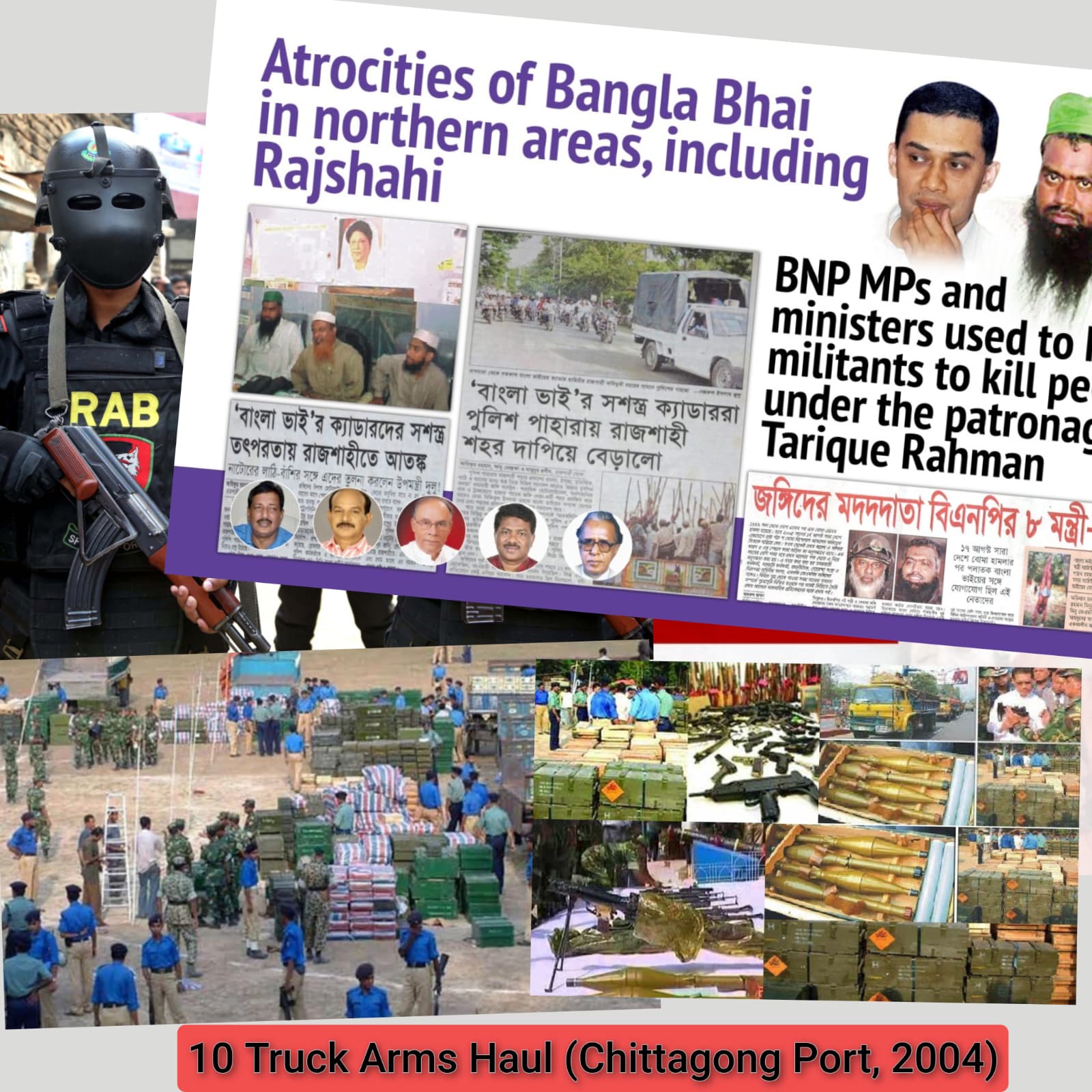
🔴 “Bangla Bhai” — State-Sponsored Terror
Siddiqul Islam — known to everyone as “Bangla Bhai.” In northwest Bangladesh, his militant organization Jagrata Muslim Janata Bangladesh (JMJB) ran a reign of terror. People were publicly hung from trees and beaten. Militant courts dispensed “justice.”
And the government? Silent.
The International Crisis Group wrote clearly — the BNP government “failed” to act against these militant groups because their alliance partner Jamaat-e-Islami had “sympathy” for them.
In May 2004, The Daily Star published investigative reports pointing directly at BNP ministers and MPs. And what happened? Bangla Bhai wasn’t arrested until March 2006 — just before BNP’s term ended. For nearly five years, a known militant leader openly conducted terror while the state looked away.
🔴 10 Trucks of Arms at Chittagong Port
April 2, 2004. Chittagong Port.
Customs officials seized 10 truckloads of weapons. Inside:
- Submachine guns
- Rocket launchers
- Over 1 million rounds of ammunition
Indian intelligence later confirmed — these weapons were destined for ULFA, an Indian separatist group. International arms were being trafficked through Bangladesh — and elements of the state apparatus knew.
This wasn’t petty crime. This was state-level international arms trafficking.
🔴 August 21, 2004 — The Day They Tried to Kill Democracy with Grenades
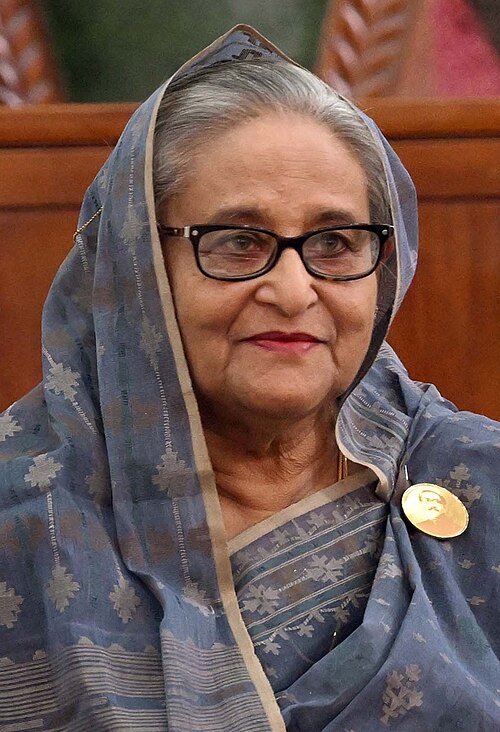
Sheikh Hasina — the target of the August 21, 2004 grenade attack. She survived; 24 others did not. Source: Wikimedia Commons
Dhaka. Bangabandhu Avenue. An Awami League rally.
Suddenly, fire rained from above. Military-grade grenades hurled into a sea of people.
24 killed. Over 400 injured.
The target was then-opposition leader Sheikh Hasina. She survived miraculously.
And the BNP government’s investigation? Then-Home Minister Lutfuzzaman Babar deliberately derailed the investigation. He invented a fictional pickpocket — “Judge Mia” — and blamed the grenade attack on him. A military-grade grenade attack blamed on a pickpocket — nothing could be more absurd and terrifying.
When did the real investigation begin? After 1/11. That investigation proved the guilt of BNP’s top leaders.
🔴 Operation Clean Heart — Legalizing State Murder
In 2002, the government launched “Operation Clean Heart” in the name of crime control. The army took to the streets. The result:
- 44+ deaths in custody
- 11,000+ arrests
- Widespread torture allegations
Then what did the government do? To protect those responsible for these deaths, they passed an Indemnity Act — ensuring no one could ever be brought to justice.
Bangladesh’s High Court later declared this act illegal.
And RAB? This “elite force” formed in 2004 killed 600+ people in “crossfire” encounters.
This was 2001 to 2004 — the first half of BNP-Jamaat rule. The rise of militancy, international arms trafficking, a grenade attack on the opposition, and impunity after state killings.
And this was only the midpoint. Two more years remained.
Next episode: Hawa Bhaban’s invisible empire, five consecutive years as the world’s most corrupt country, and that terrifying day of simultaneous bombings in 63 districts. ⏭️
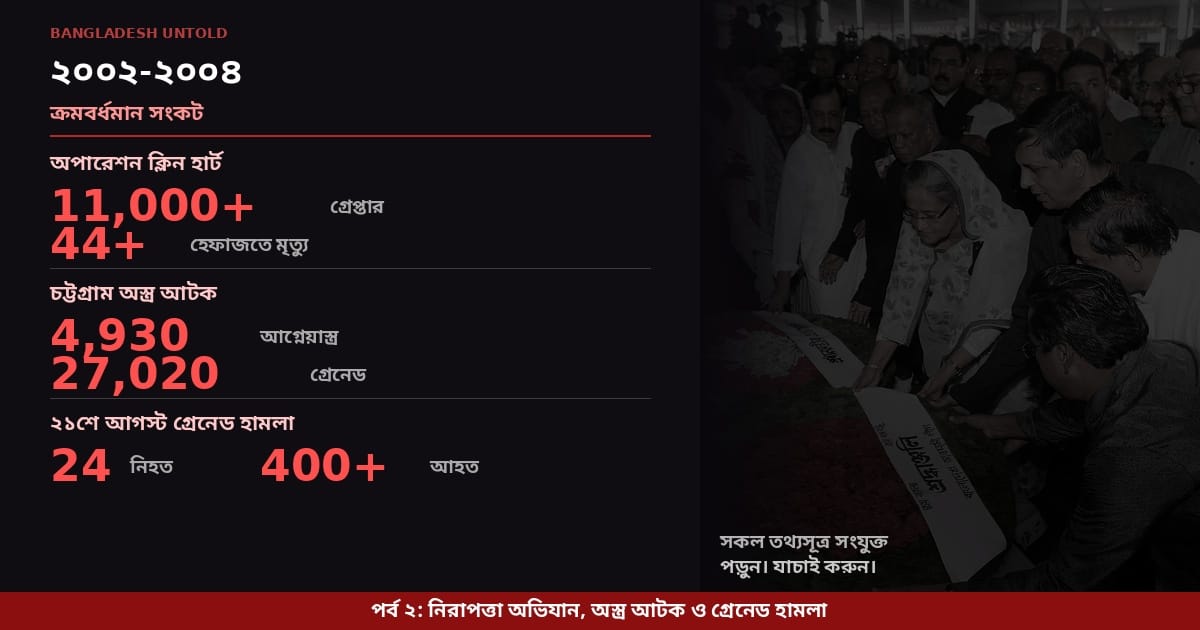
The numbers from 2002-2004: Operation Clean Heart (11,000+ arrested, 44+ custody deaths), Chittagong Arms Haul (4,930 firearms, 27,020 grenades), August 21 Grenade Attack (24 killed, 400+ injured)
📎 Sources: International Crisis Group “Countering Jihadist Militancy in Bangladesh” (2018), The Daily Star investigative reports (2004), India Today (2023), Human Rights Watch “Ignoring Executions and Torture” (2009), Dhaka Tribune, OMCT
Leave a Reply