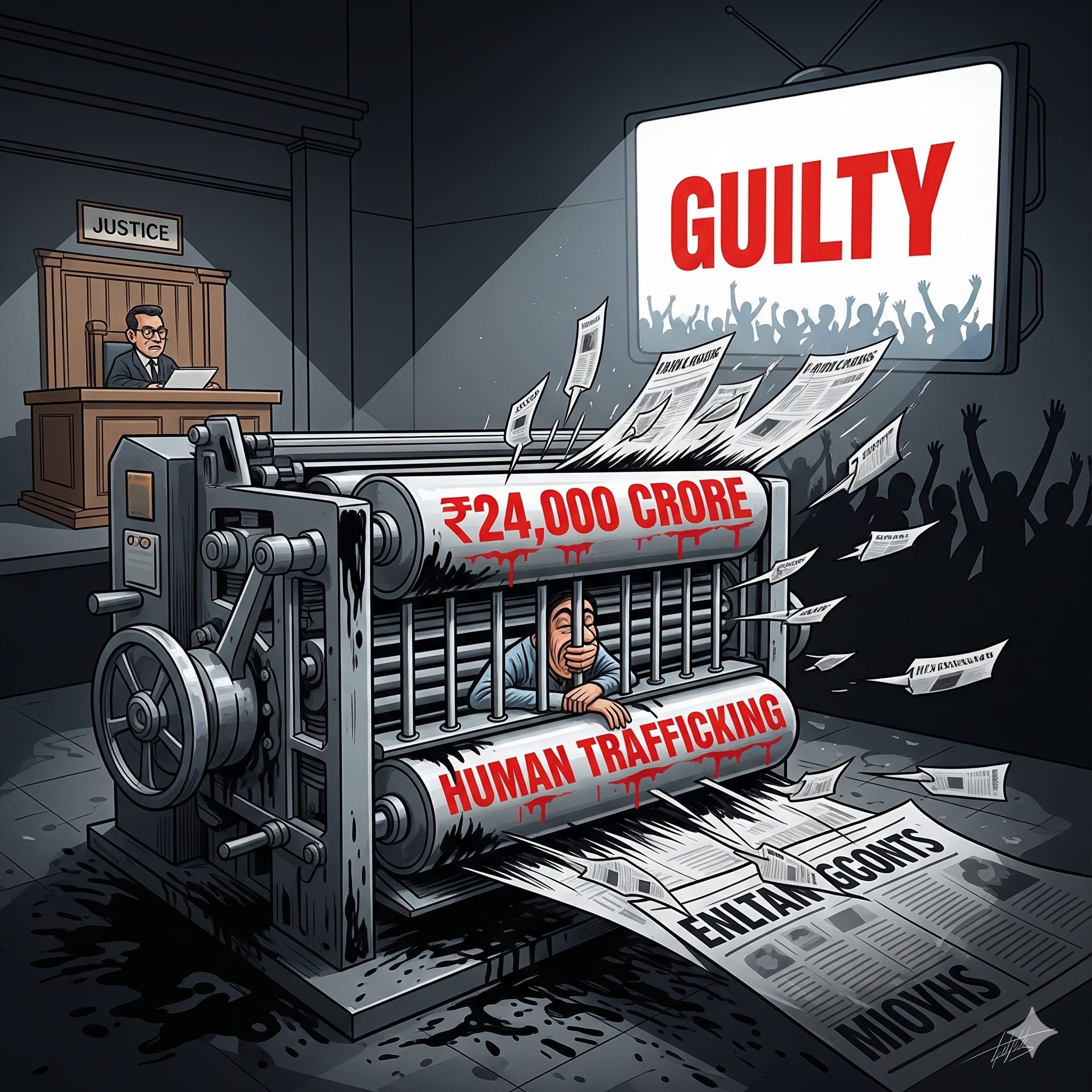
In Bangladesh, you don’t need a courtroom to destroy someone. You need a headline. For months — sometimes years — before an arrest, a coordinated media campaign plants a narrative so deeply into public consciousness that by the time handcuffs appear, the verdict is already in. This is the anatomy of a media trial — Bangladesh’s most sophisticated weapon of political persecution.

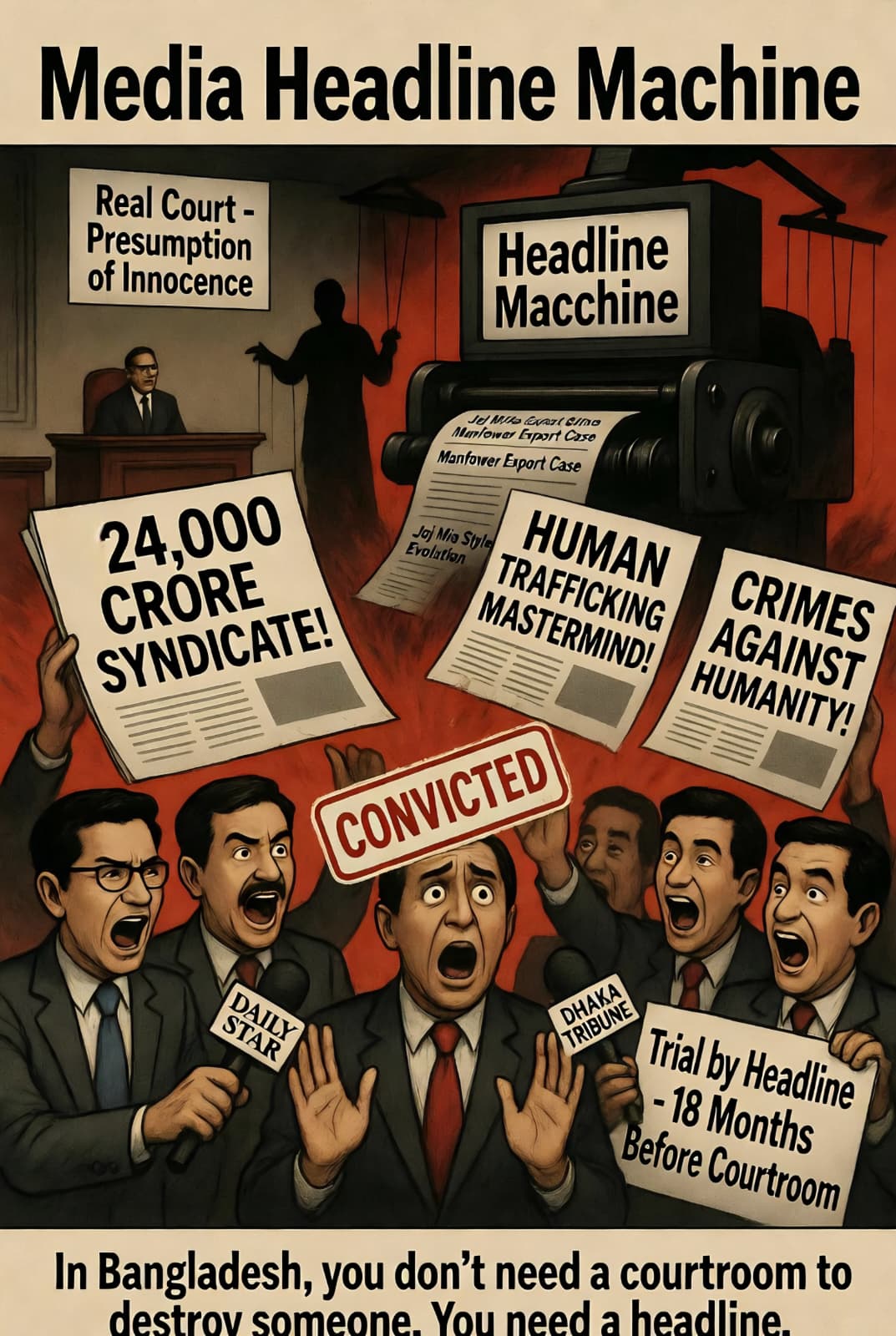
The Evolution: From Joj Mia to the Modern Media Trial
Bangladesh’s political establishment has a long history of manufacturing scapegoats. Under the BNP-Jamaat government (2001-2006), the method was crude but effective:
- Arrest a nobody
- Torture a confession
- Present it to the media
- Promote the officials who cooperated
This is exactly what happened with “Joj Mia” — a pickpocket framed for the August 21 grenade massacre. It was crude. It eventually fell apart. And it took a change of government to expose the truth.
But political operators learn from their mistakes. The new method is more sophisticated — and far more dangerous:
- Plant the narrative in media FIRST — months before any arrest
- Use emotionally loaded language — “human trafficking,” “manob pachar” (মানব পাচার), terms designed to make the accused indefensible
- Inflate the numbers beyond comprehension — figures so astronomical they become the headline themselves
- Saturate every outlet — repeat the narrative until it becomes accepted truth
- THEN arrest — now the “evidence” is “everyone already knows”
The difference is devastating. In the old method, the fabrication had to withstand judicial scrutiny. In the new method, the court of public opinion has already convicted — the actual court is almost irrelevant.
Case Study: The ৳24,000 Crore Headline
In 2024-2026, Bangladesh saw one of the most systematic media trial campaigns in its recent history — targeting over 100 people connected to the manpower export sector, including former government officials, military officers, and their families.
The Number: ৳24,000 Crore
The figure “৳24,000 crore” became the defining headline. It appeared in every major Bangladeshi outlet — The Daily Star, Dhaka Tribune, The Business Standard, bdnews24, New Age — repeated hundreds of times before a single court heard a single argument.
But look at what the actual investigations found:
| Source | Alleged Amount | Context |
|---|---|---|
| Original case (Sept 2024) | ৳24,000 crore | Alleged total across ALL 103 accused over years |
| CID investigation (Aug 2025) | ৳100.75 crore | The actual amount CID could trace in money laundering case |
| ACC investigation (Mar 2025) | ৳119 crore | Amount attributed to one specific company |
Notice the pattern: the headline says ৳24,000 crore. The actual investigation found ৳100 crore. That’s a 240x discrepancy. But which number does the public remember? Which number has already convicted the accused in the minds of 170 million Bangladeshis?
The ৳24,000 crore figure is the total alleged amount embezzled by a “syndicate” of 103 different people over multiple years across dozens of companies. But in headlines, it gets attached to individual names — creating the impression that one person stole ৳24,000 crore.
No court has verified the ৳24,000 crore figure. No audit has confirmed it. No forensic accounting has been presented. Yet it has been printed as established fact in virtually every Bangladeshi media outlet.
The Language: “মানব পাচার” (Human Trafficking)
The choice of language is not accidental. The legal issue in these cases involves manpower export agencies — companies licensed by the Bangladeshi government to recruit workers for overseas employment, primarily in Malaysia. The allegations concern overcharging workers and financial irregularities.
But in media coverage, “manpower recruitment fraud” was systematically replaced with “মানব পাচার” — human trafficking. The two are not the same:
- Manpower recruitment fraud: Overcharging workers, financial irregularities in a licensed business — a serious but prosecutable financial crime
- Human trafficking (মানব পাচার): The forcible trafficking of human beings — one of the most emotionally revulsive crimes imaginable
By framing recruitment irregularities as “human trafficking,” the media narrative made it impossible for any accused person to publicly defend themselves. Who defends themselves against “human trafficking”? The mere denial sounds guilty.
This is a deliberate strategic choice. It turns a white-collar financial case into an emotional human rights atrocity in the public mind — without a single court ruling establishing the facts.
The Timeline: Narrative First, Arrest Later
The timeline reveals the media trial methodology with surgical precision:
| Date | Event | Media Narrative Phase |
|---|---|---|
| August 5, 2024 | Government change — targets go into hiding after political violence | Vulnerability established |
| September 3, 2024 | Case filed by Altaf Khan (a competing recruiting agency owner) naming 103 people | The “৳24,000 crore” headline is born |
| Oct-Nov 2024 | Former minister Imran Ahmad arrested, remanded — media frenzy | Narrative saturates all outlets |
| August 28, 2025 | CID files separate money laundering case — now targeting family members (wives, daughters) | Net widens, narrative deepens |
| March 2025 | ACC announces intention to sue | Institutional validation of narrative |
| Late 2024 – Early 2026 | Months of continuous media coverage — “syndicate,” “manob pachar,” “24,000 crore” repeated constantly | Public conviction complete |
| March 24, 2026 | Late-night raid, arrest at home | Arrest is now a formality — public already “knows” |
| March 25-29, 2026 | 5-day remand, then fresh 6-day remand. DB says “11 cases filed” | Case pile-on begins |
| March 29, 2026 | ICT moves to show accused as arrested in separate “crimes against humanity” case | Political charges layered on top |
By the time the arrest happens — 18 months after the narrative first entered the media — the accused has been convicted in public opinion. The arrest isn’t news; it’s confirmation of what “everyone already knows.”
The Methodology: How Media Trials Work
Based on documented patterns in Bangladesh, media trials follow a consistent methodology:
1. The Emotional Frame
Choose language that makes the accused indefensible. “Human trafficking” instead of “recruitment fraud.” “Mass murder” instead of “political decision-making.” The emotional frame ensures that any public defense sounds like defending the indefensible.
2. The Astronomical Number
Cite a figure so large it shocks. ৳24,000 crore. ৳23,000 crore. The number doesn’t need to be verified — it just needs to be big enough that it becomes the headline itself. Nobody fact-checks the number because the number IS the story.
3. The Competing Plaintiff
Cases are often filed not by victims, but by business competitors or political operatives. In the manpower case, the original complaint was filed by Altaf Khan — the owner of Afia Overseas, a competing recruiting agency. This crucial detail is buried in the 15th paragraph of news reports, long after the ৳24,000 crore headline has done its work.
4. The Family Drag
Name not just the target, but their spouse and children in the case. This serves two purposes: it increases the sense of a “criminal syndicate” in public perception, and it creates maximum personal pressure on the accused by threatening their family.
5. The Case Pile-On
Once the narrative is established, multiply the cases. One case becomes five. Five becomes eleven. Each new case generates a fresh round of headlines, reinforcing the narrative. Even if each individual case is weak, the sheer volume creates an impression of overwhelming guilt.
According to the DB, a total of 11 cases have so far been filed against the accused.
— Dhaka Tribune, March 29, 2026
6. The Political Layer
Once the accused is in custody on financial charges, add political charges. In this case, the International Crimes Tribunal moved to show the accused as arrested in a separate “crimes against humanity” case — ensuring that the financial narrative and the political narrative merge into one overwhelming impression of guilt.
The Broader Pattern: Who Gets Media-Trialed?
Media trials in Bangladesh don’t target random individuals. They target people who are politically inconvenient:
- Former government officials from the previous administration — prosecuted not for specific evidence but for association
- Military officers who played roles in political transitions — particularly 1/11
- Business people connected to the previous power structure — where financial allegations serve as proxies for political persecution
- Family members — wives and children named in cases to maximize pressure
The Global Centre for Democratic Governance documented that since August 2024, Bangladesh has seen:
Pervasive surveillance, preemptive detention, and the deliberate criminalization of peaceful or symbolic acts of dissent.
— Eurasia Review, “A Nation On Trial” (September 2025)
Over 388 journalists have been implicated in fabricated criminal cases, with at least 38 imprisoned and repeatedly denied bail. When the media itself is under threat, who will question the narratives they are forced to publish?
The International Standard: What Constitutes a Fair Trial?
The International Covenant on Civil and Political Rights (ICCPR), to which Bangladesh is a signatory, establishes clear principles:
- Article 14(2): “Everyone charged with a criminal offence shall have the right to be presumed innocent until proved guilty according to law”
- Article 14(1): Right to “a fair and public hearing by a competent, independent and impartial tribunal”
Media trials systematically violate both principles. When hundreds of articles establish “guilt” before a single hearing, presumption of innocence is destroyed. When judges read the same newspapers as everyone else, impartiality is compromised.
Bangladesh’s own Constitution, Article 35(3), guarantees: “Every person accused of a criminal offence shall have the right to a speedy and public trial by an independent and impartial Court or tribunal established by law.”
An independent trial is impossible when the trial has already been conducted in the media.
The BNP Pattern: Old Wine, New Bottle
The media trial is the evolution of BNP’s scapegoating playbook:
| Era | Method | Example |
|---|---|---|
| 2001-2006 (BNP-Jamaat) | Arrest → Torture confession → Media | Joj Mia framed for grenade massacre |
| 2001-2006 | Scapegoat expendable figures | Anwarullah blamed for 2001 hall raid violence |
| 2001-2006 | Probe committee whitewash | Chittagong Arms Haul cover-up |
| 2024-2026 | Media narrative → Months of saturation → THEN arrest | “৳24,000 crore manob pachar” campaign |
The formula has evolved, but the purpose is identical: use manufactured narratives to neutralize political opponents while maintaining a veneer of legal legitimacy.
What Would Accountability Look Like?
If the allegations were genuine and the process fair, we would expect to see:
- Forensic audits verifying the specific amounts — not headlines citing unverified figures
- Independent investigation — not cases filed by business competitors
- Proportional charges — financial fraud charged as financial fraud, not repackaged as “human trafficking”
- Presumption of innocence in media coverage — not 18 months of conviction-before-trial
- Separation of financial and political charges — not layering unrelated cases to create an impression of overwhelming guilt
- Family members named only with specific evidence — not dragnet inclusion to maximize pressure
None of these conditions were met in the cases documented above.
The Silence Problem
Perhaps the most insidious aspect of the media trial is that it silences the accused and their supporters. When someone is publicly branded a “human trafficker” who stole “৳24,000 crore,” anyone who defends them risks being associated with those crimes. Family members who speak up are accused of “protecting criminals.” Lawyers who take the case face social pressure. Journalists who question the narrative face their own legal threats.
This is by design. The media trial doesn’t just convict the accused — it creates a zone of silence around them, ensuring that the only narrative that reaches the public is the prosecution’s narrative.
Sources:
- The Daily Star — “CID files case against 33 recruiting agents” (Aug 28, 2025); “Ex-minister Imran placed on 3-day remand” (Oct 21, 2024); “DB seeks five-day remand” (Mar 25, 2026)
- The Business Standard (TBS) — “CID sues 33 over Tk100cr laundering linked to Malaysian recruitment syndicate” (Aug 28, 2025); “Key 1/11 figure ex-Lt Gen Masud Uddin Chowdhury arrested” (Mar 25, 2026)
- Dhaka Tribune — “Ex-MP Masud Uddin Chowdhury placed on 6-day fresh remand” (Mar 29, 2026); “ICT moves to show retired officers arrested” (Mar 29, 2026)
- bdnews24.com — “Ex-general Masud Uddin Chowdhury, a key ‘1/11’ figure, held” (Mar 25, 2026)
- BSS (Bangladesh Sangbad Sangstha) — “Masud Uddin remanded afresh in Tk 24,000-crore embezzlement case” (Mar 29, 2026)
- Global Centre for Democratic Governance — “Press Under Siege” (Nov 2025)
- Eurasia Review — “A Nation On Trial: Bangladesh Arrest Surge Threatens Democracy” (Sep 11, 2025)
- Human Rights Watch — “No Place for Criticism: Bangladesh Crackdown on Social Media Commentary” (2018)
- ICCPR — International Covenant on Civil and Political Rights, Articles 14(1), 14(2)
- Constitution of Bangladesh — Article 35(3)
- The Business Standard — “Is Media Trial culture in Bangladesh a hindrance to the justice system?” (Feb 2021)
- SSRN — Hussain M.F. Bari, “Legal Aspects of Media Trial in Bangladesh: Free Press Versus Fair Trial Dilemma” (2019)
Read how BNP invented a pickpocket to cover a massacre: The “Joj Mia” Fabrication
Read how BNP’s terrorist militia operated: HuJI: The Terrorist Army BNP Kept in Its Backyard
Read the full 1/11 Chronicle: Part 1 · Part 2 · Part 3 · Part 4 (Finale)
Leave a Reply