This is Part 2 of a three-part investigative series, “The Dark Prince” — The Tarique Rahman Exposé, documenting the corruption, extortion, and international money trail of the man who now leads Bangladesh as Prime Minister. Read Part 1: “Mr. Ten Percent” — How Tarique Rahman Ran a Parallel Government from Hawa Bhaban.
In Part 1, we documented how Tarique Rahman ran a shadow government from Hawa Bhaban, extorting billions from Bangladesh’s business community between 2001 and 2006. But extortion was only the beginning. The real story — the one that caught the attention of the FBI, the U.S. Department of Justice, and governments across three continents — is about what happened to the money afterward. Where did the hundreds of millions go? The answer leads to a single bank in a city-state 3,200 kilometers from Dhaka: Citibank, Singapore.
This is the story of how U.S. federal investigators followed a money trail from Bangladeshi construction sites and telecom contracts to numbered bank accounts in Singapore — and how, for the first time in history, an FBI agent walked into a Dhaka courtroom to testify about what she found.
The Singapore Connection: Citibank Account #158052
Every money laundering scheme needs an offshore destination — a place where dirty money can be cleaned, stored, and spent beyond the reach of domestic law enforcement. For Tarique Rahman, that destination was Singapore.
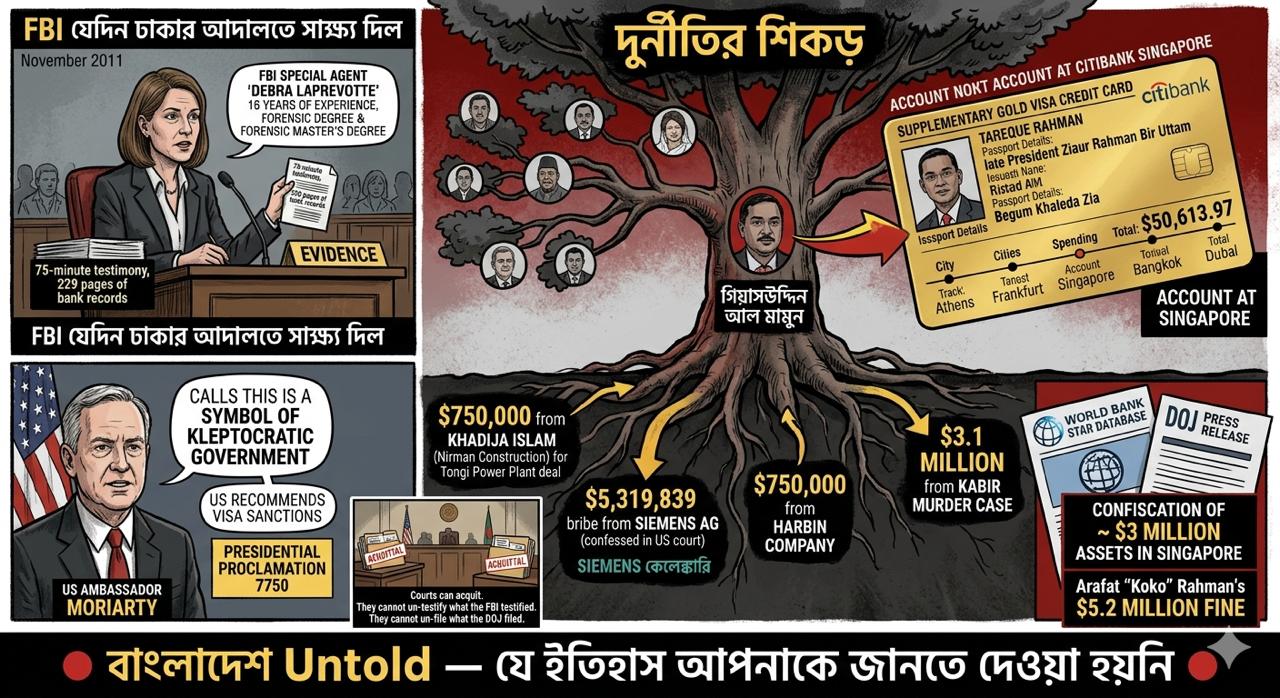
According to the FBI’s investigation and U.S. Department of Justice filings, the central node of Tarique Rahman’s offshore financial network was a set of accounts at Citibank Singapore, held under account numbers 158052-008 and 158052-016. The accounts were registered in the name of Giasuddin Al Mamun — Tarique’s business partner and the man who served as the financial conduit for the operation.
But the accounts weren’t just Mamun’s. FBI investigators discovered that a supplementary Gold Visa credit card — number 4568-8170-1006-4122 — was issued on Mamun’s Citibank Singapore account in the name of Tarique Rahman. A photocopy of Tarique’s passport (number Y0085483), listing his father as “late President Ziaur Rahman Bir Uttam” and his mother as “Begum Khaleda Zia,” had been submitted to Citibank Singapore to obtain the card.
This was no loose association. This was Tarique Rahman’s name, passport, and credit card — directly linked to an account that would become the subject of an international money laundering investigation.
How the Money Moved
The scheme operated with brutal simplicity. Bribes were collected in Bangladesh — from construction companies, telecom firms, Chinese state enterprises, and individual businesspeople seeking government favor. The cash, almost always in U.S. dollars, was then physically transported or wire-transferred to Singapore, where it was deposited into Mamun’s Citibank accounts. From there, the funds were used for international travel, luxury purchases, and further investments — all accessible to Tarique Rahman through his supplementary credit card.
Bank records obtained by the FBI covering 2002–2006 revealed that Tarique’s credit card was used for $50,613.97 in charges, including travel to Athens, Frankfurt, Singapore, Bangkok, and Dubai, along with shopping and medical expenses. This may seem modest for a man accused of laundering millions — but the credit card was merely the visible tip of a vast submerged iceberg. The real money sat in the accounts themselves, fed by a steady stream of bribe payments from across Bangladesh’s public contracting landscape.
The FBI Comes to Dhaka: Debra LaPrevotte’s Historic Testimony
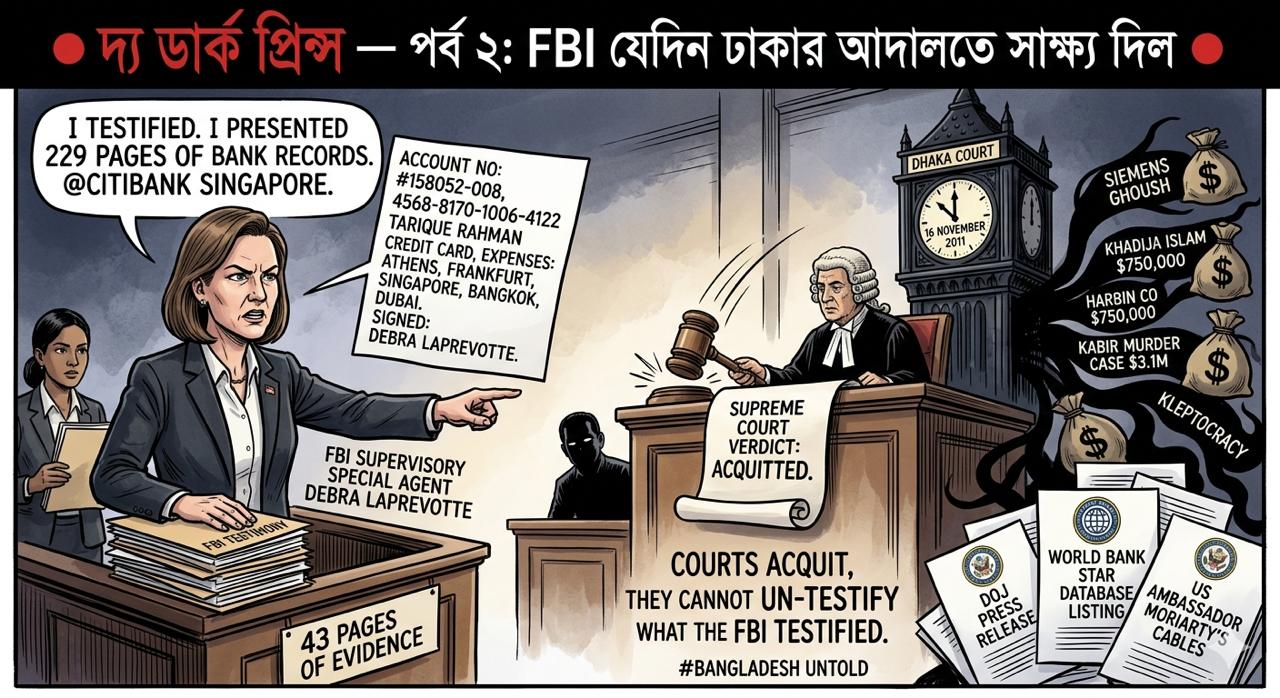
On November 16, 2011, something unprecedented happened in a Dhaka courtroom. FBI Supervisory Special Agent Debra LaPrevotte took the witness stand in Special Judge’s Court-3 to testify in the money laundering case against Tarique Rahman and Giasuddin Al Mamun. It was the first time in Bangladesh’s history that an FBI agent had testified before a court in the country.
LaPrevotte, then 50 years old and a 16-year FBI veteran with a master’s degree in forensic science and advanced training in money-laundering techniques, introduced herself to the court with a statement that underscored the gravity of her presence:
“I’m a supervisory special agent for the Federal Bureau of Investigation. I’ve been an FBI agent for 16 years. I have a master’s degree in forensic science and advanced training in money-laundering techniques. In my country, I’m considered an expert in international money-laundering for testimony purposes.”
— FBI Supervisory Special Agent Debra LaPrevotte, testimony before Dhaka Special Judge’s Court-3, November 16, 2011 (The Daily Star)
How the Investigation Began
LaPrevotte told the court that in 2008, Bangladesh’s interim government had submitted a mutual legal assistance request to the United States, asking for help investigating the asset recovery cases connected to Tarique Rahman and his associates. In response, the U.S. government sent representatives from the Department of Justice to Dhaka to assess the request and meet with the Anti-Corruption Commission (ACC).
But here is the critical detail — one that demolishes any claim that the investigation was a political witch hunt:
“The US reviewed this request to ensure that it was not politically motivated.”
— FBI SSA Debra LaPrevotte, Dhaka court testimony, November 16, 2011
The United States government independently verified that the investigation was legitimate before authorizing FBI involvement. This was not a favor to any Bangladeshi political faction. It was a deliberate, vetted decision by the U.S. Department of Justice to pursue evidence of international money laundering that had touched U.S. financial institutions.
What the FBI Found
After receiving authorization, LaPrevotte began her investigation and quickly discovered the Singapore accounts. Through mutual legal assistance requests to Singapore, she obtained detailed banking records for Citibank accounts 158052-008 and 158052-016 for the years 2004 and 2005.
Her findings, presented in a 75-minute deposition, were devastating:
- Two credit cards were issued against Mamun’s account — one Visa card in Mamun’s name (number 4568-8170-0006-4124) and one in Tarique Rahman’s name (number 4568-8170-1006-4122).
- A photocopy of Tarique’s passport (number Y0085483) had been submitted to Citibank Singapore to obtain the card, confirming Tarique’s direct knowledge of and participation in the account.
- A Bangladeshi businesswoman named Khadiza Islam had transferred $750,000 into Mamun’s Singapore account on August 18, 2003. This single transfer constituted the majority of the funds in the account — the same funds used to make payments on Tarique Rahman’s credit card.
- LaPrevotte presented 43 pages of documentary evidence to the court, followed by an additional 229 pages of banking records.
- In December 2009, LaPrevotte had certified that the records received from Singapore by the U.S. and by the Bangladesh government were identical, establishing an unbroken evidentiary chain.
As she concluded her testimony:
“These funds were transferred on August 18, 2003. This makes up most of the funds in Mr. Mamun’s account at Citibank Singapore, which was used to make payments from Tarique Rahman’s credit card. That is my testimony.”
— FBI SSA Debra LaPrevotte, final statement to the court, November 16, 2011 (The Daily Star)
Throughout the proceedings, Giasuddin Al Mamun stood in the dock at the back of the courtroom. Tarique Rahman was absent — a fugitive living in London.
The $750,000 Khadiza Islam Bribe
Who was Khadiza Islam, and why did she transfer three-quarters of a million dollars to a Singapore bank account belonging to a BNP operative?
Khadiza Islam was the chairperson of Nirman Construction Company Ltd. According to the Anti-Corruption Commission’s case statement, she paid BDT 20.41 crore (approximately $2.66 million at the time) to Mamun in exchange for securing a contract for an 80-megawatt power plant in Tongi, near Dhaka. The money was transferred to Mamun’s Citibank NA account in Singapore.
The $750,000 transfer that FBI Agent LaPrevotte traced was a component of this broader payment — the portion that landed directly in the Citibank account that funded Tarique Rahman’s credit card. This was a textbook quid pro quo: a businesswoman pays for government favor, and the money flows offshore to the accounts of the man who controlled those government decisions.
The Siemens Scandal: A 2% Commission on Everything
The Khadiza Islam bribe was damaging. The Siemens scandal was catastrophic — because it wasn’t just a Bangladeshi case. It was part of one of the largest corporate bribery prosecutions in history.
On December 15, 2008, Siemens Aktiengesellschaft (Siemens AG), the German industrial conglomerate, and three of its subsidiaries pleaded guilty to violations of the U.S. Foreign Corrupt Practices Act (FCPA). In its plea, Siemens Bangladesh admitted that from May 2001 to August 2006, it caused corrupt payments of at least $5,319,839 to be made through purported “business consultants” to Bangladeshi officials in exchange for favorable treatment during the bidding process on a mobile telephone project.
But the Bangladesh angle went deeper than Siemens’ global guilty plea. According to the classified U.S. Embassy cable 08DHAKA1143_a, authored by Ambassador James F. Moriarty:
“According to a witness who funneled bribes from Siemens to Tarique and his brother Koko, Tarique received a bribe of approximately two percent on all Siemens deals in Bangladesh (paid in US dollars). This case is currently being pursued by DOJ Asset Forfeiture (POC: Deputy Chief Linda Samuels) and by the FBI (POC: Debra Laprevotte).”
— U.S. Embassy Cable 08DHAKA1143_a, classified by Ambassador James F. Moriarty, November 3, 2008 (WikiLeaks)
Two percent on all Siemens deals. Not one contract. Not one project. Every single Siemens transaction in Bangladesh carried a hidden tax — a personal commission paid in U.S. dollars to Tarique Rahman and his brother Arafat Rahman “Koko.” Given Siemens’ massive footprint in Bangladesh’s telecommunications and energy infrastructure during this period, the total amount funneled to the Rahman brothers would have run into the millions.
And Siemens admitted it. This was not an allegation from a political rival. It was a confession by one of the world’s largest corporations, entered as part of a guilty plea in U.S. federal court.
DOJ Asset Forfeiture: $3 Million in Singapore
On January 8, 2009, the U.S. Department of Justice escalated the case to its logical conclusion. Acting Assistant Attorney General Matthew Friedrich of the Criminal Division announced that the DOJ had filed a forfeiture action against accounts worth nearly $3 million in Singapore — accounts alleged to hold the proceeds of “a wide-ranging conspiracy to bribe public officials in Bangladesh.”
“This action shows the lengths to which U.S. law enforcement will go to recover the proceeds of foreign corruption, including acts of bribery and money laundering. Not only will the Department, for example, prosecute companies and executives who violate the Foreign Corrupt Practices Act, we will also use our forfeiture laws to recapture the illicit facilitating payments often used in such schemes.”
— Acting Assistant Attorney General Matthew Friedrich, DOJ Press Release #09-020, January 9, 2009 (U.S. Department of Justice)
The DOJ’s forfeiture complaint related primarily to bribes paid to Arafat “Koko” Rahman — Tarique’s younger brother — in connection with public works projects awarded by the Bangladesh government to Siemens AG and China Harbor Engineering Company. The China Harbor project involved building a new mooring containment terminal at the port of Chittagong.
Key facts from the DOJ filing:
- The bribe payments from Siemens and China Harbor were made in U.S. dollars
- The funds flowed through U.S. financial institutions before being deposited in Singapore accounts — giving the U.S. jurisdiction
- The case was investigated by the FBI’s Washington Field Office in cooperation with Bangladeshi law enforcement
- The case was prosecuted by Deputy Chief Linda Samuel and Trial Attorney Frederick Reynolds of the Criminal Division’s Asset Forfeiture and Money Laundering Section
Koko was ultimately fined $5.2 million, and assets including those of a company in Singapore called Fairhill — also set up by Koko — were confiscated. The case is documented in the World Bank’s Stolen Asset Recovery Initiative (StAR) database, which tracks international kleptocracy cases.
The Full Bribery Ledger: What the U.S. Embassy Documented
The DOJ’s asset forfeiture was aimed at Koko’s accounts, but the U.S. Embassy’s classified cable — 08DHAKA1143_a, signed by Ambassador Moriarty — painted a far broader picture of Tarique Rahman’s personal corruption. The cable, sent on November 3, 2008, laid out case after case in clinical detail:
| Source of Bribe | Amount | Purpose |
|---|---|---|
| Siemens AG | ~2% of all deals (USD) | Commission on all Siemens contracts in Bangladesh |
| Harbin Company (Chinese) | $750,000 | Paid to open a plant; transported to Citibank Singapore |
| Monem Construction | $450,000 | To secure government contracts |
| Khadiza Islam / Nirman Construction | $750,000+ | For power plant contract; transferred to Singapore |
| Kabir Murder Case | $3.1 million (BDT 210M) | To thwart prosecution of Sanvir Sobhan |
| Al Amin Construction | $150,000 | Extortion — pay or face company closure |
The Harbin Company Payment
The Harbin Company, a Chinese construction firm, paid $750,000 to Tarique to secure permission to open a plant in Bangladesh. According to ACC sources cited in the Embassy cable, “one of Tarique’s cronies received the bribe and transported it to Singapore for deposit with Citibank.” The same Citibank. The same Singapore. The same pipeline.
Monem Construction
An ACC investigator advised U.S. Embassy officials that Monem Construction paid a bribe worth $450,000 to Tarique to secure government contracts. In a country where the per capita income was roughly $500 at the time, this single payment represented nearly a thousand lifetimes of average earnings.
The Kabir Murder Case: $3.1 Million to Obstruct Justice
Perhaps the most disturbing item on the ledger involves murder. According to the Embassy cable, the ACC had evidence that Tarique accepted a 210 million taka ($3.1 million USD) bribe to thwart the prosecution of Sanvir Sobhan, son of the chairman of the Bashundara Group — one of Bangladesh’s most powerful industrial conglomerates. Sanvir was accused of killing Humayun Kabir, a Bashundara Group director.
“The ACC has evidence that Tarique accepted a 210 million taka (3.1 million USD) bribe to thwart the prosecution of a murder case against Sanvir Sobhan. Sanvir is the son of the chairman of the Bashundura Group… Sanvir was accused in the killing of Humayun Kabir, a Bashundura Group director. An investigation by the ACC confirmed Tarique had solicited the payment, promising to clear Sanvir of all charges.”
— U.S. Embassy Cable 08DHAKA1143_a, paragraph 6(D) (WikiLeaks)
This was not a bribe for a contract or a favorable business decision. This was $3.1 million to obstruct a murder prosecution. Tarique was selling impunity itself.
Al Amin Construction: “Pay or We Shut You Down”
The extortion was not always sophisticated. In the case of Al Amin Construction, the method was pure coercion. According to the cable, Tarique “threatened Al Amin Construction owner Amin Ahmed with closure of the company unless he received a payment of $150,000 USD.” This was documented alongside similar accusations from multiple business leaders, including Mohammad Aftab Uddin Khan of Reza Construction, Mir Zahir Hossian of Mir Akhter Hossain Ltd., and Harun Ferdousi — each describing “a systematic pattern of extortion on a multi-million dollar scale.”
The U.S. Verdict: Visa Ban and “Hundreds of Millions”
Faced with this mountain of evidence, the U.S. Embassy in Dhaka took the extraordinary step of recommending that Tarique Rahman be banned from entering the United States. The cable explicitly requested a security advisory opinion under Section 212(f) of the Immigration and Nationality Act and Presidential Proclamation 7750, which allows the President to suspend the entry of foreign nationals involved in egregious public corruption.
Ambassador Moriarty did not mince words in his assessment:
“Tarique reportedly has accumulated hundreds of millions of dollars in illicit wealth.”
— Ambassador James F. Moriarty, U.S. Embassy Cable 08DHAKA1143_a, paragraph 5 (WikiLeaks)
Not millions. Hundreds of millions. And this assessment came not from a political opponent, not from the Awami League, not from a Bangladeshi newspaper — but from the United States Ambassador to Bangladesh, in a classified cable to the Secretary of State.
The cable went further, describing Tarique as:
“Notorious for flagrantly and frequently demanding bribes in connection with government procurement actions and appointments to political office, Tarique is a symbol of kleptocratic government and violent politics in Bangladesh… In short, much of what is wrong in Bangladesh can be blamed on Tarique and his cronies.”
— U.S. Embassy Cable 08DHAKA1143_a, paragraphs 4 and 9 (WikiLeaks)
The Money Laundering Case: Convicted, Then Acquitted
The domestic legal proceedings that followed the FBI’s investigation tell a story that raises profound questions about the independence of Bangladesh’s judiciary.
On October 26, 2009, the Anti-Corruption Commission filed the money laundering case, accusing Mamun of laundering BDT 20.41 crore (approximately $2.66 million) to Singapore. The ACC submitted a charge sheet against both Tarique Rahman and Mamun on July 6, 2010, and charges were formally framed on August 8, 2011.
During the trial, 13 witnesses testified — including FBI Agent Debra LaPrevotte. The documentary evidence included hundreds of pages of banking records from Citibank Singapore, passport photocopies, credit card statements, and the FBI’s certification of the records.
Here is the timeline of what followed:
- November 17, 2013: Dhaka Special Judge’s Court-3 acquitted Tarique Rahman but sentenced Mamun to seven years in jail with a BDT 40 crore fine.
- December 5, 2013: The ACC appealed Tarique’s acquittal.
- July 21, 2016: The High Court reversed the acquittal, sentencing Tarique to seven years in prison and a BDT 20 crore fine, while upholding Mamun’s conviction.
- March 6, 2025: After the July 2024 political upheaval that ousted the Awami League government, the Appellate Division — headed by Chief Justice Syed Refaat Ahmed — acquitted both Tarique Rahman and Mamun.
From conviction to acquittal. From seven years in prison to a clean record. The reversal came not because new evidence emerged exonerating Tarique — but because a political earthquake reshaped the Bangladeshi judiciary.
84 Cases. All Acquitted.
The money laundering case was not an isolated reversal. According to multiple reports in Bangladeshi media, including BD24, India Today, and Time Magazine, all 84 cases filed against Tarique Rahman during the 2007–2008 caretaker government period — including embezzlement, money laundering, extortion, and the August 21, 2004 grenade attack case — were systematically dismissed or resulted in acquittal between December 2024 and May 2025, following the July 2024 uprising that toppled the Awami League government.
Eighty-four cases. FBI testimony. DOJ filings. Siemens’ guilty plea. Hundreds of pages of Singapore bank records. Credit card numbers. Passport photocopies. Thirteen witnesses. A U.S. Ambassador’s classified assessment.
All of it — acquitted. Every last case.
The question that hangs over Bangladesh is not whether the evidence existed. It is documented in U.S. federal court filings, in classified diplomatic cables, and in the sworn testimony of an FBI supervisory special agent. The question is: what does it mean for a nation when its judiciary can erase everything?
What the Money Trail Tells Us
Follow the money, and the money tells you everything. It tells you that between 2001 and 2006, Tarique Rahman and his associates operated an international money laundering pipeline that moved millions of dollars from Bangladesh to Singapore. It tells you that the FBI investigated and confirmed the existence of the accounts, the credit cards, the passport submissions, and the fund transfers. It tells you that the U.S. Department of Justice considered the evidence strong enough to file a federal forfeiture action. It tells you that Siemens AG pleaded guilty to paying bribes to Tarique’s brother in connection with Bangladesh contracts. It tells you that the U.S. Ambassador assessed Tarique’s illicit wealth at “hundreds of millions of dollars.”
And it tells you that in 2025, all of it was swept away.
The bank accounts in Singapore are a matter of record. The FBI testimony is a matter of record. The DOJ filing is a matter of record. The Siemens guilty plea is a matter of record. The classified cables are a matter of record.
Courts can acquit. They cannot un-document what happened. They cannot un-testify what an FBI agent said under oath in a Dhaka courtroom. They cannot un-file a DOJ forfeiture action. And they cannot un-write a diplomatic cable that described Tarique Rahman as “a symbol of kleptocratic government and violent politics in Bangladesh.”
The money trail is permanent.
Coming in Part 3: “The Fugitive Returns” — Tarique Rahman’s escape to London, 17 years of exile, the fall of the Hasina government, and the extraordinary political resurrection that made a convicted money launderer the Prime Minister of Bangladesh. Subscribe to Bangladesh Untold to be notified when Part 3 is published.
Sources
- U.S. Embassy Cable 08DHAKA1143_a — Classified cable by Ambassador James F. Moriarty, November 3, 2008 (WikiLeaks)
- “What FBI stated in deposition” — The Daily Star, November 17, 2013
- “Tarique laundered money” — The Daily Star, 2011
- DOJ Press Release #09-020 — Department of Justice, January 9, 2009
- “Tarique Rahman, Mamun acquitted in money laundering case” — Prothom Alo, March 6, 2025
- Arafat “Koko” Rahman case — World Bank Stolen Asset Recovery Initiative (StAR)
- “Bangladesh Election: Tarique Rahman’s Big Test” — Time Magazine, January 2026
- “Why son and political heir Tarique Rahman isn’t with her” — India Today, December 2, 2025
Leave a Reply