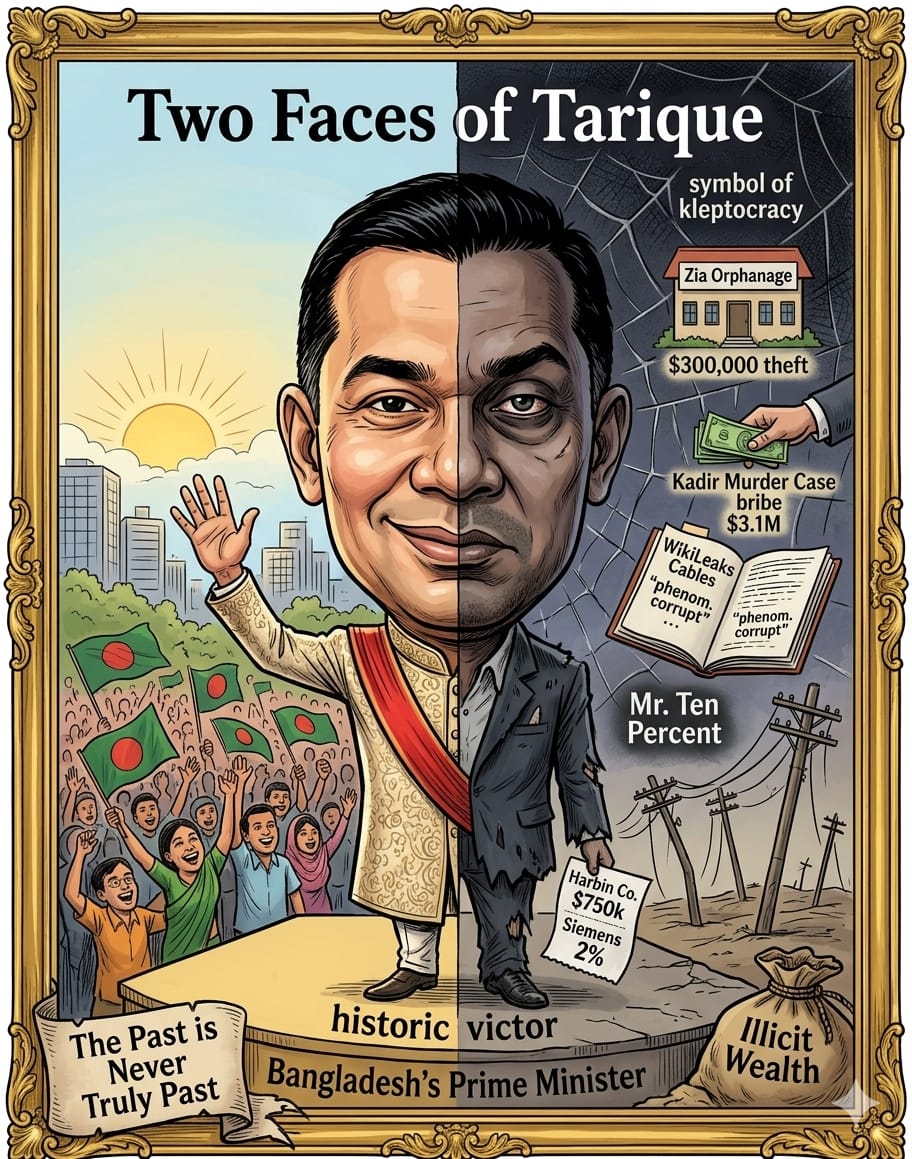
This is Part 1 of a three-part investigative series, “The Dark Prince” — The Tarique Rahman Exposé, documenting the corruption, extortion, and international money trail of the man who now leads Bangladesh as Prime Minister.
In February 2026, Tarique Rahman — son of former Prime Minister Khaleda Zia, convicted felon, and a man once barred from entering the United States for “egregious political corruption” — became the Prime Minister of Bangladesh. To understand how a nation arrived at this moment, you must first understand what happened between 2001 and 2006, when a single building in Dhaka became the real seat of power in Bangladesh. That building was Hawa Bhaban, the BNP party headquarters. And the man who ran it was Tarique Rahman — known to diplomats as “The Dark Prince,” to contractors as “Mr. Ten Percent,” and to ordinary Bangladeshis as “Khamba Tarique.”
This is the story of how one unelected man ran a parallel government, looted billions of taka from public coffers, extorted the nation’s biggest businesses, stole from orphans, and corrupted the justice system — all while his mother sat in the Prime Minister’s office. Every claim in this article is sourced from declassified U.S. diplomatic cables, Transparency International data, Bangladesh Anti-Corruption Commission (ACC) investigations, and reporting from international media including Time Magazine, the Hindustan Times, and The Daily Star.
The Shadow Government at Hawa Bhaban
When the Bangladesh Nationalist Party (BNP) won a landslide victory in October 2001, Khaleda Zia became Prime Minister for the second time. But from the very beginning of her tenure, a different kind of power structure took shape. Real decisions — about government contracts, political appointments, civil service postings, and even criminal prosecutions — were not made at the Prime Minister’s Office in the Secretariat. They were made at Hawa Bhaban, the BNP headquarters in Dhaka’s Mogbazar area, under the direct control of Khaleda’s eldest son, Tarique Rahman.
Tarique held the party title of Senior Joint Secretary General of the BNP — a position with no constitutional authority over state affairs. Yet as U.S. diplomatic cables later revealed, he operated what amounted to a “parallel administration.” According to a Hindustan Times report citing WikiLeaks cables, U.S. diplomats described Tarique as “the architect of a parallel administration operating out of Hawa Bhaban.” The phrase that circulated in Dhaka’s political circles during those years summed it up plainly: “Nothing moved without Hawa Bhaban’s approval.”
Government ministers, secretaries, and bureaucrats understood the chain of command. If you wanted a contract approved, a posting confirmed, or a tender awarded — you went to Hawa Bhaban first. The Prime Minister’s Office was, for all practical purposes, a rubber stamp.
How the System Worked
The mechanism was straightforward and ruthless. Tarique and his inner circle of loyalists — referred to in diplomatic cables as “cronies” — controlled access to state resources. Every significant government procurement action, every major political appointment, ran through Hawa Bhaban’s informal approval process. Businessmen, contractors, and even aspiring politicians quickly learned that the price of doing business in Bangladesh was a payment to Tarique Rahman.
As U.S. Ambassador James F. Moriarty documented in his confidential cable to the Secretary of State:
“[Tarique is] notorious for flagrantly and frequently demanding bribes in connection with government procurement actions and appointments to political office.”
This was not speculation. It was the official assessment of the United States government, based on years of intelligence gathering, business community reports, and evidence compiled by Bangladesh’s own Anti-Corruption Commission.
“The Dark Prince” — Named by America’s Own Ambassador
The nickname “Dark Prince” was not coined by opposition politicians or Bangladeshi tabloids. It originated in U.S. diplomatic circles, used by Ambassador Moriarty and his staff to describe the man who wielded enormous, unaccountable power from behind the scenes. The Hindustan Times reported in February 2026 that multiple leaked cables from 2008-2009, authored by Moriarty, painted a devastating portrait of Tarique Rahman:
“[Tarique Rahman is] phenomenally corrupt… inspires few but unnerves many.”
The cables described him as “the notorious and widely feared son of former Prime Minister Khaleda Zia” — a man who was not just personally corrupt, but who had built an entire ecosystem of corruption that permeated the Bangladeshi state. Ambassador Moriarty’s language was unusually blunt for diplomatic communication. In his recommendation that Tarique be banned from entering the United States, he wrote:
“Tarique is a symbol of kleptocratic government and violent politics in Bangladesh.”
And in what may be the most damning single sentence ever written by a U.S. ambassador about a foreign political figure:
“In short, much of what is wrong in Bangladesh can be blamed on Tarique and his cronies.”
“Mr. Ten Percent” — The Systematic Extortion Machine
Tarique Rahman did not merely accept the occasional bribe. He built a systematic extortion machine that extracted payments from virtually every major contractor, foreign corporation, and business owner operating in Bangladesh. The scale was staggering, and the evidence — compiled by the Bangladesh Anti-Corruption Commission and corroborated by U.S. diplomatic intelligence — reads like the ledger of a mafia operation.
The Contractor Shakedowns
According to the WikiLeaks cable 08DHAKA1143_a, the ACC documented a pattern of extortion targeting Bangladesh’s largest construction and infrastructure companies:
- Monem Construction: Paid a bribe of $450,000 USD to Tarique to secure government contracts.
- Al Amin Construction: Owner Amin Ahmed was threatened with closure of his entire company unless he paid $150,000 USD to Tarique.
- Reza Construction, Ltd: Owner Mohammad Aftab Uddin Khan filed formal accusations detailing systematic extortion on a “multi-million dollar scale.”
- Mir Akhter Hossain Ltd: Owner Mir Zahir Hossain filed similar accusations of systemic extortion.
These were not anonymous allegations. These were named business owners who filed formal legal complaints, testified before the ACC, and put their names and livelihoods on the line to expose the extortion. The cable noted that “multiple extortion cases” were pending against Tarique, “founded on the testimony of numerous prominent business owners who he victimized and exploited.”
The Siemens Commission: 2% on Every Deal
Tarique’s corruption was not limited to domestic companies. The cable reveals that he also extracted payments from multinational corporations — including the German industrial giant Siemens. According to the ACC investigation and the WikiLeaks cable:
“According to a witness who funneled bribes from Siemens to Tarique and his brother Koko, Tarique received a bribe of approximately two percent on all Siemens deals in Bangladesh (paid in US dollars).”
This was not a one-time payment. It was a standing commission — roughly 2% of every Siemens contract in the country flowed directly to Tarique Rahman. The case was serious enough that it was being actively pursued by the U.S. Department of Justice Asset Forfeiture division and the FBI.
This is how the nickname “Mr. Ten Percent” was earned — though in reality, the percentage varied by the deal. The principle was consistent: no major contract in Bangladesh moved forward without Tarique’s cut.
“Khamba Tarique” — Electric Poles to Nowhere
Perhaps no single scandal better captures the brazen absurdity of Tarique Rahman’s corruption than the “Khamba” (electric pole) controversy — the scandal that gave him his most enduring and mocking nickname: “Khamba Tarique.”
As reported by Time Magazine in January 2026, the scandal involved thousands of electricity poles that were purchased from an associate of Tarique at grossly inflated prices. These poles were then installed in rural areas across Bangladesh — areas where impoverished villagers desperately needed electricity. There was just one problem: the poles were never connected to any power grid.
Rows of electric poles stood uselessly in fields and along roads, connected to nothing, powering nothing. They became a darkly comic symbol of the BNP government’s corruption — monuments to greed standing in the countryside, mocking the very people they were supposed to help. The Hindustan Times reported that U.S. cables tracked the scandal, noting that “Rahman and his associates used Hawa Bhaban to influence government contracts, specifically the procurement of thousands of electric poles, at inflated prices.”
To ordinary Bangladeshis, these useless poles became the perfect metaphor for Tarique’s governance: grand promises, massive spending, zero benefit for the people, and enormous profit for the connected few. The nickname “Khamba Tarique” stuck. As Time Magazine noted, it persists to this day — even as that same man now occupies the office of Prime Minister.
Stealing from Orphans: The Zia Orphanage Trust Scandal
If there is a single act that distills the moral bankruptcy of Tarique Rahman’s corruption, it is the looting of the Zia Orphanage Trust — a charitable fund established in the name of his own father, assassinated President Ziaur Rahman, to support orphaned children in Bangladesh.
According to the WikiLeaks cable and ACC investigations:
“With the help of several accomplices, Tarique succeeded in looting 20 million taka (300,000 USD) from the Zia Orphanage Trust fund. According to an ACC source, Tarique, who is a co-signer on the trust fund account, used funds from the trust for a land purchase in his hometown. He also provided signed checks drawn from the orphanage fund accounts to BNP party members for their 2006 election campaigns.”
Let this sink in: Tarique Rahman, son of a former president, took $300,000 from a charity for orphaned children — children who had lost their parents — and used the money to buy land for himself and fund political campaigns. He was a co-signer on the trust, meaning he had a fiduciary duty to protect those funds. Instead, he treated the orphan trust as his personal bank account.
This was not an allegation from political opponents. This was documented by the Anti-Corruption Commission of Bangladesh and cited in an official U.S. diplomatic cable from the American Ambassador to the Secretary of State.
The $3.1 Million Kabir Murder Bribe
Tarique’s corruption extended beyond financial extortion into the obstruction of justice — including in a murder case. The WikiLeaks cable documents one of the most shocking allegations:
“The ACC has evidence that Tarique accepted a 210 million taka (3.1 million USD) bribe to thwart the prosecution of a murder case against Sanvir Sobhan. Sanvir is the son of the chairman of the Bashundara Group, one of the nation’s most prominent industrial conglomerates. Sanvir was accused in the killing of Humayun Kabir, a Bashundara Group director. An investigation by the ACC confirmed Tarique had solicited the payment, promising to clear Sanvir of all charges.”
A man was murdered. The accused was the son of one of Bangladesh’s wealthiest industrialists. And Tarique Rahman allegedly accepted $3.1 million to make the prosecution disappear. This is not corruption in the traditional sense — this is the sale of justice itself. For the right price, you could literally get away with murder in Tarique Rahman’s Bangladesh.
The Singapore Money Trail: $750,000 to Citibank
The cables also document Tarique’s use of international banking channels to move illicit wealth offshore. In one case involving the Chinese Harbin Company:
“ACC sources report that the Harbin Company, a Chinese construction company, paid 750,000 USD to Tarique to open a plant. According to the ACC, one of Tarique’s cronies received the bribe and transported it to Singapore for deposit with Citibank.”
This single transaction reveals the sophistication of Tarique’s operation: bribes received in Bangladesh, physically transported to Singapore, and deposited in an international bank. This was not petty corruption. This was an organized, international money laundering operation.
Bangladesh: World’s Most Corrupt Country, Five Years Running
The cumulative impact of the Hawa Bhaban parallel government was measured by the world’s foremost anti-corruption organization. Transparency International’s Corruption Perceptions Index (CPI) ranked Bangladesh as the most corrupt country in the world for five consecutive years: 2001, 2002, 2003, 2004, and 2005 — the exact period of the BNP government during which Tarique Rahman operated his extortion machine from Hawa Bhaban.
This was not a ranking among developing nations or South Asian countries alone. Bangladesh was ranked dead last — the single most corrupt country on the entire planet — for five straight years. As Ambassador Moriarty noted in the cable: “Through 2006, the nation topped Transparency International’s ranking of the world’s most corrupt governments four years in a row.”
The cable further noted that “corruption has lowered Bangladesh’s growth rate by two percent per year, according to experts.” In a country where millions lived below the poverty line, Tarique Rahman’s corruption machine was literally stealing food from the mouths of the poor.
“Hundreds of Millions of Dollars in Illicit Wealth”
The U.S. assessment of Tarique’s total accumulated corruption was breathtaking in scale:
“Tarique reportedly has accumulated hundreds of millions of dollars in illicit wealth.”
Hundreds of millions. Not taka — dollars. In a country where the per capita income was roughly $400 per year during that period, Tarique Rahman amassed a fortune that would be obscene by the standards of any nation on earth. The ACC had filed charges of “concealing ill-gotten wealth,” and the National Board of Revenue brought tax evasion charges. The charges against him included, in the cable’s own words: “corruption, extortion, bribery, embezzlement and tax evasion.”
And what was the impact? Ambassador Moriarty spelled it out:
“His theft of millions of dollars in public money has undermined political stability in this moderate, Muslim-majority nation and subverted US attempts to foster a stable democratic government, a key objective in this strategically important region.”
The Man Who Is Now Prime Minister
After the BNP government fell in 2006 and the military-backed Caretaker Government took power in January 2007, Tarique was arrested in the anti-corruption crackdown. He was released on bail in September 2008 and promptly left for London, where he lived in exile for 17 years — managing the BNP by video link from the suburbs of Richmond.
During his exile, Bangladeshi courts — under the Awami League government of Sheikh Hasina — convicted him in multiple cases, including a life sentence for the 2004 grenade attack. After the July 2024 uprising toppled Hasina, and under the interim government of Nobel laureate Muhammad Yunus, courts began overturning Tarique’s convictions, citing “procedural irregularities.”
In February 2026, the BNP won parliamentary elections. Tarique Rahman returned from London in triumph. The man the U.S. Ambassador once called a “symbol of kleptocratic government” — the man who stole from orphans, took $3.1 million to obstruct a murder prosecution, and ran an extortion ring that made Bangladesh the most corrupt country on earth — is now the Prime Minister of the People’s Republic of Bangladesh.
As the Hindustan Times headline on February 13, 2026 put it: “Tarique Rahman goes from ‘symbol of kleptocracy’ to ‘historic victor.’”
Sources
- WikiLeaks Cable 08DHAKA1143_a (November 3, 2008) — “VISAS DONKEY CORRUPTION 212(F) (RAHMAN, TARIQUE),” classified by Ambassador James F. Moriarty. Full cable text
- Transparency International — Corruption Perceptions Index, 2001-2005. Bangladesh ranked most corrupt country globally for five consecutive years.
- Time Magazine (January 28, 2026) — “Bangladesh Election: Tarique Rahman’s Big Test.” Read article
- Hindustan Times (February 13, 2026) — “Tarique Rahman goes from ‘symbol of kleptocracy’ to ‘historic victor’: Leaked US cables on Bangladesh’s next PM.” Read article
- The Daily Star Bangladesh — “Tarique symbol of violent politics.” Read article
- bdnews24.com — “US envoy recommended ban on Tarique: Wikileaks.” Read article
- Bangladesh Anti-Corruption Commission (ACC) — Multiple case filings and investigations referenced in Cable 08DHAKA1143_a.
Next in the series: Part 2 of “The Dark Prince” exposé follows the money trail from Dhaka to Singapore to London — the FBI investigation, the Siemens bribery case, the offshore accounts, and how Tarique Rahman moved hundreds of millions of dollars out of one of the world’s poorest countries. Subscribe to Bangladesh Untold to be notified when Part 2 drops.
Have documents, tips, or firsthand accounts related to Tarique Rahman’s corruption? Contact Bangladesh Untold securely through our website: bangladeshuntold.org
Leave a Reply