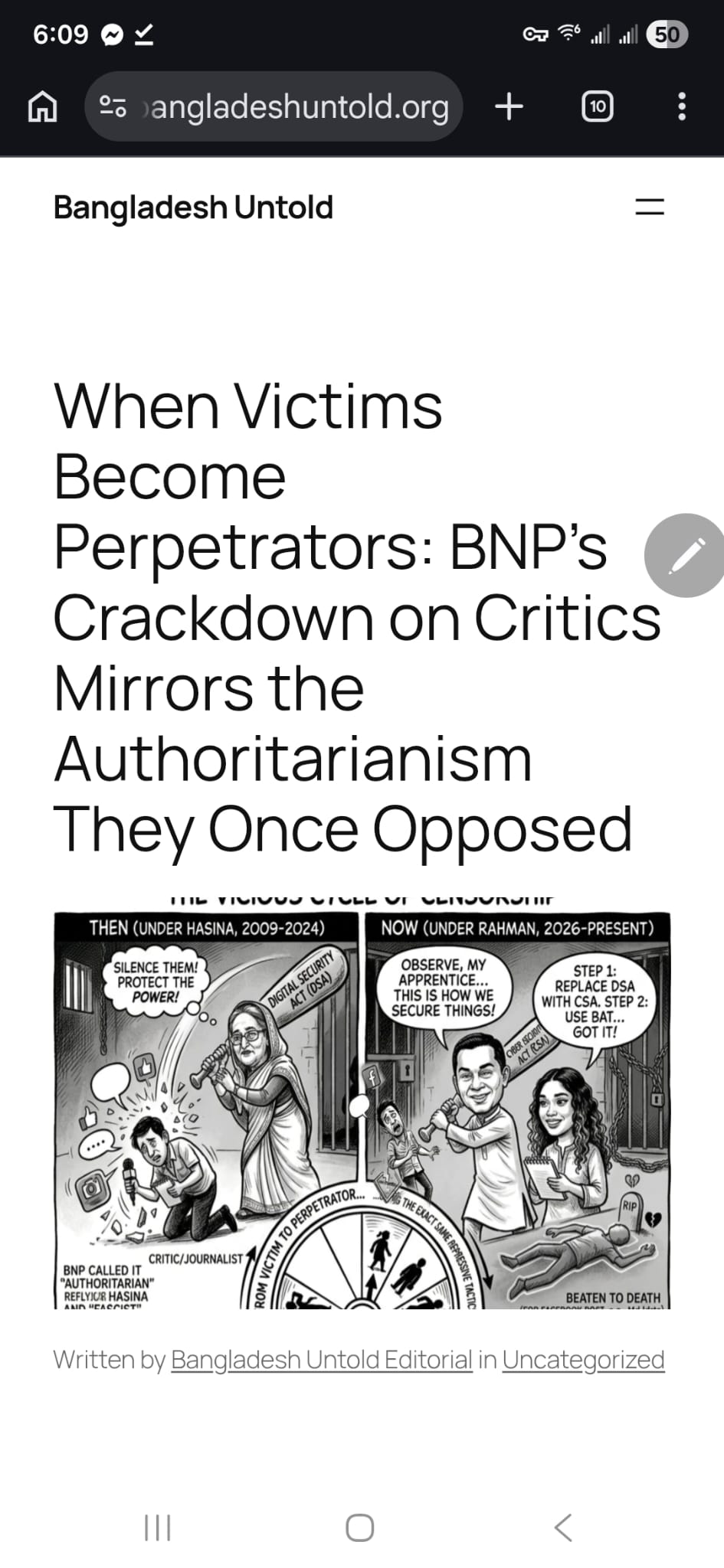
When Victims Become Perpetrators: BNP’s Crackdown on Critics Mirrors the Authoritarianism They Once Opposed
International rights groups sound alarm as Rahman government uses same repressive tactics BNP once condemned under Sheikh Hasina
April 6, 2026 — In Patuakhali’s Kalapara area, 45-year-old Md Idris made a critical comment on Facebook about a local BNP leader. Within days, he was beaten to death.
Across the country, someone else was detained simply for criticizing Prime Minister Tarique Rahman on social media. Eight journalists face charges under the Cyber Security Act. Two more were arrested for allegedly “offending religious sentiments.”
These aren’t isolated incidents. They represent a systematic pattern of repression that has emerged in the two months since Rahman took power — a pattern that bears an uncomfortable resemblance to the very authoritarianism that the Bangladesh Nationalist Party (BNP) spent 15 years condemning under Sheikh Hasina’s Awami League.
The irony is as stark as it is disturbing: the victims have become the perpetrators.
🚨 The HRSS Documentation
The grim statistics come from the Human Rights Support Society (HRSS), which released its monthly report on April 4, 2026, covering political violence in March.
The report, published in the Dhaka Tribune, documented not just the usual political clashes that have plagued Bangladesh for decades, but something more sinister: the systematic use of state power to silence critics.
“Separately, under different sections of the Cybersecurity Act, eight journalists were charged in two separate cases. One individual was detained for criticizing Prime Minister Tarique Rahman, and two were arrested for allegedly offending religious sentiments.”
— HRSS Report, April 4, 2026
But the most chilling entry was buried in the middle of the report:
“In Patuakhali’s Kalapara area, Md Idris (45) was beaten to death for posting critical comments on Facebook against BNP leader Zahirul Islam.”
Read that again. A 45-year-old man was beaten to death for a Facebook post.
📢 International Alarm
The pattern hasn’t gone unnoticed internationally. On March 19, 2026, nine major human rights organizations wrote an unprecedented joint letter to Prime Minister Rahman, demanding immediate action to protect press freedom and human rights.
The signatories read like a who’s who of international human rights advocacy:
- Committee to Protect Journalists (CPJ)
- Amnesty International
- Article 19
- CIVICUS
- FIDH
- Fortify Rights
- Human Rights Watch
- Kennedy Human Rights Center
- Tech Global Institute
Their demands were specific and urgent:
- Release detained journalists immediately
- Review cases filed under cybercrime laws including the Digital Security Act and Cyber Security Act
- End arbitrary surveillance and censorship
- Investigate attacks on major news outlets including Prothom Alo and Daily Star
The fact that these organizations felt compelled to write such a letter barely two months into Rahman’s tenure speaks volumes about how quickly the situation has deteriorated.
⚖️ The Same Playbook
What makes this crackdown particularly disturbing is how closely it mirrors the tactics that BNP spent 15 years condemning under Sheikh Hasina’s rule.
Under Hasina (2009-2024):
- Used Digital Security Act to arrest social media critics
- Targeted journalists and bloggers for “anti-government” content
- Arrested people for Facebook posts critical of the government
- Made arrests without warrants under cybercrime laws
BNP’s response at the time was unequivocal. They called Hasina’s government “fascist” and “authoritarian.” They claimed that over 300,000 of their leaders and activists faced “false and fabricated” cases. They demanded international intervention to protect human rights.
Under Rahman (2026-present):
- Using Cyber Security Act to arrest social media critics
- Targeting journalists and activists for “anti-government” content
- Arresting people for Facebook posts critical of the government
- Making arrests without warrants under cybercrime laws
The playbook is identical. Only the party in power has changed.
🔄 The Cyber Security Act: A Tool of Repression
The weapon of choice remains the same: Bangladesh’s cybercrime legislation.
The Digital Security Act, passed in 2018 under Hasina, was widely condemned by international rights groups as “draconian.” It was nominally replaced by the Cyber Security Act in 2023, but rights groups immediately noted that the new law retained the most problematic provisions of its predecessor.
The U.S. Embassy in Bangladesh stated bluntly that “the new legislation continues to criminalize freedom of expression, retains non-bailable offenses, and too easily could be misused to arrest, detain, and silence critics.”
Amnesty International called it “a replication of the ‘draconian’ Digital Security Act.”
Key provisions that enable repression:
- Police can arrest without warrants
- Non-bailable offenses for online criticism
- Broadly defined “anti-state” activities
- Power to confiscate equipment without court orders
Under the previous Digital Security Act, approximately 2,000 cases were filed, with journalists often targeted. About 1,000 people were arrested under its predecessor, the Information and Communication Technology Act.
Now, just two months into Rahman’s tenure, the arrests have resumed under the Cyber Security Act — but this time targeting critics of BNP rather than Awami League.
📊 The Historical Context
This isn’t the first time BNP has wielded state power to silence critics. The original Information and Communication Technology Act was actually passed in 2006 under a BNP-Jamaat government and was used to arrest more than 1,200 people.
As Al Jazeera Media Institute noted in 2022: “These digital security laws did not spring out of a vacuum… It has been actively used by all parties, not just BNP-Jamaat.”
The pattern is clear: regardless of which party holds power, Bangladesh’s cybercrime laws become tools of political repression.
🌍 International Precedent
Bangladesh’s use of cybercrime laws to silence critics fits a global pattern documented by human rights organizations.
Human Rights Watch’s 2018 report “No Place for Criticism: Bangladesh Crackdown on Social Media Commentary” detailed how “dozens of arbitrary arrests” occurred under these laws, with “police making arrests without warrant.”
The report noted that as of April 2018, police had submitted 1,271 charge sheets to cyber crime tribunals — a staggering number that illustrated the systematic nature of the crackdown.
What’s happening now under Rahman appears to be a continuation of this pattern, just under different political leadership.
⚰️ The Ultimate Price
But the case of Md Idris represents an escalation beyond even what occurred under Hasina. While the previous government relied primarily on legal harassment and detention, the beating death of a Facebook critic suggests that violence has now been added to the toolkit of repression.
The fact that Idris was killed for criticizing a local BNP leader — not even the Prime Minister himself — suggests that the culture of impunity extends down to the grassroots level of the party.
This represents a dangerous normalization of violence as a response to political criticism.
🔍 What This Means
The emergence of this repression so early in Rahman’s tenure raises several disturbing questions:
1. Institutional Continuity: Does this suggest that Bangladesh’s repressive apparatus transcends party politics? That regardless of who holds power, the tools of authoritarianism remain the same?
2. The Victim-Perpetrator Cycle: How quickly do those who suffered under repression become willing to use the same tactics against their own critics?
3. Democratic Consolidation: If both major parties resort to the same authoritarian tactics when in power, what hope is there for democratic consolidation in Bangladesh?
4. International Response: How will the international community, which welcomed Rahman’s democratic victory, respond to evidence that his government is replicating the authoritarianism it replaced?
📸 The Broader Pattern
This crackdown doesn’t exist in isolation. It’s part of a broader pattern of score-settling that has emerged since Rahman took power:
- March 23: Lt. Gen. (Retd.) Masud Uddin Chowdhury arrested — a key 1/11 figure
- March 26: Lt. Gen. (Retd.) Sheikh Mamun Khaled arrested — former DGFI chief
- March 30: Mohammad Afzal Naser arrested — prosecution openly stated he was detained for being “involved in the arrest and torture of Tarique Rahman”
The arrest of critics appears to be part of a broader campaign to eliminate opposition voices and consolidate power.
🎭 The Irony of History
Perhaps the most damning aspect of this crackdown is how it exposes the hollowness of BNP’s previous rhetoric about democracy and human rights.
For 15 years, BNP leaders gave impassioned speeches about the need to protect free speech. They welcomed international criticism of Hasina’s repression. They positioned themselves as the democratic alternative to authoritarianism.
Yet when given power, they have reached for the same tools of repression they once condemned.
This suggests that their opposition to these tactics was never principled — it was simply partisan. They opposed repression when they were the targets, but they’re perfectly willing to use it when they’re in control.
⏰ A Critical Moment
Bangladesh stands at a critical juncture. The country has just emerged from 15 years of increasingly authoritarian rule under Sheikh Hasina. The February 2026 election was seen as a chance for democratic renewal.
But the early signs from the Rahman government suggest that rather than breaking the cycle of authoritarianism, Bangladesh may simply be changing the victims.
The death of Md Idris for a Facebook post should serve as a wake-up call. When criticism becomes a capital offense — literally — democracy is already dead.
The question now is whether Bangladesh’s democratic institutions, civil society, and international partners will act to prevent further deterioration, or whether they will stand by as the victims of yesterday become the perpetrators of today.
The nine international human rights organizations who wrote to Prime Minister Rahman have sounded the alarm. The question is whether anyone is listening.
And whether, in a country where someone can be beaten to death for a Facebook post, anyone dares to speak up at all.
📚 Sources
- Human Rights Support Society (HRSS) Report, Dhaka Tribune, April 4, 2026
- Committee to Protect Journalists Joint Letter, March 19, 2026
- Human Rights Watch: “No Place for Criticism: Bangladesh Crackdown on Social Media Commentary” (2018)
- Amnesty International: “Restore freedom of expression in Bangladesh & repeal Cyber Security Act” (2024)
- Al Jazeera Media Institute: “Bangladesh’s Digital Security Act is criminalising journalism” (2022)
- U.S. Embassy Bangladesh statements on Cyber Security Act
- Transparency International Bangladesh: Position Paper on Digital Security Act 2018 and Draft Cyber Security Act 2023
🔴 Bangladesh Untold — The History You Were Never Told
Leave a Reply