Six days after Tarique Rahman was sworn in as Prime Minister, the Bangladesh government cancelled the appointment of the International Crimes Tribunal’s chief prosecutor and replaced him with a card-carrying BNP party lawyer — a man who had represented Khaleda Zia in her corruption case, served as central vice president of the BNP lawyers’ forum, and sought the party’s own nomination to run for parliament. This is not a coincidence. It is a blueprint.
The Swap That Shocked International Legal Observers
On February 23, 2026 — just six days after Tarique Rahman took oath as Prime Minister following BNP’s landslide election victory — Bangladesh’s Law Ministry issued a notification signed by Solicitor Md Manjurul Hossain: Mohammad Tajul Islam, the sitting Chief Prosecutor of the International Crimes Tribunal (ICT), was out. In his place: Md Aminul Islam, Supreme Court lawyer and senior member of BNP’s Habiganj district committee.
The speed was breathtaking. Six days.
Not six weeks to conduct a search. Not a judicial committee to assess qualifications. Six days — the time it took the new government to identify which of its own party lawyers should now control the prosecution of crimes against humanity in Bangladesh.
“The new chief prosecutor, advocate Aminul Islam, previously served as central vice president of the BNP lawyers’ forum and reportedly sought the party’s nomination for a parliamentary constituency in the recent elections. He also represented Khaleda Zia — mother of the new prime minister — in the corruption case that led to her conviction in 2018.”
— JusticeInfo.net, Bangladesh: A New Prosecutor Under Pressure, February 27, 2026
Read that again. The man now in charge of prosecuting crimes against humanity in Bangladesh:
- Is a member of the BNP party committee in Habiganj
- Served as central vice president of Jatiyatabadi Ainjibi Forum — BNP’s lawyers’ wing
- Defended Khaleda Zia (the Prime Minister’s own mother) in her criminal corruption case
- Applied for BNP’s own party ticket to run for parliament in February 2026
- Previously served as a special public prosecutor at Dhaka Speedy Trial Tribunal-4 during BNP’s 2001–2006 government
This is not an independent prosecutor. This is a party official in a prosecutor’s robe.
What the ICT Is — And What It Was Supposed to Be
The International Crimes Tribunal was established in 2009 under the Awami League government to prosecute war crimes committed during Bangladesh’s 1971 Liberation War. Over the years, it became politically controversial — its early years marked by fair trial concerns, its later years by hard-won convictions of Jamaat-e-Islami war criminals.
When the Yunus-led interim government took power in August 2024 following the student uprising that ousted Sheikh Hasina, it reconstituted the ICT with a new mandate: prosecute crimes against humanity committed during Hasina’s crackdown on protesters in July-August 2024, which killed approximately 1,400 people. This was a legitimate and internationally recognized mission.
In November 2025, the reconstituted ICT delivered its most significant verdict: Sheikh Hasina was sentenced to death in absentia for crimes against humanity. Her former Home Minister was also sentenced to death. A former police chief, in custody, received five years after testifying for the prosecution.
Then BNP won the election. And everything changed.
The Pattern: From Justice Institution to Political Weapon
Human Rights Watch’s World Report 2026 — the definitive annual accounting of human rights conditions globally — documented what was happening to the ICT even before BNP took power:
“The tribunal had been fraught with violations of fair trial standards, and while the interim government amended the law that establishes the court, introducing some improvements, it still lacks important due process protections and includes the death penalty, in violation of international human rights law. The interim government also gave the tribunal broad powers to prosecute and dismantle political organizations.“
— Human Rights Watch, World Report 2026: Bangladesh
“Prosecute and dismantle political organizations.” That is the critical phrase. The ICT — a crimes against humanity tribunal — was quietly granted the power to not just try individuals, but to legally destroy entire political parties.
The Awami League was already banned in May 2025 under the interim government. Hundreds of its leaders were in custody, held without trial and routinely denied bail.
Now BNP controls the ICT prosecution. And the ICT has the power to dismantle political parties.
The geometry of this should not be lost on anyone.
Who Is Aminul Islam? A Profile
New Age Bangladesh — one of the country’s most respected English-language newspapers — headlined its coverage of the appointment bluntly: “BNP leader Aminul made ICT chief prosecutor, Tajul removed.” Not “lawyer Aminul.” Not “advocate Aminul.” BNP leader Aminul.
Here is what is publicly known about Md Aminul Islam:
| Credential | Detail |
|---|---|
| Party affiliation | BNP, Habiganj district committee member |
| Lawyers’ wing | Central Vice President, Jatiyatabadi Ainjibi Forum (BNP lawyers’ forum) |
| Electoral ambition | Sought BNP nomination for Habiganj-4 seat, February 2026 elections |
| Client history | Represented Khaleda Zia in corruption case (BNP chairperson, mother of the PM) |
| Government service | Special Public Prosecutor, Dhaka Speedy Trial Tribunal-4, during BNP government (2001–2006) |
| Date of ICT appointment | February 23, 2026 (6 days after Tarique Rahman became PM) |
Upon taking charge, Aminul Islam told journalists he would work “according to the aspirations of the martyrs who sacrificed their lives in the July 2024 Uprising” and promised that “real offenders” would receive “the punishment they deserve.”
What he did not address was the obvious structural question: How can a party lawyer — who sought that party’s electoral nomination — serve as an independent prosecutor of cases that politically benefit that same party?
The Rushed Verdicts and the Review
Among Aminul Islam’s first statements as Chief Prosecutor was an announcement that the three verdicts delivered by Tajul Islam — including the death sentences against Sheikh Hasina — would be “re-examined.”
“New Chief Prosecutor Aminul Islam told the media that during the rule of Muhammad Yunus’s interim government, the case files and verdict documents of the three judgments — including death sentences — issued against the ousted Prime Minister Sheikh Hasina by the International Crimes Tribunal will be re-examined.”
— NE News, Bangladesh ICT: Will the Trial Continue While Legal Questions Remain Unresolved?, March 9, 2026
This matters for two reasons:
First: Hasina’s death sentence — however controversial — was the product of a tribunal process that investigated the killing of approximately 1,400 protesters. BNP’s own new prosecutor announcing he will “re-examine” those verdicts signals the possibility that accountability for those killings could be quietly unwound.
Second: If the ICT is powerful enough to deliver death sentences against former prime ministers, it is powerful enough to be used as a weapon against anyone BNP designates as an enemy. The question is not whether the tool works — the question is who is holding it, and for what purpose.
A History of Weaponized Justice: BNP’s 2001–2006 Playbook
This is not the first time Bangladesh has seen a justice institution transformed into a political instrument. During BNP’s previous government (2001–2006), the pattern was well-documented:
- RAB — created under BNP, used for 600+ extrajudicial killings in “crossfire”, now under US sanctions
- Operation Clean Heart — 44 deaths in custody, 11,000 arrests, followed by an indemnity law that legalized the murder
- Speedy Trial Tribunals — the same courts where Aminul Islam himself served as special prosecutor under BNP, used to fast-track cases against opposition figures
- NSI and DGFI — used to facilitate the Chittagong Arms Haul cover-up, with intelligence officials actively threatening witnesses
The current ICT situation is not an aberration. It is the continuation of a pattern: BNP seizes institutions that were designed for justice and reconfigures them for political enforcement.
As we documented in “When Victims Become Perpetrators”: the party that once positioned itself as the victim of political persecution is now deploying the same architecture of persecution against its opponents.
International Alarm Bells: HRW, Fair Trial Standards, and the Disappearing Safeguards
Human Rights Watch has raised consistent concerns about the ICT’s compliance with international fair trial standards. These concerns predate BNP’s return to power — but they become significantly more acute when the prosecution is now controlled by a party operative:
- The ICT still lacks critical due process protections required under international law
- The death penalty — a violation of international human rights law — is built into the tribunal’s sentencing framework
- Trials were conducted in absentia, without adequate mechanisms for defendants to contest charges
- Key trials proceeded with limited access for international observers
- The law governing the tribunal was amended rapidly, without adequate consultation or time for review
These were problems when an interim government ran the tribunal. Under a party-controlled prosecution, every one of these gaps becomes a potential weapon.
“Hundreds of Awami League leaders, members, and supporters are in custody as murder suspects, held without trial and routinely denied bail.”
— Human Rights Watch, World Report 2026: Bangladesh
Those hundreds of people are now awaiting prosecution by a tribunal led by a BNP party official. They will face a process that HRW has documented as lacking basic due process protections. They will be tried under laws that include the death penalty.
The Tarique Connection: Dismissed Corruption Charges, Now Controlling the Tribunal That Charges Others
There is a profound irony in who is now running Bangladesh — and whose man now leads the ICT.
Tarique Rahman — now Prime Minister — was convicted by Bangladesh’s High Court in 2016 of money laundering, sentenced to 7 years and fined Tk 20 crore. He had faced 84 criminal cases, including charges connected to the August 21, 2004 grenade attack that killed 24 people at an Awami League rally.
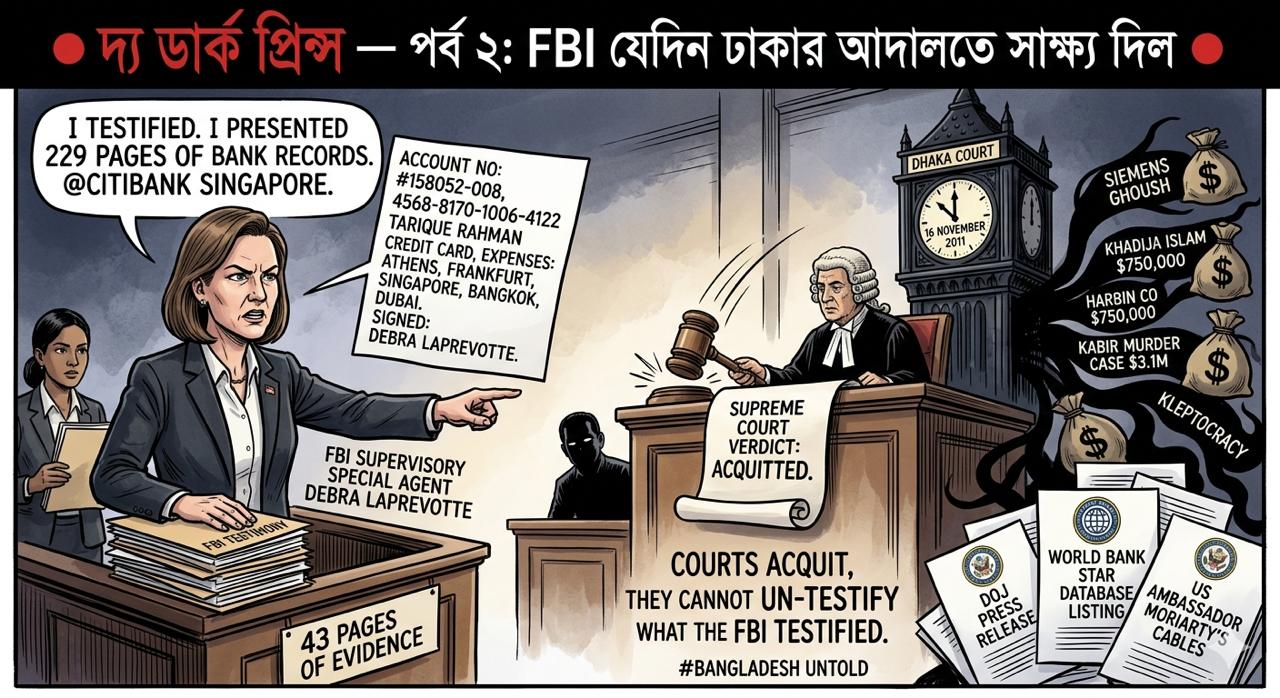
All of those cases were acquitted after the July 2024 uprising swept away the political system that had produced them. As we documented in “Follow the Money”, the FBI and Singapore courts had found evidence of money laundering. A US diplomatic cable called him a “symbol of kleptocratic government” and “Dark Prince.”
The man the US once called a kleptocrat now leads a government whose appointed prosecutor controls Bangladesh’s most powerful justice institution.
And Aminul Islam — who defended Tarique’s mother Khaleda Zia in her criminal case — is now the prosecutor who decides who gets charged with crimes against humanity.
The Bigger Picture: A Tribunal With the Power to Erase Parties
The most dangerous element of the current ICT framework is the one least discussed: the power to “prosecute and dismantle political organizations,” as documented by Human Rights Watch.
The Awami League was already banned administratively. If the ICT — now under BNP’s prosecution control — moves to formally dismantle the Awami League as an organization through criminal proceedings, it would represent something extraordinary in Bangladesh’s political history: the legal annihilation of the country’s oldest and largest political party by a tribunal controlled by that party’s opponents.
This is not speculation. This is the logical extension of the institutional powers that have been assembled.
Bangladesh has watched BNP cherry-pick constitutional reforms to entrench its own power. It has watched 28 judges punished for speaking up while the judiciary was reshaped. It is now watching the prosecutor of the country’s crimes against humanity tribunal be replaced, six days into a new government, with a party lawyer.
Each step, in isolation, can be rationalized. Together, they describe a government systematically eliminating the institutional checks that could constrain it.
Conclusion: When the Tribunal Becomes the Weapon
The International Crimes Tribunal was created to deliver justice for mass atrocities. It has delivered some — imperfect, contested, sometimes rushed, but real. Sheikh Hasina’s government killed 1,400 people in three weeks. Someone should answer for that.
But justice institutions derive their legitimacy from independence. A prosecutor who owes his position to the party whose political opponents he will prosecute is not independent. He is, regardless of his personal intentions, a political instrument.
Six days. That’s how long BNP waited before placing one of its own in charge of Bangladesh’s most powerful criminal justice institution.
In that speed lies the answer to every question about what this appointment means, and what it is for.
Sources
- New Age Bangladesh, “BNP leader Aminul made ICT chief prosecutor, Tajul removed”, February 23, 2026
- JusticeInfo.net, “Bangladesh: A New Prosecutor Under Pressure”, February 27, 2026
- Human Rights Watch, World Report 2026: Bangladesh, February 8, 2026
- The Daily Star, “Aminul Islam Appointed New ICT Chief Prosecutor”, February 23, 2026
- NE News, “Bangladesh ICT: Will the Trial Continue While Legal Questions Remain Unresolved?”, March 9, 2026
- The Business Standard, “Aminul Islam Appointed Chief Prosecutor of ICT”, February 23, 2026
Bangladesh Untold is an independent documentation project. All articles are sourced from international human rights organizations, court records, and verified news reporting.
Leave a Reply