People in Bangladesh are criticizing NCP leaders for going out to eat duck. Counting their taka. Questioning every plate of food.
Nobody asks where Zaima Rahman’s wardrobe comes from.
The Prime Minister’s daughter steps out in a different saree at every event — silk, muslin, Banarasi, hand-woven Jamdani — each one worth tens of thousands of taka. In London she built a life of expensive education, upscale living, and the quiet comfort of someone who has never had to worry about money. She returned to Dhaka in December 2025 and the country fell over itself praising her “simplicity.”
Simplicity. In sarees that cost more than a garment worker’s monthly salary.
Nobody is asking the question. So we will.
Where does the money come from?
A Family That Courts Said Was Laundering Money
Start with what’s documented.
In 2007, the Anti-Corruption Commission filed a money laundering case against Tarique Rahman and his close friend Giasuddin Al Mamun. The allegation: Tarique used his political position — as the de facto power behind his mother Khaleda Zia’s government — to direct government contracts to Mamun, who then laundered the proceeds abroad. The amount: Tk 20.41 crore.
In 2016, the High Court convicted Tarique. Sentenced him to seven years in prison. Fined him Tk 20 crore. The court found that “Tarique Rahman influenced political power to help his close friend, Giasuddin Mamun, to get and then launder 200 million taka.”
The laundered money — Tk 20 crore returned by the Singapore government — was sitting at Bangladesh Bank. The ACC also filed a case against Tarique and his wife Zubaida Rahman for amassing wealth beyond known sources of income.
Then the July 2024 uprising happened. By 2025, every case was acquitted. Tarique became Prime Minister on February 17, 2026.
The wealth didn’t disappear. Just the accountability.
17 Years in London: On What Income?
Tarique Rahman left Bangladesh in 2008. He landed in London. He stayed for seventeen years.
London is not cheap. A comfortable flat in a decent London neighborhood runs £2,000–£4,000 per month in rent. A house in areas favored by wealthy South Asian diaspora costs far more.
Zaima went to International School Dhaka before the family relocated. In London, she enrolled at Queen Mary University of London — a Russell Group institution — for her law degree. Then Lincoln’s Inn, one of England’s four Inns of Court, for her Bar-at-law certification, received in 2019.
Queen Mary tuition for international students: approximately £20,000 per year. Lincoln’s Inn qualification fees and living expenses: tens of thousands of pounds more.
The family’s declared income during those seventeen years? Tarique was in exile, a convicted criminal in Bangladesh, with assets allegedly frozen under court order. His wife Zubaida is a doctor and may have practiced in the UK. But the lifestyle they maintained does not come from an NHS salary.
Barrister Zaima was called to the Bar in 2019. A newly called barrister in London typically earns between £30,000 and £60,000 in early years — before London living expenses. Zaima does not appear to have been in active practice; she has spent recent years representing her father at political events, not clients in court.
So: Queen Mary education. Lincoln’s Inn. Seventeen years in London. Luxury sarees at every public appearance in Dhaka. On what income?
The Wardrobe Nobody Is Talking About
Since returning to Bangladesh in December 2025, Zaima Rahman has appeared at dozens of public events — political meetings, diplomatic receptions, state functions, media appearances.
The sarees are not Aarong. They are not off-the-rack from New Market.
A handwoven Dhakai Jamdani muslin saree of quality can run Tk 20,000–80,000 and up. A Banarasi silk saree for formal events: Tk 30,000–150,000. An embroidered designer piece: easily Tk 1,00,000 or more. Zaima has attended multiple events per week since arriving. She has not worn the same saree twice in public photographs.
Calculate that math.
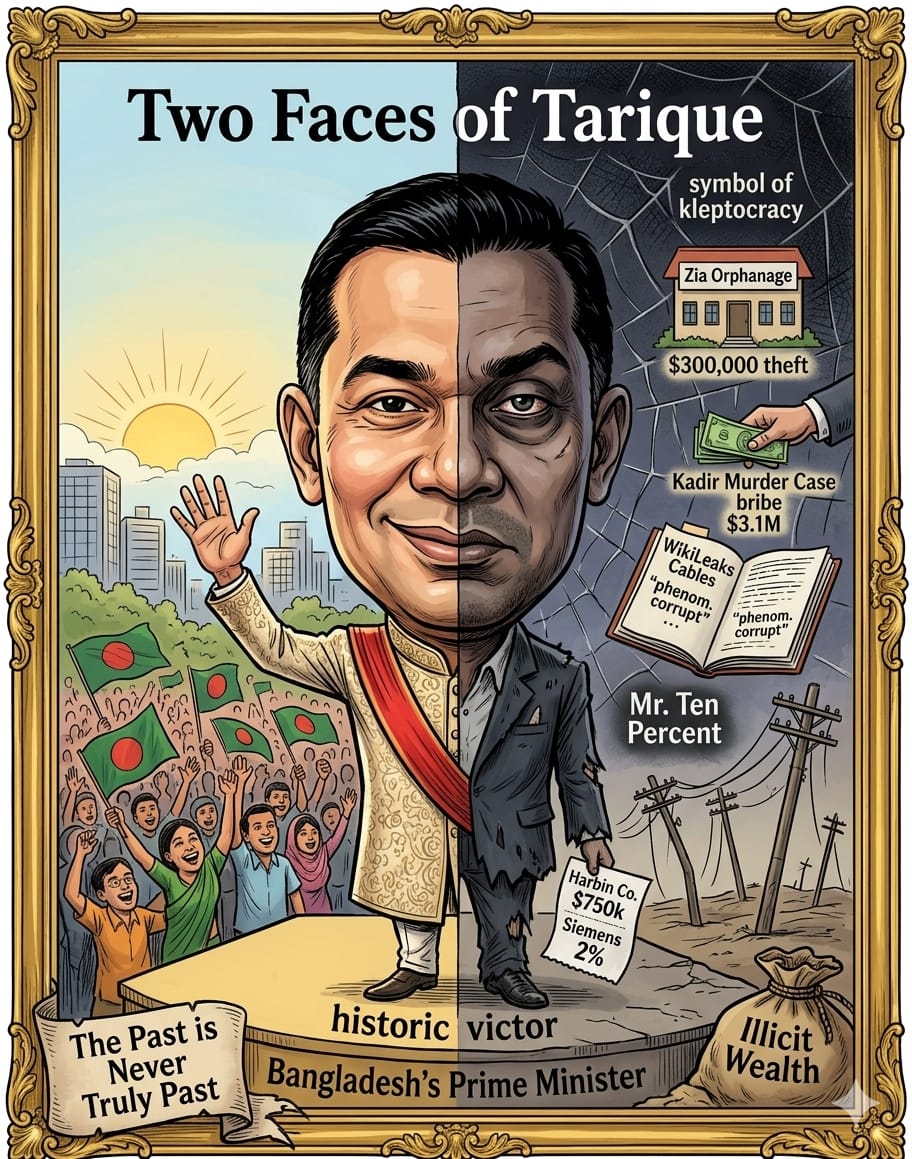
Her father spent years being called “Mr. Ten Percent” — the nickname for the commission allegedly extracted from every government contract through Hawa Bhaban. A US Embassy cable described him as a “symbol of kleptocratic government.” The ACC, the FBI, and Singapore courts all found evidence of money laundering.
The question is not whether there is wealth in the Rahman family. There clearly is. The question is: where did it come from, and why is nobody asking?
The Double Standard Is Glaring
NCP leaders eat duck and Bangladesh erupts. The Prime Minister’s daughter wears a different designer saree to every event — in a country where the average monthly income is under Tk 15,000 — and the commentary is about how elegant she looks.
The same people who screamed about Awami League corruption are not asking about the source of this wealth. The same media that hunted down every receipt for Sheikh Hasina’s foreign trips is not asking how a family that spent seventeen years in London exile, with assets allegedly frozen, managed to sustain and apparently grow significant wealth.
This is not about Zaima personally. She did not choose who her father is. Attacking her personally, or her clothing choices in isolation, is not the point. The point is accountability. The same accountability that Bangladeshis — rightly — demand of every public figure who accumulates unexplained wealth.
Zaima Rahman is now effectively a public political figure. She attended the US National Prayer Breakfast in Washington on behalf of her father. She meets foreign dignitaries. She appears at state functions. She has stepped into the political arena. That means her family’s finances are a legitimate public question.
What Nobody Has Declared
Bangladesh law requires public officials to declare their assets. Tarique Rahman’s asset declarations were the basis for the ACC’s wealth-beyond-means case. That case is now acquitted. But the wealth is still there. The question is still unanswered.
How much is the Rahman family worth? What assets do they hold in the UK? What accounts exist in Singapore, where courts once found evidence of laundered funds? What is the source of the income that funded seventeen years of comfortable London exile, a Lincoln’s Inn legal education, and a wardrobe that costs more per event than most Bangladeshis earn in a month?
These are not opposition talking points. These are accounting questions. The kind that should follow any family that moves from a corruption conviction to the Prime Minister’s residence without stopping to explain how.
The Duck Eaters and the Saree Wearers
If a junior politician eating duck deserves national outrage, the Prime Minister’s daughter’s unexplained luxury wardrobe deserves at minimum a question. A financial disclosure. A press conference where someone actually asks.
Instead, Bangladesh’s media has published dozens of articles about Zaima’s “simple” and “graceful” presence. Her suits. Her demeanor. Her “dignity.”
Nobody asked: on whose money?
Until now.
Sources: Anti-Corruption Commission case records (2007); High Court verdict, Tarique Rahman money laundering case (July 21, 2016); Al Jazeera — “Bangladesh: Tarique Rahman jailed for money laundering” (July 21, 2016); Prothom Alo — “Tarique Rahman, Zubaida Rahman acquitted in ACC case” (May 28, 2025); US Embassy WikiLeaks cable (2005); Wikipedia — Zaima Rahman; BBC News Bangla (February 20, 2026); Times Now (December 27, 2025).
Leave a Reply