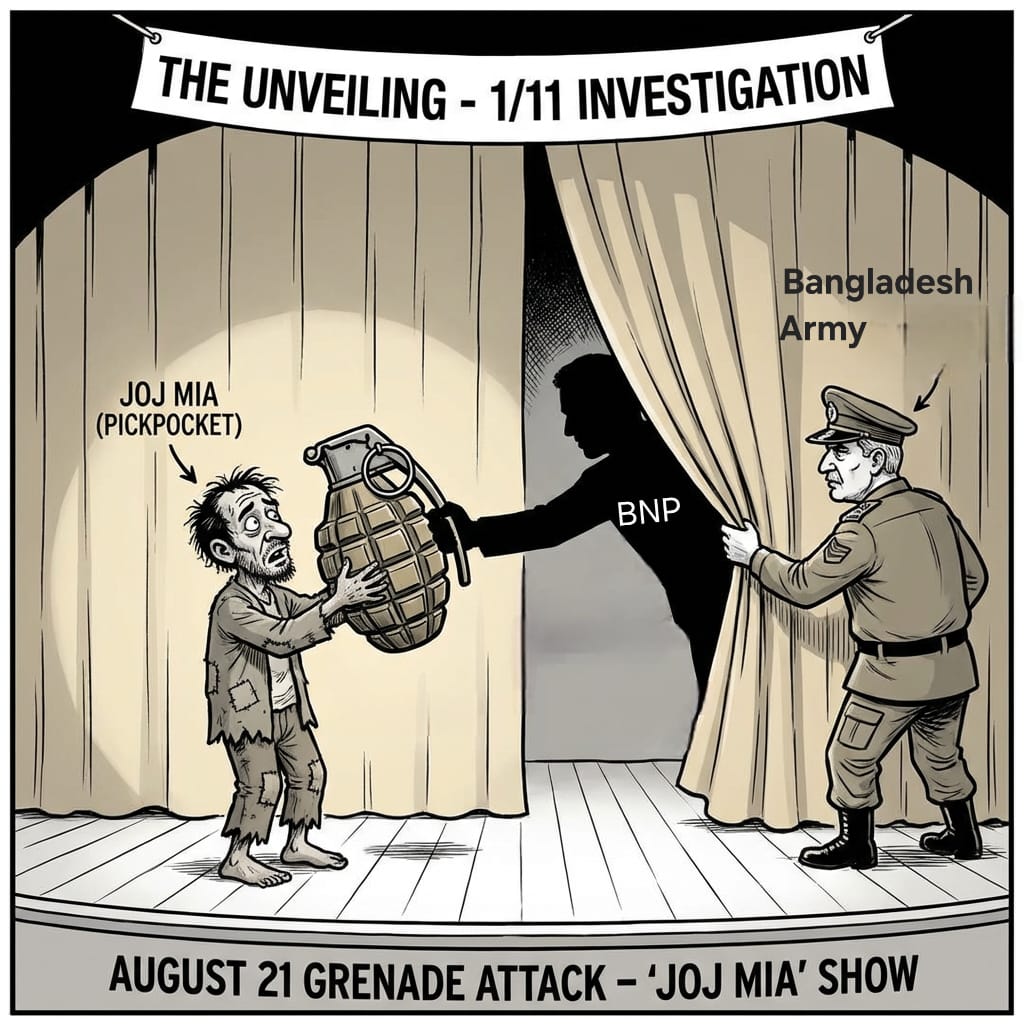
On August 21, 2004, grenades rained down on an Awami League rally in Dhaka, killing 24 people and wounding over 500. The attack was the most brazen assassination attempt in Bangladesh’s history — targeting Sheikh Hasina herself. But instead of finding the perpetrators, the BNP-Jamaat government manufactured a scapegoat: a petty criminal named “Joj Mia” who had nothing to do with the massacre. This is the story of how a government covered up its own complicity — and how the truth eventually broke through.

The Attack That Demanded Justice
The August 21, 2004 grenade attack on the Awami League rally at Bangabandhu Avenue was not a random act of terrorism. It was a coordinated assassination attempt using military-grade Arges grenades — the same type found in the massive Chittagong arms haul just four months later. Twenty-four people died. Over 500 were injured. Sheikh Hasina survived only because her bodyguards shielded her with their bodies.
The nation demanded answers. International observers called for a credible investigation. The pressure on the BNP-Jamaat government was immense.
Their response was not to find the killers — but to invent a cover story.
Enter the CID: An Investigation Designed to Fail
In 2004, the government assigned the Crime Investigation Department (CID) to investigate the grenade attack. From the outset, the investigation was compromised. Rather than following the evidence — which pointed toward state-linked militant networks — the CID was directed to fabricate a false narrative that would shield the real perpetrators.
“The investigation was not designed to find the truth. It was designed to bury it.”
— Analysis based on subsequent court findings
The CID concocted an elaborate fiction: that the attack was carried out by a ragtag group of criminals led by Subrata Bain’s “Seven Star terrorist group” — a local criminal gang with no connection to political violence or military-grade weaponry.
Who Was “Joj Mia”?
Joj Mia — real name Jamal Ahmed — was a petty criminal from Noakhali District. He was not a militant. He was not an explosives expert. He had no connection to Harkat-ul-Jihad-al-Islami (HuJI) or any political organization. He was, in the most literal sense, a pickpocket being framed for a massacre.
According to the fabricated CID story:
- Joj Mia and 14 other criminals from the Seven Star group carried out the grenade attack
- They allegedly met at Moghbazar before the attack to coordinate
- They had supposedly “rehearsed” the attack on a remote island
The story was absurd on its face. A pickpocket and petty criminals obtaining military-grade Arges grenades? Rehearsing a precision attack on a political rally? None of it withstood scrutiny — but that wasn’t the point. The point was to create a narrative that diverted attention from the real perpetrators.
The Arrest and Torture
On June 10, 2005 — nearly a year after the attack — CID officials arrested Joj Mia from his home. What followed was a textbook case of state-sponsored fabrication:
On June 26, 2005, under torture by security forces, Joj Mia was coerced into giving a false confession under Section 164 to a magistrate. The confession — extracted through physical abuse — implicated the Seven Star Group in the grenade attack.
Shaibal Saha Partha: Another Victim
Joj Mia was not the only victim. Shaibal Saha Partha was also arrested and tortured in custody, forced to give a false confessional statement corroborating the fabricated narrative. Though eventually released, Partha continues to suffer from post-traumatic stress caused by his ordeal at the hands of state security forces.
The Supreme Court Bar Association’s investigation accused the government of destroying evidence related to the grenade attack.
The Sham Judicial Commission
To give the cover-up a veneer of legitimacy, the BNP government formed a one-man judicial probe led by Justice Joynal Abedin.
The commission produced a report that was farcical even by the standards of political whitewashing. Rather than investigating the mounting evidence of state complicity, Justice Abedin’s report absurdly blamed the attack on “foreign and local enemies” — a meaningless catch-all designed to deflect responsibility.
| Element | Reality |
|---|---|
| Commission finding | “Foreign and local enemies” responsible |
| Evidence considered | Selectively filtered to exclude state links |
| Duration of investigation | Minimal — designed for speed, not depth |
| Consequence for Justice Abedin | Elevated to Appellate Division of Supreme Court |
The reward was telling. Two years after producing his sham report, Justice Abedin was promoted to the Appellate Division of the Supreme Court — widely understood as a quid pro quo for his cooperation in the cover-up.
The Daily Star described Abedin as a “shame” for the judiciary in Bangladesh.
Two Years of Deliberate Delay
For two full years (2004-2006), the CID failed to submit charge sheets against anyone. BNP leaders repeatedly claimed the investigation was “about to be completed” — a stalling tactic designed to run out the clock on public interest and international pressure.
Meanwhile:
- The government hurriedly buried two unidentified dead bodies connected to the attack in the middle of the night — destroying potential evidence
- Evidence was systematically tampered with or destroyed
- Witnesses were intimidated
- The real perpetrators remained free — and in some cases, in government
The Architects of the Cover-Up
The fabrication was not the work of rogue investigators. It was orchestrated at the highest levels of the BNP government:
Lutfozzaman Babar — State Minister for Home Affairs
As the minister directly overseeing law enforcement, Babar was alleged to have:
- Assured government support for the original attack
- Coordinated with intelligence agencies (DGFI, NSI) to facilitate the plot
- Used state machinery to obstruct the investigation
- Orchestrated the “Joj Mia” false confession story specifically
The Senior Police Officers
The following officers were later convicted for their roles in fabricating the investigation:
- Former IGP Khoda Baksh
- SP Ruhul Amin
- ASP Abdur Rashid
- ASP Munshi Atikur Rahman
All four received 2-year sentences for misleading the investigation and fabricating the Joj Mia story.
How the Truth Emerged: The Post-1/11 Investigation
Everything changed after January 11, 2007, when the military-backed caretaker government took power and launched genuine investigations into the corruption and criminality of the BNP-Jamaat era.
July 2007: Fresh Investigation
The CID initiated a completely new investigation, free from political interference.
November 2007: Mufti Hannan Breaks His Silence
Mufti Abdul Hannan, the leader of Harkat-ul-Jihad-al-Islami (HuJI), had been arrested by the BNP government in September 2005 — but was deliberately NOT linked to the August 21 case. Under the new investigation, Hannan revealed:
- The attack was operated by HuJI, not the Seven Star group
- He received support from Maulana Tajuddin, brother of BNP leader Abdus Salam Pintu
- Abdus Salam Pintu had direct knowledge of the attack
2008: CID Charge Sheet
Lead investigator Mohammad Javed Patwary concluded that:
- The attack aimed to kill Sheikh Hasina
- It was guided by the common grievance of both Mufti Hannan and Abdus Salam Pintu against Hasina
- Abdus Salam Pintu was personally responsible
On June 11, 2008, CID submitted charge sheets against 22 people, including Mufti Hannan and Abdus Salam Pintu.
2011: The Full Picture
Mufti Hannan gave another confessional statement implicating the top leadership of BNP:
- Tarique Rahman (BNP Acting Chairman, Khaleda Zia’s son)
- Lutfozzaman Babar (State Minister for Home)
- Harris Chowdhury (Political Secretary to PM Khaleda Zia)
- Abdus Salam Pintu (Deputy Education Minister)
- Senior officials of the Home Ministry, Police, DGFI, NSI, and Prime Minister’s Office
The 2018 Verdict: Justice, 14 Years Late
On October 10, 2018, Speedy Trial Tribunal-1 in Dhaka delivered its historic judgment. Judge Shahed Nuruddin ruled that the attack was “a well-orchestrated plan, executed through abuse of state power.”
19 Sentenced to Death
Among those sentenced to death:
- Lutfozzaman Babar — former State Minister for Home
- Abdus Salam Pintu — former Deputy Education Minister
- Major General (Retd) Rezzakul Haider Chowdhury — former DGFI Director General
- Brigadier General (Retd) Abdur Rahim — former NSI Director General
- 15 others including HuJI operatives and military-linked figures
Sentenced for Life
Tarique Rahman, acting chairman of BNP and son of Khaleda Zia, received a life sentence — cementing the court’s finding that the attack was directed from the very top of the party hierarchy.
2 Years for the Fabricators
Former IGP Khoda Baksh, SP Ruhul Amin, and ASPs Abdur Rashid and Munshi Atikur Rahman received 2-year sentences for misleading the investigation and fabricating the Joj Mia narrative.
What the “Joj Mia” Fabrication Reveals
The Joj Mia fabrication was not an isolated incident. It was part of a systematic pattern of the BNP-Jamaat government using expendable figures to absorb blame while protecting the political principals:
- Anwarullah was used as a scapegoat for the 2001 hall raid violence
- “Joj Mia” was fabricated as the grenade attack perpetrator
- Probe committees were used to whitewash the Chittagong arms haul
In every case, the pattern was identical: arrest a nobody, extract a confession through torture, present it to the media, and promote the officials who cooperated.
The Joj Mia fabrication stands as one of the most cynical episodes in Bangladesh’s political history — a government that orchestrated a grenade massacre against its own citizens, then tortured an innocent man into taking the blame. It took 14 years, a change of government, and the courage of investigators willing to follow the evidence for the truth to finally emerge.
But the full reckoning is still incomplete. Tarique Rahman remains in London. Several convicted figures are fugitives. And the institutional reforms needed to prevent such abuses remain unfinished.
Sources:
- The Daily Star — Reporting on Justice Joynal Abedin’s role and the CID investigation failures
- Speedy Trial Tribunal-1, Dhaka — Judgment of October 10, 2018 (Case No. 1/2015)
- Supreme Court Bar Association — Investigation accusing the government of destroying evidence
- CID Investigation Reports — Charge sheets of June 11, 2008 and supplementary sheets of July 2011
- Human Rights Watch — Reports on extrajudicial activities during BNP-Jamaat rule
- International Crisis Group — “Bangladesh: Getting Police Reform on Track” (2009)
- bdnews24.com, Prothom Alo — Contemporary reporting on the Joj Mia arrest and confession
Read the full timeline of the grenade attack: August 21, 2004: The Grenade Attack That Nearly Killed Democracy
Read how the BNP government smuggled 10 truckloads of weapons: The Chittagong Arms Haul
Read the full story of how Bangladesh reached the breaking point: The 1/11 Chronicle — Part 1
Leave a Reply