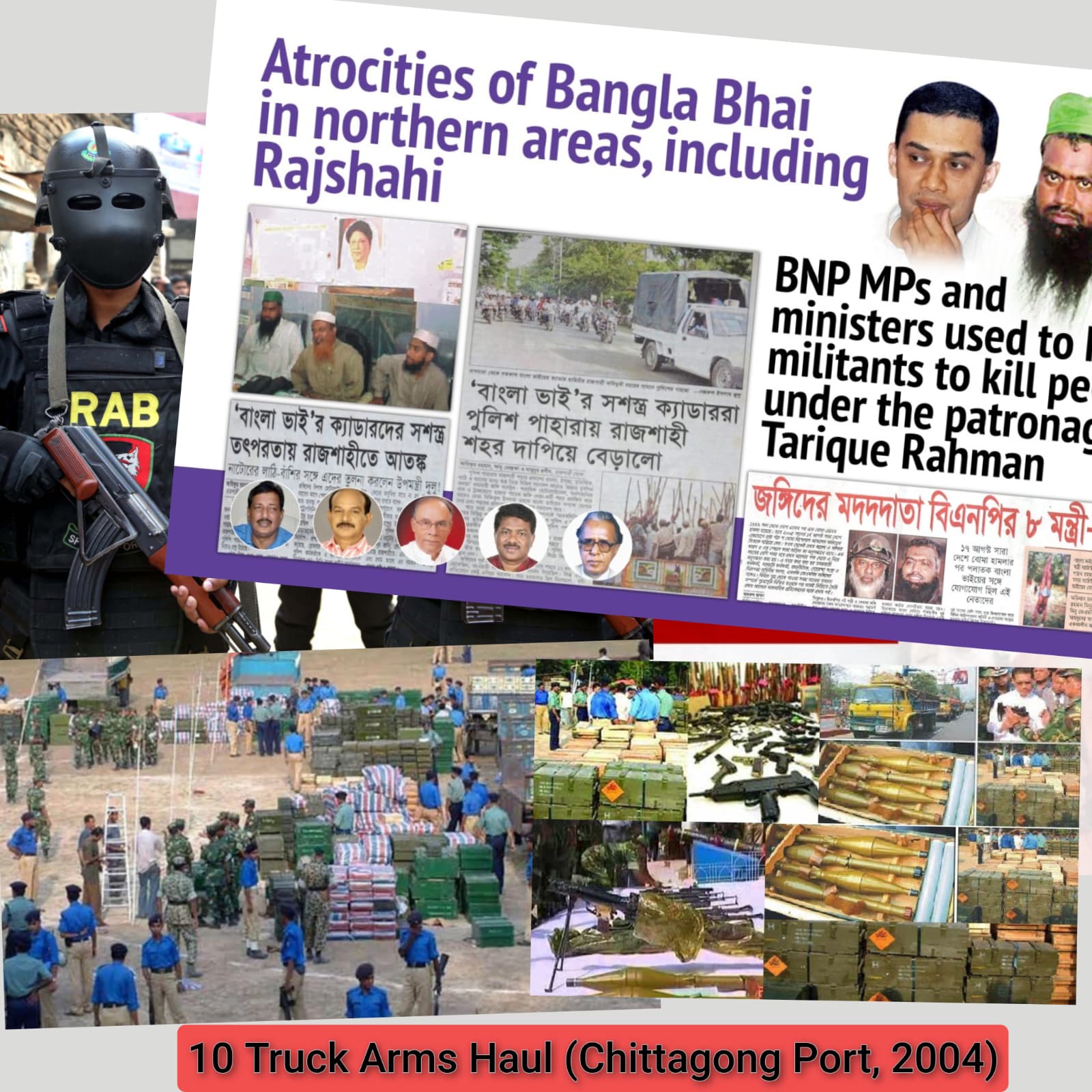
How a former student wing activist built a private army, tortured 500+ people, bombed 63 districts in a single day — and operated freely under the BNP-Jamaat government for years before anyone lifted a finger.
In 2004, a man calling himself “Bangla Bhai” — Bengali Brother — began patrolling the villages of northwestern Rajshahi. He said he was fighting crime. Local police helped him. Government officials looked the other way. Within months, he had built a private militia that tortured, kidnapped, and terrorized entire communities.
His real name was Siddiqul Islam. He was the military commander of Jagrata Muslim Janata Bangladesh (JMJB) and the operational mastermind of Jama’atul Mujahideen Bangladesh (JMB) — the most dangerous militant organization in Bangladesh’s history.
On August 17, 2005, his organization detonated 459 to 500 bombs across 63 of Bangladesh’s 64 districts within a single hour — the most synchronized terrorist attack the country had ever seen.
And throughout it all, the BNP-Jamaat government did nothing. Until it was too late.
I. Origins: From Shibir Activist to Militant Commander
Siddiqul Islam was born in 1970 in Rajshahi Division, northwestern Bangladesh. His path to militancy ran through the very political infrastructure that would later protect him:
- He was a former member of Islami Chhatra Shibir — the student wing of Jamaat-e-Islami, the BNP’s coalition partner in government
- He claimed to have an MA in Bangla from Rajshahi University — but the university found no record of him ever being enrolled
- By the early 2000s, he had evolved from student politics to militant Islamism, connecting with Shaykh Abdur Rahman, the founder and supreme leader of JMB
The connection to Jamaat-e-Islami’s student wing is not incidental. It was through these networks — madrasas, student organizations, and political patronage — that JMB and JMJB recruited, trained, and expanded. The BNP-Jamaat coalition government (2001–2006) was not just negligent; it was structurally complicit in creating the ecosystem that produced Bangla Bhai.
II. The “Crime Fighter” Cover: How Bangla Bhai Operated in Plain Sight
In 2004, Bangla Bhai began operations in the Rajshahi region with a clever cover story. As the New York Times reported:
He started “by campaigning against neighborhood criminals, purportedly with the help of the police and some government officials.”
— New York Times, March 30, 2007
This was the genius of Bangla Bhai’s strategy: he positioned himself as a vigilante fighting petty crime — thieves, drug dealers, local troublemakers — in areas where police were ineffective. Local communities initially welcomed him. Police cooperated. Government officials endorsed the effort.
But behind the “crime-fighting” facade, something far darker was happening:
- The Taskforce Against Torture, a Bangladeshi human rights organization, documented 500+ instances of individuals being threatened and tortured by Bangla Bhai and his associates
- JMJB established Sharia courts in villages, dispensing their own “justice” — amputations, floggings, forced conversions
- Journalists who tried to report on JMJB activities were attacked, threatened, and driven out (documented by the Committee to Protect Journalists and Refworld)
- Minority communities — Hindus, Ahmadiyyas, moderate Muslims — were targeted with systematic violence
- JMJB and JMB set up training camps in madrasas and remote areas, funded by foreign money intended for building mosques
All of this happened while the BNP-Jamaat coalition held power. All of it was reported in the press. None of it was stopped.
III. The BNP-Jamaat Government’s Complicity
The International Crisis Group — one of the world’s most respected conflict analysis organizations — published multiple reports documenting the BNP government’s deliberate failure to act against JMB and JMJB:
“Though religious extremism arose under its watch, the BNP-led coalition government (2001-2006), which included the Jamaat, did not target radical Islamist groups.”
— International Crisis Group, Asia Report No. 277, April 2016
Bangladesh’s political mainstream “has either deliberately used it [JMB] for narrow political ends, as during the coalition government led by BNP from 2006 to 2007, or been distracted by other concerns.”
— International Crisis Group, Asia Report No. 187, March 2010
The complicity went beyond negligence:
- The BNP-Jamaat coalition’s complicity “allowed groups like JMB, HuJI-B, and JMJB to establish training camps, often in collaboration with the Rohingya Solidarity Organization in Bandarban” (Global CDG)
- Bangla Bhai’s JMJB operated with active support from local police and government officials, not just passive tolerance
- The Home Ministry — under Lutfozzaman Babar, who simultaneously facilitated the Chittagong arms haul and the grenade massacre — took no action against JMJB despite mounting evidence
- Jamaat-e-Islami, whose student wing Shibir had produced Bangla Bhai himself, sat in the cabinet as a coalition partner
The pattern is identical to the BNP’s approach with HuJI: use militant groups as political tools, protect them from law enforcement, and deny everything until international pressure forces action.
IV. August 17, 2005: 63 Districts, 500 Bombs, One Hour
On August 17, 2005, JMB carried out the most audacious terrorist operation in Bangladesh’s history.
The Numbers
| Detail | Figure |
|---|---|
| Districts hit | 63 of 64 (all but one) |
| Bombs detonated | 459–500 |
| Timeframe | Approximately one hour |
| Killed | 3 |
| Injured | Approximately 100 |
The relatively low casualty count was intentional. This was not primarily designed to kill — it was a show of force. JMB was demonstrating to the government and the world that it had operatives in virtually every corner of Bangladesh, that it could coordinate a near-simultaneous nationwide attack, and that it possessed the logistical capability to do far worse.
Leaflets found at bomb sites, written in Bangla and Arabic, declared:
“It is time to implement Islamic law in Bangladesh.”
The synchronized nature of the attack stunned security analysts worldwide. Coordinating 500 bombs across 63 districts required:
- A nationwide network of trained operatives
- Secure communications infrastructure
- Centralized bomb-making and distribution
- Months or years of planning and recruitment
- Financial resources from foreign and domestic sources
All of this had been built in plain sight, under BNP-Jamaat rule, with the active or passive cooperation of the state.
V. The Escalation: Judges Assassinated, Suicide Bombings Begin
August 17 was just the beginning. In the weeks and months that followed, JMB escalated to unprecedented levels of violence:
Mid-November 2005: Judges Assassinated
Two judges were killed when a bomb was thrown at their vehicle in Jhalakathi, approximately 120 km south of Dhaka. This was a targeted assassination of the judiciary — a direct attack on the rule of law itself.
November 29, 2005: Bangladesh’s First Suicide Bombing
JMB carried out the first suicide bomb attack in Bangladesh’s history:
- 7 killed (including the suspected suicide bomber) in Gazipur
- 2 police officers killed in a separate attack in Chittagong
- At least 16 injured across both attacks
Bangladesh had crossed a threshold. Suicide bombings — previously unheard of in the country — had arrived. And they arrived because a government chose to protect the people who built the infrastructure for them.
VI. Too Little, Too Late: The Belated Crackdown
Only after the August 17 bombings did the BNP government finally ban JMB and JMJB. Only under mounting domestic and international pressure did arrests begin.
Timeline of the Belated Response
- August 17, 2005: 500 bombs detonate across 63 districts
- Late August 2005: JMB and JMJB finally banned (years after they should have been)
- September 30, 2005: Mufti Abdul Hannan (HuJI chief, linked to the August 21 grenade attack) arrested — but even then, the government deliberately did not connect him to the grenade massacre, maintaining the fabricated “Joj Mia” cover story instead
- November 2005: Judges assassinated, suicide bombings begin
- March 6, 2006: Bangla Bhai finally captured by RAB in Mymensingh after a firefight
- March 2006: Shaykh Abdur Rahman captured
By the time the BNP government acted, the damage was catastrophic: suicide bombings had entered Bangladesh, judges had been assassinated, 500 bombs had exploded across the country, and hundreds of people had been tortured by JMJB in the northwest.
The International Crisis Group’s verdict was clear: the BNP government either “deliberately used” JMB for political purposes or was so compromised by its Jamaat coalition partner that it couldn’t act against Jamaat’s militant offspring.
VII. Execution: March 30, 2007
After the January 11, 2007 caretaker government took over, the judicial process moved swiftly. On March 30, 2007, six JMB leaders were executed by hanging:
- Shaykh Abdur Rahman — JMB founder and supreme leader
- Siddiqul Islam / Bangla Bhai — Military commander, the “Bengali Brother” who terrorized Rajshahi
- Ataur Rahman Sunny — Military wing leader
- Abdul Awal — Organizational commander
- Khaled Saifullah — Operative
- Iftekhar Hasan Mamun — Operative
The New York Times reported on the executions, noting that the men had been found guilty of carrying out the bombings and establishing a militant infrastructure across the country.
VIII. The Ecosystem of Terror: How Everything Connects
Bangla Bhai did not operate in isolation. He was one node in a network of state-protected militancy that defined BNP-Jamaat rule:
- HuJI — Carried out the August 21 grenade attack, killing 24 people. Protected by the BNP government for years
- JMB/JMJB — Bangla Bhai’s organization. Bombed 63 districts, assassinated judges, introduced suicide bombing. Protected until international pressure forced action
- RAB — The BNP’s elite death squad that killed 600+ people in “crossfire.” Eventually captured Bangla Bhai in 2006 — years after he should have been stopped
- Chittagong Arms Haul — 10 trucks of weapons smuggled under state supervision for foreign insurgents. Same government, same pattern
- World-record corruption — Bangladesh ranked #1 most corrupt for 5 consecutive years. The corruption funded the impunity
The common thread: Lutfozzaman Babar’s Home Ministry. The same ministry that controlled police (who helped Bangla Bhai), that controlled RAB (600+ extrajudicial killings), that facilitated the arms haul, and that covered up the grenade massacre.
IX. The Question Nobody Can Answer
If the BNP government could capture Bangla Bhai in March 2006, why didn’t they do it in 2004 when his crimes were already being documented?
If they could ban JMB after August 17, 2005, why not before — when 500+ torture incidents had already been recorded?
If they knew about militant training camps in madrasas, why did they allow their coalition partner Jamaat — whose student wing Shibir had produced Bangla Bhai — to remain in government?
The answer, as the International Crisis Group documented, is that the BNP-Jamaat government either deliberately used militant groups for political ends or was so deeply compromised by its coalition dynamics that it could not act.
Either way, the result was the same: 500 bombs across 63 districts, judges assassinated, suicide bombings introduced to Bangladesh, and hundreds of people tortured by a private militia operating with state protection.
Bangla Bhai was executed. The system that created him walked free.
Sources
- New York Times, “Bangladesh Executes 6 Islamist Militants” (March 30, 2007)
- Eliza Griswold, New York Times, “The Next Islamist Revolution?” (January 23, 2005)
- BBC News, Coverage of Bangla Bhai’s capture (March 6, 2006)
- BBC News, Coverage of escalating extremism in Bangladesh (November 29, 2005)
- International Crisis Group, Asia Report No. 121: “Bangladesh Today” (October 2006)
- International Crisis Group, Asia Report No. 187: “The Threat from Jamaat-ul Mujahideen Bangladesh” (March 2010)
- International Crisis Group, Asia Report No. 277 (April 2016)
- Taskforce Against Torture (Bangladesh) — Documentation of 500+ torture cases
- Committee to Protect Journalists (CPJ) — Reports on attacks on journalists by JMJB
- Refworld / UNHCR — Documentation of militant activities and attacks on press
- Global CDG — Analysis of BNP-Jamaat complicity in militant camp establishment
Bangladesh Untold is committed to source-backed journalism. Every claim in this article is documented by international organizations, court records, or verified news reports. We invite readers to verify every source.
Leave a Reply