Category: Uncategorized

  • US Embassy Cables: What American Diplomats Really Thought About Tarique Rahman

    US Embassy Cables: What American Diplomats Really Thought About Tarique Rahman

    There is a version of Tarique Rahman’s story that BNP supporters tell. In that version, every corruption case against him was fabricated. Every court that convicted him was politically compromised. Every international body that documented his crimes was either misled or acting on behalf of his enemies. The 84 cases filed against him between 2007 and 2024 were not investigations — they were persecution. His 17 years in London exile were not a fugitive’s refuge — they were principled resistance.

    Then there are the cables.

    On November 3, 2008, the United States Ambassador to Bangladesh, James F. Moriarty, sent a confidential message from the US Embassy in Dhaka to the Secretary of State in Washington. It was classified. It was written by a senior American diplomat — a career professional with no personal stake in Bangladeshi politics, no party affiliation in Bangladesh, no history of anti-BNP advocacy. He was simply reporting what the US Embassy had observed, investigated, and concluded.

    Ambassador Moriarty requested that Tarique Rahman be banned from entering the United States of America.

    The cable is now public. It was released by WikiLeaks under the reference 08DHAKA1143_a. Anyone can read it. And what it says about the man who is today the Prime Minister of Bangladesh is not an opposition allegation, not a partisan claim, and not an editorial opinion. It is the formal, on-the-record assessment of the United States government.

    “A Symbol of Kleptocratic Government”

    The Ambassador’s language was precise. Diplomatic cables are not written for public consumption — they are written for accuracy, because the people reading them make consequential decisions based on what they contain. Ambassador Moriarty had no reason to exaggerate. His audience was not the Bangladeshi public. His audience was the United States government.

    He described Tarique Rahman as “the notorious and widely feared son of former Prime Minister Khaleda Zia.”

    He wrote that Tarique was “notorious for flagrantly and frequently demanding bribes in connection with government procurement actions and appointments to political office.”

    He stated that Tarique had “accumulated hundreds of millions of dollars in illicit wealth.”

    He concluded that “Tarique is a symbol of kleptocratic government and violent politics in Bangladesh.”

    And then he wrote the sentence that should be printed in every history book covering Bangladesh’s political crisis:

    “In short, much of what is wrong in Bangladesh can be blamed on Tarique and his cronies.”

    This is not from a Dhaka Tribune editorial. This is not from an Awami League party statement. This is from the United States Ambassador to Bangladesh, in a classified cable sent to the Secretary of State, requesting that Tarique Rahman be formally banned from entering the United States under Presidential Proclamation 7750 — the proclamation that allows the US to deny entry to foreign nationals who engage in public corruption.

    The Ambassador’s final recommendation was unambiguous: “Embassy recommends that Tarique Rahman be found subject to Presidential Proclamation 7750 for participating in public official corruption.”

    The Specific Cases — Names, Numbers, Amounts

    What makes the cable significant is not only its conclusions but its specificity. Ambassador Moriarty did not write in generalities. He documented specific transactions, specific company names, specific dollar amounts. The cable reads less like a diplomatic assessment and more like a prosecutorial brief.

    The Siemens Bribery Scheme. Tarique Rahman received a commission of approximately 2% on all Siemens contracts in Bangladesh — paid in US dollars. This was not an informal arrangement known only within Bangladesh. The US Department of Justice had filed a $3 million asset forfeiture case (January 8, 2009) against Singaporean bank accounts linked to the scheme. The FBI’s Asset Forfeiture unit and the DOJ were both involved. Siemens subsequently admitted and pleaded guilty to paying bribes to Tarique’s brother, Arafat Rahman “Koko,” as part of a broader $200 million money laundering investigation.

    Harbin Company. A Chinese company paid $750,000 to Tarique as a bribe. The cable documents that the money was physically transported to Singapore and deposited at a Citibank account. FBI Supervisory Special Agent Debra LaPrevotte later testified in a Dhaka court — the first time an FBI agent had ever testified in Bangladesh — tracking $2.66 million laundered to Citibank Singapore (Account #158052-008/016). She found Tarique’s credit card (#4568817010064122) linked to his associate Mamun’s account. She found the $750,000 bribe from businesswoman Khadiza Islam traced to that same account. The US government, before proceeding with any of this, verified independently that the investigation was not politically motivated.

    Monem Construction. The cable documents that Monem Construction paid Tarique $450,000 in bribes in exchange for government contracts.

    The Kabir Murder Case. This one is particularly striking. Sanvir Sobhan — son of the chairman of the Bashundhara Group, one of Bangladesh’s largest conglomerates — was accused of killing a man named Humayun Kabir. Tarique Rahman accepted 210 million taka — approximately $3.1 million — in exchange for intervening to thwart the murder prosecution. The Ambassador’s cable documents this not as rumor but as a specific bribery transaction: a murder case was sold, and the price was $3.1 million.

    The Zia Orphanage Trust. Tarique and his mother, Prime Minister Khaleda Zia, looted 20 million taka from the Zia Orphanage Trust — a charity fund established in the name of the late President Ziaur Rahman. Money designated for orphans was diverted to land purchases and BNP election campaigns.

    Al Amin Construction. The cable documents straightforward extortion: Tarique threatened the owner of Al Amin Construction with shutting down the company unless they paid $150,000. They paid.

    The cable goes beyond these specific cases to note that Tarique’s associates systematically extorted contractors and businessmen across multiple sectors. Reza Construction, Mir Akhter Hossain Ltd, and others are referenced. The pattern was consistent: government proximity, demands for payment, and threats for non-compliance.

    What the Ambassador Said About the Broader Consequences

    The cable’s most chilling passage is not about the money. It is about what the corruption enabled.

    Ambassador Moriarty wrote: “His flagrant disregard for the rule of law has provided potent ground for terrorists to gain a foothold in Bangladesh.”

    This is the connection that Bangladesh’s current political discourse tries hardest to obscure. Tarique’s corruption was not merely a financial crime. It rotted the institutions — the judiciary, the police, the prosecution service, the civil service — that would otherwise have been able to contain and prosecute the militant organizations that flourished under BNP-Jamaat rule. When every government contract is contingent on bribery. When every court case can be purchased. When state ministers are sheltering militant operatives because the chain of command has been corrupted from the top. When prosecution services can be neutralized for $3.1 million. The environment that produces a Bangla Bhai, a JMB, and an August 21 grenade attack does not emerge from nothing. It is cultivated through systematic institutional destruction.

    The US Ambassador — in 2008, in a classified cable, writing only for his government — connected these dots explicitly.

    The Broader Cable Record: Other American Diplomatic Assessments

    The November 2008 cable is the most comprehensive single document, but it was not the first time American diplomats had documented their views on BNP-era governance.

    Earlier cables from the US Embassy in Dhaka — also released by WikiLeaks — described the operational structure of Hawa Bhaban, the informal parallel government Tarique ran from BNP’s party headquarters. The cables use the phrase “Dark Prince” for Tarique, noting his alleged involvement in what they termed “violent politics.” American diplomats on the ground documented how government contracts were being steered through Hawa Bhaban, how business appointments were being sold, and how Tarique’s associates were embedded across the procurement apparatus of the state.

    The cable record also corroborates the Transparency International assessments that Bangladesh topped the global corruption rankings for five consecutive years under BNP rule. The Ambassador notes this fact directly: “Through 2006, the nation topped Transparency International’s ranking of the world’s most corrupt governments four years in a row.” He adds a figure that is rarely cited in debates about Bangladesh’s development: “Corruption has lowered Bangladesh’s growth rate by two percent per year.”

    Two percent per year. Compounded over five years of BNP rule. That is the cost, in lost economic growth, that ordinary Bangladeshis paid for Tarique Rahman’s hundreds of millions of dollars in personal enrichment.

    The FBI Investigation — Unprecedented in Bangladesh’s History

    The WikiLeaks cables document American concern and American recommendations. The FBI investigation went further. It produced evidence.

    FBI Supervisory Special Agent Debra LaPrevotte traveled to Dhaka and testified in a Bangladeshi court on November 16, 2011. It was the first time in Bangladesh’s history that an FBI agent had testified in a local court case. She brought forensic financial evidence with her: traced wire transfers, verified bank account records, documented transaction trails.

    Her testimony confirmed what the cables had stated: $2.66 million laundered through Citibank Singapore. A specific account number. A specific credit card linked to the defendant. A specific bribe payment, traced to its source, documented in the forensic record.

    The US government — before committing to this extraordinary step of having an FBI agent testify in a foreign country’s court — made an independent determination that the case was not politically motivated. That determination was reached. The testimony proceeded.

    The High Court subsequently overturned Tarique’s trial acquittal in 2016, sentencing him to seven years’ imprisonment and fining him 20 crore taka. The court explicitly found that he had “influenced political power to help his close friend Giasuddin Mamun to get and then launder 200 million taka.”

    What Happened Next: The Great Erasure

    After the student uprising of July 2024 ousted Prime Minister Sheikh Hasina, Bangladesh’s courts underwent a comprehensive reversal. The Supreme Court stayed Tarique’s seven-year sentence. Then, in March 2025, the Appellate Division of the Supreme Court acquitted Tarique and Mamun in the money laundering case entirely. One by one, all 84 cases against him — spanning money laundering, corruption, the grenade attack, extortion — were acquitted or quashed.

    He returned to Bangladesh in late 2025. BNP won a landslide election in February 2026. On February 17, 2026, Tarique Rahman — the man Ambassador James Moriarty had called “a symbol of kleptocratic government,” the man the FBI had tracked money laundering to Citibank Singapore, the man whose specific bribery transactions were documented in a classified cable sent to the US Secretary of State — was sworn in as Prime Minister of Bangladesh.

    In October 2025, in his first major media appearance after 17 years in exile, Tarique described the 1/11 caretaker government as “maliciously motivated.”

    The investigators who had gathered evidence of his corruption are now being arrested.

    Lieutenant General (Retd.) Masud Uddin Chowdhury — a key figure from the 2007-2009 caretaker period — was arrested on March 23, 2026, on 11 charges including murder, human trafficking, and fraud. The prosecution explicitly stated that one basis for targeting him was that he was “involved in the arrest and torture of Tarique Rahman” during the 1/11 period.

    NE News (India) described these arrests as “acts of revenge and retaliation.” Human Rights Watch confirmed the targets were “key figures during the 2007-2009 military-backed government.”

    The strategy is transparent: discredit 1/11 as illegitimate, and every piece of evidence gathered during that period — including the cooperation with the FBI, including the cases that led to court convictions, including the international documentation — becomes retroactively invalid. The logic is neat. The history is not.

    What Cannot Be Erased

    The cables exist. The WikiLeaks archive is public. The FBI testimony transcript exists. The Siemens DOJ filings exist. The Singapore court records exist. The specific names, amounts, and transaction details documented by Ambassador Moriarty on November 3, 2008, exist.

    No acquittal can unwrite 08DHAKA1143_a. No Supreme Court order can recall a diplomatic cable. No act of parliament can alter the public record of what the United States government formally concluded about the man now leading Bangladesh.

    The Ambassador wrote: “Tarique is a symbol of kleptocratic government and violent politics in Bangladesh.”

    He wrote: “In short, much of what is wrong in Bangladesh can be blamed on Tarique and his cronies.”

    He wrote: “His flagrant disregard for the rule of law has provided potent ground for terrorists to gain a foothold in Bangladesh.”

    And he recommended that the United States of America bar Tarique Rahman from its territory.

    That was the official position of the United States government in 2008. It was not written for public consumption. It was written because it was true, because American diplomats had done their homework, and because the evidence was solid enough to recommend action under a presidential proclamation.

    Bangladeshis deserved to know this in 2008. They deserve to know it now.


    Source: WikiLeaks Cable 08DHAKA1143_a — US Embassy Dhaka to Secretary of State, November 3, 2008. Full text available at: https://wikileaks.org/plusd/cables/08DHAKA1143_a.html

    Additional sources: FBI testimony transcript, Dhaka court (November 16, 2011); Bangladesh High Court judgment overturning acquittal (July 21, 2016); US DOJ asset forfeiture filing (January 8, 2009); Transparency International Corruption Perceptions Index 2001–2005.

  • What the International Crisis Group Documented: How a World-Class Think Tank Watched Bangladesh Descend

    What the International Crisis Group Documented: How a World-Class Think Tank Watched Bangladesh Descend

    When the International Crisis Group issues a report, governments listen. The ICG is not an advocacy organization, a partisan body, or a lobby for any political cause. It is one of the world’s most respected conflict-prevention institutions — staffed by former diplomats, career analysts, and field researchers who have spent decades in the most dangerous places on earth. When the ICG publishes a report warning that a country may be on the path to violent conflict, that is not a protest. That is a diagnosis.

    In October 2006 — just months before the January 11, 2007 intervention that Bangladesh now debates endlessly — the International Crisis Group published Bangladesh Today (Asia Report N°121). The report was the product of years of field research, face-to-face interviews with diplomats, academics, lawyers, human rights defenders, and political figures across the country. It was written by people with no stake in Bangladeshi politics. They had nothing to gain from framing their conclusions one way or the other.

    What they found was damning.

    “The Worst Time in the History of Bangladesh”

    The report opens with a quote that deserves to be remembered.

    A Dhaka-based academic told Crisis Group researchers: “This is the worst time in the history of Bangladesh.”

    That was not a partisan activist speaking. That was a scholar who had watched the country for decades, looking at the state of its institutions in 2006 and arriving at that conclusion.

    Another Bangladeshi political scientist told the ICG: “The deterioration since 2001 is a serious change.”

    A Western development worker with many years of field experience in Bangladesh told Crisis Group: “I’d bet [our ambassador] a year’s salary we would never have suicide bombers here — but I was wrong.”

    These are not opposition talking points. These are the on-the-ground assessments that the International Crisis Group gathered from credible observers who had no reason to distort what they saw.

    The ICG’s own framing was direct: Bangladesh faced “twin threats to its democracy and stability: the risk that its political system will founder in a deadlock over elections and the growing challenge of militant Islamism, which has brought a spate of violence.” It noted that the country had featured as high as seventeenth on Foreign Policy’s global ranking of failed states. The World Bank Country Director had described Bangladesh as a “fragile state.” The head of a major bilateral donor agency warned that it displayed signs of “pre-conflict.”

    That was the Bangladesh the BNP-Jamaat coalition government handed to history.

    What the ICG Said About the BNP Government’s Record

    The ICG did not editorialize. It documented what it found.

    On corruption, it noted the well-established fact: Transparency International ranked Bangladesh as the most corrupt country in the world for five consecutive years during BNP rule — a reality the Crisis Group treated as baseline context for understanding why institutions had rotted.

    On the judiciary: “The judicial system is not independent but even the AL will not change this — it’s our political culture,” an AL activist told the ICG. A senior lawyer described the courts to researchers as following “what the political leaders want.” A lawyer championing unpopular causes said: “The judicial system is not working, is not impartial — it just follows what the political leaders want. I haven’t received any direct threats but I’ve had lots of problems and indirect threats. I feel very insecure.”

    The ICG documented systematic judicial manipulation: “Judges and lawyers favouring the BNP are being preferred and promoted.” A senior lawyer described to researchers how “a senior judge in Bogra was transferred to a junior position in the most distant part of the country for not giving a judgement in favour of the government.” Public prosecutors, the ICG noted, were required to be members of the ruling party “regardless of their capability.”

    On the civil service: “In the four years after the 2001 elections, five deputy commissioners were transferred for not supporting the government enough.” The civil service, the ICG found, had become so politicized that officials were beginning to “behave a bit neutrally just in case there’s a change of government” — not out of professionalism, but self-preservation.

    On parliament: it had functioned as a near-complete shell. With the opposition boycotting sessions and the ruling coalition using parliamentary machinery as an instrument of political power rather than democratic governance, the ICG found that “with governments refusing to cede their parliamentary opponents their due role and parliamentary oppositions refusing to accept the legitimacy of elected governments, parliament has been through lengthy periods of complete dysfunction.”

    The Grenade Attack: An International Crisis Group Finding

    The ICG did not sidestep the August 21, 2004 grenade attack.

    In assessing the political crisis, the report stated clearly: “The AL has good grounds for its complaints of victimisation: an August 2004 grenade attack on an AL rally in the capital nearly killed its president, Sheikh Hasina, and left other senior leaders dead or injured; other assaults include the murder of Shah A.M.S. Kibria, a respected former finance minister.”

    Then the ICG added four words that should have sent shockwaves through every international chancellery: “There have been no serious investigations of these killings.”

    Not “limited” investigations. Not “slow” investigations. No serious investigations.

    The International Crisis Group — drawing on field research and interviews with diplomats, lawyers, and analysts — concluded that the BNP government had not conducted serious investigations into the murder of the former Finance Minister and former UN Under-Secretary General, or into the grenade attack that killed 24 people at a political rally. The government had every tool of the state at its disposal. It chose not to investigate.

    This is not a Bangladesh Untold editorial. This is what the International Crisis Group found.

    The BNP’s Private Polls — and What They Revealed

    The ICG obtained information from political analysts about internal BNP polling that is rarely discussed today.

    “Tareq [Rahman] commissioned three polls last year,” an international political analyst told Crisis Group researchers. “Each one showed them facing serious losses. So they’ll surely put the machinery in place to rig the elections.”

    Tarique Rahman — who is today the Prime Minister of Bangladesh — knew, according to his own commissioned polling, that his party was heading for serious electoral defeat. The ICG documented this finding not as speculation but as a key factor shaping the BNP’s political strategy heading into the 2006-2007 electoral crisis.

    The implications are significant. A party with confidence in its popularity does not need to engineer the caretaker system. It does not need to manipulate the Chief Justice’s appointment. It does not need to install a sympathetic Election Commission Chief. The BNP, according to its own internal numbers, knew it was losing. What followed — the constitutional manipulation, the fake voter rolls, the stacked caretaker arrangements — followed logically from that knowledge.

    Militants, the Government, and “Cold Political Logic”

    One of the most consequential sections of the ICG report addresses the relationship between the BNP government and the Islamist militant groups that terrorized Bangladesh during 2002-2006.

    The ICG wrote: “Circumstantial evidence, as well as cold political logic, suggests that underground terrorist groups have been cultivated and sheltered by those in power.”

    This was not a fringe view. It was the conclusion of a serious international research organization based on extensive fieldwork. The ICG documented:

    – The JMJB under Bangla Bhai was tolerated because it targeted left-wing extremists — “The police and government were happy to encourage JMJB in this.” – Photos existed of Bangla Bhai “coming out of the Rajshahi police superintendent’s office and speaking to his cadres” — the Daily Star had published them in 2006. – Following the arrest of JMB chief Abdur Rahman, “former district Jamaat chief Saidur Rahman’s chequebook was found in his house” — a direct financial link between the governing coalition’s party and the terrorist leadership. – Jamaat leader Motiur Rahman Nizami had “repeatedly denied that the JMJB even existed” — a fabrication sustained until the evidence made it impossible. – The IOJ’s chairman was “reportedly on the advisory council of the radical HuJI” — the same organization that carried out the August 21 grenade attack.

    An academic who had studied Islamist politics closely told the ICG: “These are Jamaati organisations, even though Jamaat leaders still deny it face to face. At first they’d say Bangla Bhai and his colleagues were media creations; now they say they’re an exaggeration.”

    The ICG concluded: “Whatever the evidence, it would be logical for elements of the government to cultivate extremists.”

    When an independent international organization studying conflict-prevention tells you it is logical for your government to have cultivated terrorists, that is not political rhetoric. That is an analytical finding with documented evidentiary support.

    The RAB: “A Licensed Vigilante Outfit”

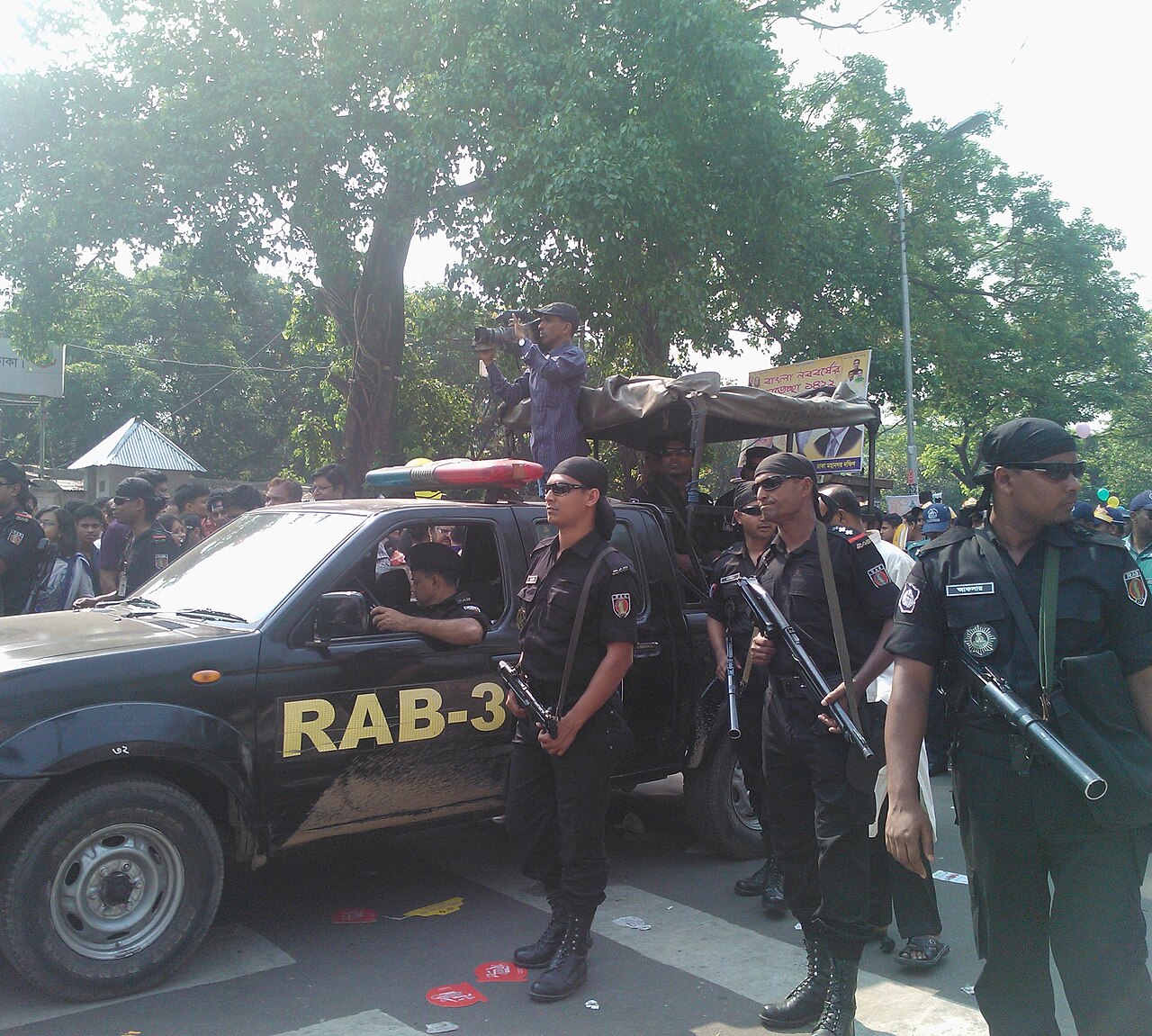
    The Rapid Action Battalion was created by the BNP government in 2004 and presented to the public as a solution to organized crime. The ICG had a different description.

    “RAB appears to be little better than a licensed vigilante outfit with no need to account for its excesses.”

    By July 2006, RAB had officially recorded making almost 11,000 arrests and killing 283 people in “exchanges of fire.” The ICG noted that this number was the official figure — the actual toll of extrajudicial killings was widely believed to be higher.

    The pattern was unambiguous. An international observer told the ICG: “There is no doubt that it is involved in extrajudicial killings. And not a single Islamist has died in crossfire.”

    This was the essential truth that the ICG captured in a single devastating sentence. The force that was supposedly fighting terrorism was killing criminals, opposition figures, and alleged criminals — in “crossfire.” But the militants who had bombed 63 districts in a single day, who had carried out suicide bombings, who had assassinated judges — they were not dying in crossfire. They were being arrested, with television cameras invited to film their apprehension.

    “RAB is very worrying,” an international observer told the ICG. “There is no doubt that it is involved in extrajudicial killings. And not a single Islamist has died in crossfire.”

    The ICG documented the conclusion that was unavoidable: RAB was a political tool, not a counter-terrorism instrument.

    What the Elections Were Really About

    The ICG’s analysis of the electoral crisis of 2006-2007 provides essential context for understanding what January 11, 2007 actually interrupted.

    The report documented that the AL’s core demands were not partisan power games — they were responses to documented manipulation:

    – The Chief Justice, K.M. Hasan, was “seen as biased in favour of the BNP, which appointed him” — even the Law Minister admitted Hasan had been involved in BNP politics and was a party member. The automatic convention made him head of the caretaker government. – The Chief Election Commissioner had “damaged his credibility with a misconceived, and apparently politically biased, revision of the electoral roll” — the same voter roll scandal that had stuffed millions of fake names into the voter lists. – The army reported to the BNP-appointed president. The AL was demanding army neutrality under the caretaker government, not under a president installed by the party whose election the army would be overseeing.

    The ICG concluded that the four institutions the election would rely on — “the presidency, the head of the caretaker government charged with supervising the process, the election commission and the army” — were none of them “free of controversy.” The president and the incoming caretaker chief “are seen as partial to the governing Bangladesh Nationalist Party (BNP).”

    This is what the world’s foremost conflict-prevention organization said about the electoral conditions Bangladesh faced at the end of 2006. Not “contested.” Not “disputed.” Partial to the governing party.

    The Minorities: A Warning Unheeded

    The ICG’s field research included testimony from religious and ethnic minorities that deserves to be quoted in full.

    A Hindu activist told ICG researchers: “The election increases the heartbeat of minorities. They will be prevented from going to court, will be threatened, will be told not to vote…and if they do, it will be assumed they voted for the opposition. All of this — even torture — will not be disclosed in the media.”

    This testimony was given to ICG researchers in 2006, five years after the post-election pogrom of 2001 that had seen over 18,000 rapes, the displacement of hundreds of thousands of Hindus, and the burning of temples and homes across two dozen districts.

    The ICG noted that “Bangladesh’s Hindu ethnic minority and Ahmadi communities are victims of chronic state discrimination and increasing targeted violence by Islamist groups.” It documented the anti-Ahmadiyya campaign — rallies against them, attacks on mosques, denial of education for children, confiscation of publications — all occurring under the watch of a government whose coalition partner had led the campaign.

    The report’s findings on minorities were not standalone. They were part of a pattern the ICG documented as systemic: a government that protected those who attacked minorities, prosecuted those who defended them, and depended electorally on the forces that saw minority-targeting as both ideologically correct and politically useful.

    What the International Community Knew

    The ICG’s documentation of international community awareness during this period is equally important.

    By February 2005, the US, UK, and EU troika had “all lambasted the government on election issues.” A February 2005 donors conference in Washington — to which the Bangladesh government was pointedly not invited — had terrorism and rising violence “topping the agenda.” In direct response to being excluded, the BNP government chose the eve of the conference to announce the banning of the JMB and JMJB, and the arrest of their leaders.

    The ICG’s interpretation was precise: “The catalyst for the crackdown appears to have been a donor meeting in Washington.”

    Not genuine counter-terrorism commitment. Not a government awakening to the threat within its borders. The crackdown happened when international embarrassment made continued denial politically untenable.

    A U.S. diplomat told the ICG: “On human rights, why does the U.S. accept complete silence in the face of well documented violations?” A senior development official was direct: “The government is characterised by extraordinary centralisation and short-termism with no real capacity to think seriously about the future.”

    The picture was consistent: the international community knew. Diplomats knew. Donor agencies knew. Analysts knew. The BNP government was documented, assessed, and found wanting by every serious international body that examined it.

    The Verdict

    The International Crisis Group published Bangladesh Today on October 23, 2006 — less than three months before January 11, 2007.

    Its verdict: “The questions of whether Bangladesh’s traditional moderation and resilience will see it through or whether escalating violence and political confrontation could derail its democracy are vital ones.”

    Its findings: a government that had cultivated terrorists, operated a death squad, manipulated every democratic institution, stolen voter rolls, and blocked serious investigation of a grenade massacre that killed 24 people.

    Its warning: that “canaries in the mine that must be watched” included “the treatment of minorities, the increased power of the paramilitary and the criminalisation of politics.”

    The ICG said none of this because it was an Awami League sympathizer. It said it because that is what the evidence showed. It said it because the people its researchers interviewed — lawyers, diplomats, academics, development workers, civil society figures — told them what they saw with their own eyes.

    The International Crisis Group was not predicting 1/11. It was documenting the conditions that made 1/11 comprehensible to anyone paying attention.

    The BNP had five years to prevent this outcome. They used those five years to deepen every pathology the ICG documented: more corruption, more impunity, more Islamist cultivation, more institutional destruction, more violence.

    “This is the worst time in the history of Bangladesh,” said the Dhaka academic.

    He was right. And he wasn’t alone in seeing it.


    Source: International Crisis Group, “Bangladesh Today,” Asia Report N°121, 23 October 2006. The full report is available in the public domain. All quotes in this article are drawn directly from that document.

  • What Amnesty International Documented: A Timeline of Reports on BNP-Era Bangladesh

    What Amnesty International Documented: A Timeline of Reports on BNP-Era Bangladesh

    What Amnesty International Documented: A Timeline of Reports on BNP-Era Bangladesh

    When Amnesty International issues a report on your country, the world pays attention. When they issue report after report — year after year — documenting the same patterns of abuse, impunity, and state-sponsored violence, the world should not look away.

    Between 2001 and 2006, Amnesty International published a devastating series of reports on Bangladesh. They documented the post-election pogroms against Hindus, the legal architecture of torture, the persecution of religious minorities, the assault on human rights defenders, and the extrajudicial killings carried out by state forces with total impunity.

    Each report was a separate alarm bell. Together, they form a sustained indictment of a government that treated human rights as an obstacle to power — not a constraint on it.

    Here is the timeline of what Amnesty International documented during BNP-Jamaat rule.

    December 2001: “Attacks on Members of the Hindu Minority”

    The first alarm came just weeks after the BNP-Jamaat coalition took power. Amnesty International published *”Bangladesh: Attacks on members of the Hindu minority”* (AI Index: ASA 13/006/2001) — a report that documented the systematic violence unleashed against Hindus following the October 1, 2001 general election.

    Amnesty’s findings were unambiguous:

    *”The current wave of attacks against the Hindu community in Bangladesh began before the general elections of 1 October 2001 when Hindus were reportedly threatened by members of the BNP-led alliance not to vote.”*

    The report documented:

  • Hindus threatened and intimidated to prevent them from voting
  • Post-election violence including killings, rape, arson, and looting targeting Hindu communities
  • The destruction of Hindu temples and sacred sites across affected districts
  • **Hundreds of Hindus** fleeing the violence, crossing the border into India
  • The deliberate economic targeting of Hindu properties — homes looted, businesses destroyed, trees cut down on victims’ land
  • Amnesty called on the BNP government to investigate the attacks and prosecute those responsible. The government dismissed the report as politically motivated. No meaningful investigation was ever conducted. No BNP leader or MP was held accountable.

    The Judicial Inquiry Commission later confirmed that **25 Ministers and Members of Parliament** from the BNP-Jamaat alliance were involved in orchestrating the violence. But that confirmation came years later, under a different government. By then, the evidence had grown cold and the victims had been forgotten.

    2002–2003: “Urgent Need for Legal and Other Reforms”

    In 2003, Amnesty published *”Bangladesh: Urgent need for legal and other reforms to protect human rights”* — a report that moved beyond documenting individual abuses to exposing the legal architecture that enabled them.

    The report focused on two specific laws that Amnesty identified as facilitating “endemic human rights violations”:

    **The Special Powers Act (SPA):** This law allowed the government to detain people arbitrarily for long periods without charge. Under BNP rule, it was used extensively to imprison political opponents, journalists, and activists. No evidence required. No trial needed. Just the signature of a district magistrate acting on political instructions.

    **Section 54 of the Code of Criminal Procedure:** This provision allowed police to arrest anyone without a warrant on vaguely defined grounds. Amnesty documented how it was systematically used to facilitate torture in police or army custody. The pattern was consistent: arrest under Section 54 → transfer to custody → torture → “confession” or death.

    Amnesty’s recommendation was direct: repeal or substantially amend both laws. The BNP government ignored the recommendation entirely.

    The same year, Amnesty also raised concerns about the arrest of prisoners of conscience — political figures detained not for any crime but for their opposition to the ruling party.

    2004: “The Ahmadiyya Community — Their Rights Must Be Protected”

    By 2004, the persecution of the Ahmadiyya community had escalated from harassment to organized violence. Amnesty published *”Bangladesh: The Ahmadiyya Community – their rights must be protected”* (AI Index: ASA 13/005/2004) in April 2004.

    The report documented:

  • A campaign of hate speech and incitement against Ahmadis by extremist groups operating with state acquiescence
  • Physical attacks on Ahmadiyya mosques
  • Beatings and killings of Ahmadiyya community members
  • Denial of access to schools and livelihoods
  • The BNP government’s failure to provide police protection or prosecute attackers
  • Amnesty specifically called on the government to “take prompt and effective action to protect the Ahmadiyya community from violence and intimidation.” Instead, the BNP-Jamaat coalition moved closer to banning Ahmadiyya publications — doing the opposite of what the world’s leading human rights organization recommended.

    The Khatme Nabuwat and other extremist groups, some linked to the BNP’s coalition partner Jamaat-e-Islami, continued their campaign with impunity. The government’s inaction was not neutrality. It was complicity.

    2005: “Human Rights Defenders Under Attack”

    As BNP rule entered its final years, the government turned its attention to the people documenting its abuses. Amnesty published *”Bangladesh: Human rights defenders under attack”* — a report that documented the systematic harassment, intimidation, and violence against journalists, lawyers, NGO workers, and activists who dared to criticize the government.

    The report documented:

  • Physical attacks on journalists who reported on government corruption and human rights abuses
  • Threats and intimidation against human rights organizations
  • Legal harassment through fabricated cases
  • The murder of journalists with no investigations or prosecutions
  • Bangladesh had already become one of the most dangerous countries in the world for journalists. Under BNP rule, the pattern was clear: report on corruption or abuses → receive threats → if you continue, face physical violence → if you survive, face fabricated legal charges. The government’s response to every case was the same: no investigation, no prosecution, no accountability.

    2005–2006: Annual Reports Document Escalating Crisis

    Amnesty’s annual reports on Bangladesh during the BNP era read like a countdown to collapse:

    **2004 Report:** Documented the use of Section 54 and the SPA for arbitrary detention. Noted that torture in custody remained “widespread.” Raised concerns about the death penalty and extrajudicial killings.

    **2005 Report:** Documented escalating violence against minorities, particularly Ahmadis and Hindus. Noted the government’s failure to protect vulnerable communities. Raised alarm about the continued use of arbitrary detention and torture.

    **2006 Report:** Documented the full-scale human rights crisis as the BNP government collapsed. Extrajudicial killings by RAB and other security forces had reached hundreds. The government was using the full apparatus of state power to suppress opposition and rig elections. Amnesty noted that “impunity for human rights violations remained widespread.”

    Each annual report added another layer of evidence. Each was ignored by the government.

    The Pattern Amnesty Identified

    Across six years of reports, Amnesty International identified a consistent pattern:

    1. **State-sponsored or state-tolerated violence** against minorities, political opponents, and human rights defenders

    2. **Legal instruments of repression** — the Special Powers Act, Section 54, the Indemnity Act — that enabled arbitrary detention, torture, and impunity

    3. **Systematic failure to investigate or prosecute** — creating a culture of absolute impunity for state actors and their allies

    4. **Escalation without consequence** — each year the abuses grew worse because there were never any consequences for the previous year’s abuses

    The pattern was not accidental. It was structural. BNP-Jamaat rule was built on the assumption that state power could be used without limit against those who lacked the power to fight back. Amnesty documented this assumption in action — year after year after year.

    What the BNP Government Did With These Reports

    The same thing they did with every international report: nothing.

  • No Amnesty recommendation was implemented
  • No investigation was launched in response to any report
  • No prosecution resulted from any finding
  • The government dismissed every report as “biased” or “politically motivated”
  • When Amnesty documented the Hindu pogroms, the government called it exaggerated. When Amnesty documented the legal architecture of torture, the government ignored it. When Amnesty called for protection of the Ahmadiyya, the government moved closer to banning Ahmadiyya publications. When Amnesty documented attacks on human rights defenders, the government accelerated those attacks.

    The message was clear: international human rights organizations had no power in Bangladesh. The BNP government was not accountable to them, not responsive to them, and not interested in the evidence they presented.

    Why This Timeline Matters

    Amnesty International is not a political organization. It does not take sides in elections. It does not campaign for or against political parties. It documents human rights violations wherever they occur, regardless of who is in power.

    The fact that Amnesty issued report after report on Bangladesh during BNP rule — each one documenting escalating abuses, each one calling for accountability, each one ignored — tells you everything you need to know about what that government was.

    These reports are still on Amnesty International’s website. The evidence hasn’t expired. The victims haven’t been compensated. The perpetrators haven’t been prosecuted. The only thing that has changed is that the people who built this system are now back in power — and they are telling Bangladeshis that the past doesn’t matter.

    It does matter. Amnesty documented why. The record is there for anyone who cares to read it.


    Sources:

  • Amnesty International, *”Bangladesh: Attacks on members of the Hindu minority”* (AI Index: ASA 13/006/2001), December 2001
  • Amnesty International, *”Bangladesh: Urgent need for legal and other reforms to protect human rights”* (AI Index: ASA 13/012/2003), 2003
  • Amnesty International, *”Bangladesh: The Ahmadiyya Community – their rights must be protected”* (AI Index: ASA 13/005/2004), April 2004
  • Amnesty International, *”Bangladesh: Human rights defenders under attack”*, 2005
  • Amnesty International, Annual Reports 2002–2006 (Bangladesh chapters)
  • Judicial Inquiry Commission on post-election violence (findings submitted 2011)
  • US State Department, Country Reports on Human Rights Practices 2002–2006
  • What Human Rights Watch Said About BNP Rule (2001-2006)

    What Human Rights Watch Said About BNP Rule (2001-2006)

    What Human Rights Watch Said About BNP Rule (2001-2006)

    When Human Rights Watch speaks, governments listen. Or they should. Between 2001 and 2006, HRW issued report after report documenting the systematic erosion of human rights in Bangladesh under BNP-Jamaat rule. The organization’s findings were unambiguous: extrajudicial killings on an industrial scale, religious minorities hunted with impunity, journalists attacked for doing their jobs, and a security apparatus that operated above the law with the full blessing of the state.

    This is what the world’s leading human rights organization documented during the BNP era. Not opposition propaganda. Not partisan commentary. The cold, sourced, evidence-based record of a government at war with its own people.

    The Reports That Documented a Crisis

    Human Rights Watch published multiple major reports on Bangladesh during the BNP-Jamaat tenure. Each one added another layer of evidence to what Bangladeshis already knew from lived experience.

    “Judge, Jury, and Executioner” (December 2006)

    This 79-page report is the definitive account of RAB’s killing spree. Published in December 2006, as the BNP government was collapsing, it documented how the Rapid Action Battalion — created under BNP rule in 2004 — had become a death squad operating with total impunity.

    HRW’s findings were staggering:

  • **367 people killed by RAB** between its formation in 2004 and October 2006
  • Victims ranged from **14 to 65 years old** — all male
  • The youngest victim was a **14-year-old boy**
  • Torture methods included **beatings, drilling holes in suspects’ bodies with electric drills, and applying electric shock**
  • Every killing was explained away as “crossfire” — the claim that suspects died in gunfights while trying to escape
  • The report named names. Documented patterns. Compiled a database of every known RAB killing. And it reached a conclusion that should have ended the careers of everyone in the chain of command:

    “RAB has made a practice of killing criminal suspects in detention.”

    Not in combat. Not in shootouts. In detention. After arrest. After torture. This was state-sponsored murder dressed up as law enforcement.

    “Breach of Faith” (June 2005)

    This 45-page report documented something that received far less international attention than RAB’s killings: the systematic persecution of the Ahmadiyya Muslim community.

    The Khatme Nabuwat — an umbrella group of Sunni extremists — attacked Ahmadiyya mosques, beat and killed Ahmadis, blocked access to schools, and destroyed livelihoods. And the BNP-Jamaat government did nothing.

    HRW’s recommendation to the government was direct: “Investigate thoroughly and impartially attacks on the Ahmadiyya community, as well as other religious minorities, and prosecute the perpetrators and sponsors of such attacks to the fullest extent of the law.”

    The government ignored it. The attacks continued. And the BNP’s coalition partner, Jamaat-e-Islami, openly supported the persecution.

    But the Ahmadiyya were not the only religious minority under siege. The report came in the context of a broader pattern: the post-2001 election violence that saw **over 18,000 rapes of Hindu women** documented by a judicial commission, the Bhola district mass rapes, and the systematic destruction of Hindu properties across southwestern Bangladesh. HRW documented the government’s failure to protect minorities — and in many cases, active complicity in their persecution.

    The World Reports (2002-2008)

    HRW’s annual World Reports on Bangladesh read like a crime blotter in slow motion. Each year, the same patterns repeated:

    **2002:** The post-election violence against Hindus. Operation Clean Heart launched — the military deployment that killed at least 44 people in custody, with the government claiming every death was a “heart attack.”

    **2003:** The Indemnity Act passed, retroactively granting immunity to every soldier and official involved in Operation Clean Heart. No one was ever prosecuted. HRW condemned it. The government ignored them.

    **2004:** RAB created. The killings began immediately — 114 in its first year. The August 21 grenade attack killed 24 people at an Awami League rally. The government fabricated a “Joj Mia” cover story that HRW and others debunked. The same year, the Chittagong arms haul — 4,930 guns and 27,020 grenades — was discovered, and the BNP government moved swiftly to bury the investigation.

    **2005:** RAB’s killing rate accelerated to **320 deaths**. Between January and October 2005 alone, HRW documented that an estimated **300 persons were killed** at the hands of security forces. The Ahmadiyya persecution intensified. JMB bombed 63 districts in a single day on August 17, 2005, killing 2 and injuring over 700 — revealing the BNP government’s failure to contain a militant threat that was growing under its watch.

    **2006:** By October 1, 2006, RAB had killed **367 people**. HRW’s “Judge, Jury, and Executioner” report was published. In December, when President Iajuddin Ahmed deployed the military ahead of elections, HRW’s Brad Adams issued a stark warning:

    “Past experience with Bangladeshi leaders deploying the military gives us serious cause for concern. During the last major deployment, in 2002, more than 50 people died after being arrested by troops.”

    “Abusive members of the military have enjoyed near-total immunity for their violent crimes in the past. If the military is to promote law and order today, it must respect the law.”

    **2008:** HRW’s World Report noted that the January 11, 2007 emergency was triggered after “the United Nations and European Union announced that plans for elections were so compromised that they would not send observers.”

    The Kill Count: By the Numbers

    The numbers HRW documented tell their own story:

    |——|——-|——–|——–|

    Year Event Deaths Source
    2002 Operation Clean Heart At least 44 in custody (HRW: at least 60) HRW, OMCT
    2004 RAB killings 114 Ain O Shalish Kendra
    2005 RAB killings 320 Ain O Shalish Kendra
    2005 All security forces 377 extrajudicial killings Global Policy Institute
    2006 (Jan-Sep) RAB killings 246 HRW
    2006 All security forces 362 extrajudicial killings Global Policy Institute
    **Total by Oct 2006** **RAB alone** **367** HRW database

    These are not allegations from political opponents. They are documented findings from the world’s most respected human rights organization, cross-referenced with local monitoring groups and confirmed by multiple independent sources.

    The Torture Methods

    HRW’s “Judge, Jury, and Executioner” report didn’t just count bodies. It documented how they were made.

    RAB’s torture methods included:

  • **Beatings** — routine, systematic, and often fatal
  • **Electric drills** — boring holes into suspects’ bodies
  • **Electric shock** — applied to sensitive areas
  • **Suspension** — hanging victims by their arms from ceilings
  • **Water boarding** — near-drowning techniques
  • **Needle insertion** — under fingernails and into other sensitive areas
  • Every person killed in “crossfire” had been arrested first. Detained first. Tortured first. Then executed and described as a “gunfight victim.” The pattern was so consistent that HRW could predict it: arrest → torture → kill → claim crossfire. Every single time.

    The Impunity Architecture

    HRW identified the structural reasons why these abuses continued with no accountability:

    1. **The Indemnity Act (2003)** — Retroactively immunized all security forces for Operation Clean Heart deaths. Not one soldier or police officer was ever prosecuted.

    2. **RAB’s institutional design** — Created as an elite force drawn from multiple branches (army, navy, air force, police, Ansar, BDR), making accountability diffuse and responsibility easily shifted between agencies.

    3. **Political protection** — RAB reported directly to the Home Ministry, then headed by Lutfozzaman Babar — the same man later sentenced to death for the August 21 grenade attack. With the architect of the grenade massacre overseeing the death squad, accountability was structurally impossible.

    4. **Judicial complicity** — Courts routinely accepted “crossfire” narratives without investigation. HRW noted that no RAB officer had been convicted for any custodial killing during the BNP era.

    5. **International silence** — Despite HRW’s detailed reports, donor governments continued military and security assistance to Bangladesh without conditioning it on human rights improvements.

    The Government’s Response

    The BNP government’s response to HRW’s reports followed a familiar pattern:

  • **Denial** — Officials called the reports “exaggerated” or “politically motivated”
  • **Deflection** — Pointing to crime statistics to justify RAB’s existence
  • **Inaction** — No meaningful investigations or prosecutions resulted from any HRW recommendation
  • **Counter-accusation** — Suggesting HRW was biased toward the Awami League
  • When HRW’s Brad Adams called for accountability after the December 2006 military deployment, the government didn’t respond to a single recommendation. When “Breach of Faith” documented the Ahmadiyya persecution, the BNP-Jamaat coalition did the opposite of what HRW recommended — they moved closer to banning Ahmadiyya publications, not further from it.

    Why This Matters Now

    The pattern HRW documented between 2001 and 2006 is not ancient history. It is the foundation of everything that followed:

  • The same RAB that killed 367 people under BNP rule was later sanctioned by the US Treasury Department in December 2021 under Global Magnitsky — for extrajudicial killings, enforced disappearances, and torture that continued long after BNP left power.
  • The same culture of impunity that HRW identified in 2006 enabled the subsequent Awami League era’s abuses — because the institutions were never reformed. BNP created the architecture of unaccountable state violence. The Awami League inherited it and expanded it.
  • The same Lutfozzaman Babar who oversaw RAB as Home Minister was later convicted of orchestrating the August 21 grenade attack. The death squad he built was never dismantled.
  • And now, in 2026, every BNP-era conviction has been overturned. The same people who created this machinery of state terror are back in power, and the question HRW raised in 2006 hangs in the air: who holds the killers accountable when the killers run the government?
  • Human Rights Watch didn’t just document abuses. They documented a system. A system where security forces kill with impunity, minorities are persecuted with state acquiescence, and every mechanism of accountability is captured or neutralized. That system was built under BNP rule. HRW saw it in real time and named it clearly.

    The reports are still on HRW’s website. The evidence hasn’t changed. The only thing that changed is that the people who built this system are now back in power — and telling Bangladeshis to forget.


    **Sources:**

  • Human Rights Watch, “Judge, Jury, and Executioner: Torture and Extrajudicial Killings by Bangladesh’s Elite Security Force” (December 2006)
  • Human Rights Watch, “Breach of Faith: Persecution of the Ahmadiyya Community in Bangladesh” (June 2005)
  • Human Rights Watch, “Crossfire: Continued Human Rights Abuses by Bangladesh’s Rapid Action Battalion” (May 2011)
  • Human Rights Watch, “Ignoring Executions and Torture: Impunity for Bangladesh’s Security Forces” (May 2009)
  • Human Rights Watch, World Reports 2002-2008 (Bangladesh chapters)
  • Human Rights Watch, “Bangladesh: Military Must Stay Neutral in Election Campaign” (December 12, 2006)
  • US Treasury Department, Global Magnitsky Sanctions on RAB (December 10, 2021)
  • Ain O Shalish Kendra — RAB killing statistics (2004-2006)
  • Global Policy Institute — Extrajudicial killing statistics (2005-2006)
  • The Indemnity Act: How BNP Legalized Murder and Got Caught

    The Indemnity Act: How BNP Legalized Murder and Got Caught

    You want to know what absolute power looks like? It looks like this: your government kills 44 people in custody, and then passes a law saying nobody can do anything about it. Not a clarification. Not an amendment. A full, blanket, iron-clad legal shield that made murder legal retroactively.

    That’s what the Joint Drive Indemnity Act 2003 was. And it happened in Bangladesh under BNP-Jamaat rule.

    Let me walk you through it.

    The Setup: Operation Clean Heart

    On October 16, 2002, the BNP-Jamaat government launched “Operation Clean Heart.” The name itself was a masterpiece of propaganda — who could oppose a “clean heart”? The stated purpose was restoring law and order. The army, navy, police, BDR, and Ansar — the entire security apparatus — were deployed across the country.

    Over 24,000 army personnel and 339 navy personnel, along with BDR, police, and Ansar members, swept through Bangladesh. They arrested 11,245 people. They recovered 2,028 firearms and 29,754 bullets.

    On paper, it looked like a crackdown on crime.

    In reality, it was a crackdown on everything — including human life.

    What Actually Happened

    During the 86 days of Operation Clean Heart (October 16, 2002 to January 9, 2003), people died in custody. Not one or two. Not a handful. According to the writ petition later filed in the High Court, 57 people died in custody and hundreds more suffered injuries from torture.

    The government’s response? They claimed only 12 people had died, and — you cannot make this up — they said every single one of them died of “heart attack” in hospitals after being handed over to police.

    Heart attacks. All of them. Young men picked up by security forces, thrown into custody, and every single one of them coincidentally had a fatal cardiac event. In a country where heart disease kills people in their 60s and 70s, these healthy young men in their 20s and 30s were apparently just dropping dead from bad luck.

    Nobody believed it. Not Amnesty International. Not Human Rights Watch. Not a single credible international human rights organization.

    Amnesty International issued a report titled “Bangladesh: Time for action to protect human rights” in 2003, specifically documenting the custodial deaths and torture during the operation. They condemned what was happening in the strongest terms.

    Human Rights Watch made submissions to the UN’s Universal Periodic Review highlighting the extrajudicial killings and the culture of impunity.

    The Asian Human Rights Commission documented case after case.

    But none of it mattered. Because the government was about to make sure none of it could ever be prosecuted.

    The Midnight Law

    On January 9, 2003 — the very day Operation Clean Heart ended, mere hours before the troops stood down — the BNP-Jamaat government promulgated the Joint Drive Indemnity Ordinance 2003.

    Think about that timing. The operation ends, and the same day, the government rushes out an ordinance giving blanket immunity to everyone involved. Not after an investigation. Not after a review. The same day. As if they knew exactly what had happened and needed to bury it immediately.

    Parliament wasn’t even in session. So the government used presidential powers under the Constitution to push through an ordinance — a mechanism meant for genuine emergencies, not for shielding killers from accountability.

    When Parliament reconvened on February 24, 2003, the BNP-Jamaat coalition majority rubber-stamped it into law as the Joint Drive Indemnity Act 2003.

    What the Law Actually Said

    The Act was breathtaking in its scope. It provided that:

    No suit, prosecution, or other legal proceeding could be initiated or continued against any person for acts done in connection with Operation Clean Heart.

    Read that again. Not “reasonable acts.” Not “acts within the scope of duty.” Any acts. During the entire operation period. By anyone connected to the joint forces or acting under their authority.

    The law also barred courts from entertaining any complaints or petitions regarding deaths, injuries, or damage caused during the operation. Courts. The very institution designed to deliver justice was told: you are not allowed to even hear these cases.

    A father whose son was tortured to death in custody? No case. A wife whose husband came home with broken bones and internal injuries? No case. A family that lost their breadwinner to a “heart attack” in a detention cell? No case.

    The law didn’t just deny justice. It made justice illegal.

    The Legal Justification — and Why It Was Nonsense

    The government relied on Article 46 of the Bangladesh Constitution, which allows Parliament to enact indemnity laws. And technically, yes, Article 46 exists. It was written into the original 1972 Constitution as a compromise measure in a young nation.

    But here’s what the BNP-Jamaat government conveniently ignored: Article 46 does not override fundamental rights. Part III of the Constitution guarantees the right to life (Article 32), equality before the law (Article 27), and protection of law (Article 31). These are not suggestions. They are constitutional rights that no law can erase.

    The government essentially argued: “We have the power to pass indemnity laws, so we passed one. End of discussion.”

    But the Constitution is not a menu where you pick the articles you like and ignore the ones you don’t. The fundamental rights chapter is the backbone of the entire constitutional framework. If Parliament could simply pass a law saying “the government can kill you and you can’t do anything about it,” then the Constitution would be meaningless.

    This wasn’t just bad law. It was an attack on the constitutional order itself.

    The Context Nobody Talks About

    Here’s what makes this even more damning: the Joint Drive Indemnity Act 2003 was only the second indemnity law in Bangladesh’s history. The first was the infamous 1975 Indemnity Ordinance, passed by Khondker Moshtaque Ahmed after the assassination of Bangabandhu Sheikh Mujibur Rahman. That ordinance shielded the killers of the founding president and his entire family from prosecution.

    Let that sink in. The BNP-Jamaat government reached for the same legal tool that was used to protect presidential assassins. The same constitutional mechanism that shielded the men who murdered Bangladesh’s founder was now being deployed to protect soldiers and police officers who killed ordinary citizens in custody.

    The 1975 Indemnity Ordinance was eventually repealed in 1996 by the Awami League government under Sheikh Hasina — allowing the Bangabandhu murder trial to finally proceed. But the damage had been done. For 21 years, the assassins walked free.

    The BNP-Jamaat government was apparently comfortable following that exact playbook. Kill. Shield. Wait.

    The Fight to Kill the Law

    For over nine years, the Indemnity Act sat on the books, untouchable. Families of the victims had no legal recourse. The security forces operated with total impunity. The “heart attack” narrative was never challenged in court because courts weren’t allowed to hear the cases.

    Then, in June 2012, Supreme Court lawyer ZI Khan Panna filed a writ petition challenging the constitutionality of the Act. He argued — correctly, as it turned out — that the law violated fundamental rights including the right to life, equality before the law, and protection of law.

    On July 29, 2012, the High Court issued a rule asking the government to explain why the Act should not be declared void and why a compensation fund of Tk 100 crore should not be established for victims.

    The government’s response was staggering. The home ministry informed the court that the government had no information that anyone died of torture in the joint force’s custody during the operation.

    No information. Zero. Fifty-seven people dead, international human rights organizations documenting every case, and the ministry responsible for the security forces claimed they had no information.

    This was either breathtaking incompetence or breathtaking dishonesty. Given that the same government had passed the Indemnity Act the same day the operation ended, you can draw your own conclusions about which one it was.

    The Verdict: The Law Dies

    On September 13, 2015, a High Court bench of Justice Moyeenul Islam Chowdhury and Justice Md Ashraful Kamal delivered their verdict.

    They declared the Joint Drive Indemnity Act 2003 unconstitutional, void ab initio — dead from the moment of its birth.

    The court’s reasoning was devastating in its clarity:

    “Parliament cannot enact laws that contradict the fundamental rights guaranteed by the Constitution.”

    The Act violated Articles 27, 31, and 32 of the Constitution — equality before the law, protection of law, and the right to life.

    “All citizens are equal before the law and nobody, including members of law enforcement agencies, is above the law. Therefore, there is no scope for giving wholesale indemnity to the individuals or members of joint force or law enforcement agencies.”

    The court said that any form of torture of citizens in custody was illegal. That law enforcers could not take the law into their own hands. That by doing so, the joint force had infringed the rule of law.

    The court specifically noted that hundreds of people had reportedly been injured and maimed and thousands of their family members suffered and were deprived of earnings due to the actions of the joint force.

    And crucially: the court ruled that victims and their families were entitled to pursue legal remedies through both criminal and civil courts. The legal door that had been slammed shut for 12 years was finally kicked open.

    The court declined to order a general compensation fund — an understandable judicial restraint — but made clear that individual victims could seek redress through the courts.

    The HC bench thanked ZI Khan Panna for filing the writ petition. It was a small but meaningful gesture — acknowledging that one lawyer’s persistence had taken down a law that an entire government had built to shield killers.

    The Pattern: BNP’s Playbook of Impunity

    The Indemnity Act wasn’t an isolated incident. It was part of a systematic pattern under BNP-Jamaat rule:

    The Shamsunnahar Hall raid (July 2002): Police and JCD cadres assaulted 200+ female students in their dormitory. The government blamed the Vice-Chancellor, who was forced to resign. The Home Minister who ordered the raid — Lutfozzaman Babar — was never touched. A one-man commission whitewashed the incident.

    The August 21 grenade attack (2004): 24 people killed, 500+ injured. The government fabricated the “Joj Mia” story — a petty criminal tortured into confessing to a crime he had nothing to do with. The real perpetrators, connected to Hawa Bhaban, were shielded for years.

    The crime scene wash-up: After the grenade attack, the entire crime scene on Bangabandhu Avenue was washed with water and detergent. Recovered grenades were deliberately destroyed. This wasn’t incompetence. It was a cover-up directed from the top.

    The Justice Joynal Abedin Commission: A one-man judicial probe into the grenade attack that produced a sham report blaming “foreign and local enemies.” Two years later, Abedin was elevated to the Appellate Division of the Supreme Court. The Daily Star called him a “shame” for the judiciary.

    RAB: The same government created RAB — the elite death squad responsible for 600+ extrajudicial killings. RAB operated with complete impunity, branding every killing as “crossfire” or “gunfight,” a fiction that nobody in the government ever challenged.

    The Indemnity Act was the legal architecture of this entire system. It was the formal, statutory expression of what the BNP-Jamaat government practiced every day: the state can kill you, and you cannot do anything about it.

    The Bigger Question: What Happened After the Verdict?

    The High Court’s 2015 verdict was a landmark. It established that no law — not even an indemnity law passed by Parliament — can override fundamental rights. It restored the possibility of justice for the families of the 57 who died.

    But here’s the uncomfortable truth: as of 2026, no member of the joint forces has been prosecuted for the custodial deaths during Operation Clean Heart.

    The legal door was opened. But nobody has walked through it.

    The families of the dead — the mothers, fathers, wives, and children who lost loved ones to “heart attacks” in custody — are still waiting. Some of them have been waiting for over 23 years.

    The verdict said they could file cases. But filing a case against the security forces in Bangladesh requires resources, courage, and a legal system that functions. For poor families in rural Bangladesh — the same people who bore the brunt of Operation Clean Heart — those resources don’t exist.

    The law was struck down. The principle was established. But justice? Justice is still pending.

    Why This Matters Now

    In 2026, BNP is back in power. The same party that passed the Indemnity Act, that created RAB, that presided over custodial deaths and then made them legally untouchable, is now running the government again.

    And the same patterns are already visible. The Great Acquittal — the systematic overturning of every BNP-era conviction after the July 2024 uprising — is the 2026 version of the Indemnity Act. Different mechanism, same goal: make state violence legally untouchable.

    The 2003 Indemnity Act said: you can’t sue us. The 2024-2026 acquittals say: you can sue us, but we’ll be acquitted. Different path, same destination.

    The lesson of the Indemnity Act isn’t just about 2003. It’s about what happens when any government decides that its power is above accountability. The High Court struck down the law in 2015. It took 12 years. In those 12 years, the families suffered without recourse.

    Today, we’re watching the same movie again. The names change. The faces change. The party in power changes. But the impulse — to use the law as a shield for state violence — that stays the same.

    The Numbers

    • 44 to 57 people killed in custody during Operation Clean Heart (government claimed 12, all “heart attacks”)
    • 11,245 people arrested
    • 2,028 firearms and 29,754 bullets recovered
    • 24,023 army and 339 navy personnel deployed
    • 86 days of operation (October 16, 2002 to January 9, 2003)
    • 12 years the Indemnity Act was in force before being struck down (2003-2015)
    • 57 families still waiting for justice as of 2026
    • Zero prosecutions of joint force members for custodial deaths
    • 1 lawyer (ZI Khan Panna) who had the courage to challenge the law

    Sources:

    • Wikipedia: Joint Drive Indemnity Ordinance, 2003
    • The Daily Star: “Indemnity law illegal: HC” (September 13, 2015)
    • Prothom Alo: “HC declares Joint Drive Indemnity Act unconstitutional” (September 13, 2015)
    • Amnesty International: “Bangladesh: Time for action to protect human rights” (2003)
    • Amnesty International: “Bangladesh: Indemnity Bill — A Human Rights Challenge for Parliament” (January 24, 2003)
    • Human Rights Watch: UPR Submission on Bangladesh (2008)
    • Asian Human Rights Commission: AHRC-SPR-005-2015-Bangladesh (2015)
    • bdnews24.com: “Lawyer challenges indemnity for Clean Heart operation” (June 14, 2012)
    • bdnews24.com: “Full High Court verdict scrapping Operation Clean Heart indemnity law published” (September 14, 2015)
    • New Age: “HC allows Operation Clean Heart victims to sue army-led joint force” (January 2, 2017)
    • Daily Sun: “Indemnity Act — The most draconian law in the history of Bangladesh”
  • Khamba Tarique: The Power Sector Scandal That Left Bangladesh in the Dark

    Khamba Tarique: The Power Sector Scandal That Left Bangladesh in the Dark

    The Poles That Stole a Nation’s Electricity

    In the summer of 2006, a farmer in rural Bogra stood in his field and stared at a concrete pole sticking out of the ground. It had been there for two years. No wires. No transformer. No connection to any grid. Just a gray column of concrete, baking in the sun, doing absolutely nothing.

    He was not alone. Across Bangladesh, thousands of these poles stood like sentinels of a theft so brazen it earned the man behind it a nickname that has followed him for two decades: Khamba Tarique. Pole Tarique. The man who turned concrete cylinders into the most expensive decorative items in South Asia.

    Between 2001 and 2006, the BNP-Jamaat government spent billions of taka on rural electrification. Thousands of electric poles were purchased at inflated prices and installed across the countryside. A significant number were never connected to anything. The money vanished. The poles remained. And Bangladesh sat in the dark — 16 to 18 hours of load shedding every single day.

    A Country in the Dark

    Imagine running a factory and having electricity for six hours out of twenty-four. Imagine being a surgeon mid-operation when the lights cut out. Imagine a student trying to study for exams by candlelight — not in the 1800s, but in 2006, in a country with a GDP growth rate of nearly 7%.

    This was Bangladesh under BNP rule. The economy was surging. Garments exports were booming. Foreign investment was flowing in. And yet the power sector was in freefall.

    Transparency International had already ranked Bangladesh the most corrupt country on earth for five consecutive years — 2001 through 2005. The power sector was ground zero for that corruption. And at the center of it sat a political operator whose office wasn’t in any ministry building, but in a nondescript complex called Hawa Bhaban.

    Hawa Bhaban: The Parallel Government

    Officially, Hawa Bhaban was the BNP chairman’s office. In practice, it was the clearing house for every major government contract during Khaleda Zia’s 2001-2006 tenure. Tarique Rahman, the Prime Minister’s eldest son, operated from this building as what US diplomats would later call “a parallel power centre where government contracts were influenced in exchange for bribes.”

    A 2008 US diplomatic cable — classified CONFIDENTIAL and later released by WikiLeaks — described Tarique Rahman as

    “notorious for flagrantly and frequently demanding bribes in connection with government procurement actions and appointments to political office.”

    The cable went further. Ambassador James F. Moriarty wrote:

    “Tarique is a symbol of kleptocratic government and violent politics in Bangladesh.”

    The power sector was one of Hawa Bhaban’s most lucrative prey.

    The Minister Who Knew Too Much

    In 2001, Khaleda Zia appointed Iqbal Hasan Mahmud as State Minister for Power. His job was to expand electricity access across Bangladesh. Instead, he presided over one of the most spectacular collapses of a power system in recent memory.

    Under his watch, power generation actually declined. Not a single megawatt was added to the national grid during the entire BNP tenure. The country’s existing power plants deteriorated from neglect. Load shedding became a way of life — 16 to 18 hours a day in many areas.

    Teachers held classes by candlelight. In broad daylight. Farmers couldn’t run irrigation pumps. Industrial production ground to a halt. Crime spiked in neighborhoods that went dark at 6 PM.

    On May 21, 2006, the government finally sacked Iqbal Hasan Mahmud.

    His replacement, Major (Retd.) Anwarul Kabir Talukdar, walked into the ministry and found a crime scene. After inspecting the documents, he went public with what he found:

    “There were anomalies every day during the previous minister’s tenure. Staff under the previous minister got involved in this corruption. Crores of taka have been embezzled daily in the name of power plant repair. But there is no account of the project. Thousands of crores of money have been looted and swindled.”

    The numbers were staggering. Thousands of crores of taka — billions in today’s terms — had been siphoned through fictitious repair projects, inflated procurement contracts, and phantom installations.

    Iqbal Hasan Mahmud’s defense was revealing. He didn’t deny the corruption. He said:

    “The aim was to work properly. But I could not do anything due to surrounding pressure and various complications.”

    The “surrounding pressure” was Hawa Bhaban. No one in the government dared interfere with Tarique Rahman’s operations.

    Khamba Limited: How It Worked

    The scheme was elegant in its simplicity. Bangladesh’s Rural Electrification Board needed electric poles — thousands of them — to expand the national grid into villages and towns that had never had power. The procurement contracts for these poles were routed through Hawa Bhaban.

    Poles were purchased from companies connected to Tarique Rahman’s associates at prices far above market rate. They were then installed across rural Bangladesh with great fanfare — ribbon-cuttings, press releases, promises of electrification.

    The problem was that many of the poles were never connected to any power line. No wires. No transformers. No substations. Just concrete posts standing in fields, beside roads, in village squares — monuments to a theft that everyone could see but no one could stop.

    The total amount embezzled through this single scheme has been estimated at Tk 20,000 crore — approximately $2.9 billion at the time. That figure comes from multiple Bangladeshi news sources who reported on the scandal during and after the BNP’s tenure.

    The nickname stuck. Khamba Tarique. It appeared in newspaper headlines, in opposition speeches, in dinner-table conversation across the country. When Time magazine profiled Tarique Rahman in January 2026 — after his return from exile and election as Prime Minister — they noted that “to many Bangladeshis, Rahman is still snidely known as Khamba Tarique.”

    The One Achievement

    There is one documented power-sector achievement from the BNP’s 2001-2006 tenure. On September 3, 2005, the Tongi Power Station was brought back online after an overhaul. Prime Minister Khaleda Zia herself inaugurated it.

    Then the power station tripped. Before she could reach Abdullahpur in Uttara. The Prime Minister’s motorcade was still en route from the inauguration when the plant shut down.

    You could not write a better metaphor for the BNP’s entire power sector record.

    What the US Embassy Saw

    Ambassador Moriarty’s 2008 cable didn’t just describe Tarique as corrupt in general terms. It listed specific cases with specific dollar amounts:

    • Siemens: 2% commission on all Siemens deals in Bangladesh, paid in USD, pursued by the FBI and DOJ Asset Forfeiture unit.
    • Harbin Company (Chinese): $750,000 paid to Tarique, transported to Singapore for deposit at Citibank.
    • Monem Construction: $450,000 bribe for government contracts.
    • Al Amin Construction: Owner threatened with closure unless he paid $150,000.

    The cable also documented a $3.1 million bribe (210 million taka) to thwart a murder prosecution, and Tk 20 million stolen from the Zia Orphanage Trust — money meant for parentless children.

    The ambassador’s assessment was unflinching:

    “In short, much of what is wrong in Bangladesh can be blamed on Tarique and his cronies. His flagrant disregard for the rule of law has provided potent ground for terrorists to gain a foothold in Bangladesh.”

    The Aftermath — and the Amnesty

    When the military-backed caretaker government took over in January 2007, Tarique Rahman was arrested. He faced 84 charges — embezzlement, money laundering, orchestrating the August 21 grenade attack. He spent 18 months in prison, where he says he was tortured, suffering spinal injuries that still affect him.

    Then the political winds shifted. Sheikh Hasina returned to power in 2009. The cases against Tarique became tools in the Awami League’s own power games — prosecuted vigorously when convenient, negotiated away when not. In 2013, a trial court acquitted him in the Tk 20.41 crore money laundering case. In 2016, the High Court overturned that acquittal and sentenced him to seven years. In 2024, the Supreme Court stayed the sentence. In March 2025, the Appellate Division acquitted him entirely.

    All 84 cases. Gone.

    The Khamba Tarique scandal was never independently investigated after the caretaker government’s mandate expired. No audit was published. No one went to jail for the phantom poles. The poles themselves — thousands of them — still stand in fields across Bangladesh, slowly crumbling, concrete evidence of a theft that was never prosecuted.

    The Poles Are Still There

    What makes the Khamba scandal different from other corruption cases is its visibility. Most corruption is hidden — money moved through shell companies, deposits in foreign banks, contracts buried in bureaucratic filing cabinets. The Khamba scandal was hiding in plain sight. You could drive through rural Bangladesh and physically count the evidence.

    That’s why the nickname endured. You can erase court records. You can overturn convictions. You can rewrite history books. But you can’t make thousands of concrete poles disappear from the landscape without anyone noticing.

    And people noticed. When Tarique Rahman gave his first interview to Time magazine after returning from 17 years of exile — positioning himself as a reformer, a bridge between Bangladesh’s political aristocracy and its young revolutionaries — the magazine felt compelled to mention Khamba Tarique within the first few paragraphs. His own supporters acknowledge the name. His detractors wield it like a weapon.

    When Tarique told Time that “they have failed to prove anything,” he was technically correct. Every conviction was overturned. Every case was dismissed. But the poles don’t lie. They stand in the ground, mute and patient, waiting for a grid that was promised twenty years ago and never came.

    The farmer in Bogra moved on. He bought a diesel generator. It cost him more than electricity ever would have. It broke down regularly. The fuel was expensive. But at least it worked. Unlike the pole in his field, which still stands there, a monument to what Bangladesh could have been if the money had gone to wires instead of pockets.


    Sources:

  • The $300 Million Ghost Company: How Bangladesh’s Oil Contracts Were Handed to Shell Firms With No Website, No Experience, and Political Connections

    The $300 Million Ghost Company: How Bangladesh’s Oil Contracts Were Handed to Shell Firms With No Website, No Experience, and Political Connections

    A company with $100 in paid-up capital. No website. No track record. No experience in energy infrastructure. Yet it was chosen — over qualified international firms — to receive a stake in a $305 million government oil contract in Bangladesh.

    This is not a hypothetical. It happened. It was documented. And the company had one thing the other bidders did not: a hidden connection to the man who controlled Bangladesh’s entire energy sector.

    His name is Nasrul Hamid Bipu. For over a decade — from 2009 to 2024 — he served as Bangladesh’s State Minister for Power, Energy and Mineral Resources under the Awami League government. During that time, Bangladesh spent over Tk 1.66 trillion (approximately $15 billion USD) on energy imports. Nasrul Hamid was the gatekeeper for every major contract.

    And hiding inside some of those contracts — holding shares, collecting commissions, absorbing millions — was a network of shell companies tied directly to his family.


    How the Playbook Works: A Ghost Company in Singapore

    In March 2021, the Bangladesh Petroleum Corporation (BPC) — the government’s sole petroleum import and distribution agency — signed a Memorandum of Understanding with a three-company consortium to build Bangladesh’s largest-ever LPG terminal at Matarbari deep-sea port.

    The consortium was made up of:

    • Marubeni Corporation — Japanese trading giant with $1+ billion in existing contracts from Nasrul Hamid’s ministry
    • Vitol Asia — Singapore-based trading arm of Dutch-Swiss energy giant Vitol, previously fined $164 million by the US Department of Justice for bribing officials in Brazil, Ecuador, and Mexico
    • PowerCo International — a Bangladeshi company registered in Singapore with a paid-up capital of exactly $100

    The deal: the consortium would build a one-million-tonne LPG terminal at a cost of $305 million on a Build, Own, Operate and Transfer (BOOT) model. Vitol and PowerCo would together hold a 30% combined stake — meaning PowerCo, a company with $100 to its name, would theoretically need to contribute $45.75 million in capital.

    PowerCo had no prior experience in energy infrastructure. No known track record in commodity trading. No public presence. When a journalist visited its head office in Banani, Dhaka, they found three employees — including a receptionist — who could not name their own managing director.

    “He did not know about BPC’s decision. When asked about the company’s share and investment in the consortium, he sought more time to comment. He also failed to name the company’s managing director.”

    — The Business Standard, February 2021, reporting on PowerCo’s Chief Operating Officer Murad Hassan

    Industry insiders immediately flagged the absurdity: How does a company with $100 in capital hold a stake in a $305 million project?

    The answer, as journalists would discover, was that PowerCo wasn’t there to provide capital. It was there to collect.


    Follow the Ownership Documents

    Registered with Singapore’s Accounting and Corporate Regulatory Authority (ACRA), PowerCo International listed its principal activities as “management consultancy services and wholesale trade in a variety of goods.” Its principal shareholder was one Md Kamruzzaman Chowdhury.

    Investigators cross-referenced Kamruzzaman’s identity documents and social media. The finding: Kamruzzaman Chowdhury is the maternal uncle of Nasrul Hamid Bipu.

    Netra News — a Bangladeshi investigative outlet — obtained a recorded conversation with Kamruzzaman, in which he openly admitted he had no idea what he had signed:

    “They are my relatives. I am their maternal uncle. They asked me to sign [the documents], I signed. I didn’t even read closely what I was signing.”

    “I don’t know the details. In fact, I don’t know anything. I was told, ‘You have some shares in this company, sign here’ — I signed. Then, they told me, ‘You no longer have shares, sign here’ — I signed. That’s it. I don’t know anything beyond that.”

    — Kamruzzaman Chowdhury, in recorded conversation with Netra News

    A classic frontman. Signed in, signed out. The real controlling interest remained hidden.

    The company’s link to Nasrul Hamid ran even deeper. PowerCo’s alternative director listed in Singapore filings was Md Murad Hassan — who simultaneously served as CEO of Delco Business Associate Ltd, a sister concern of the Hamid Group, the family conglomerate of which Nasrul Hamid had previously served as Managing Director.

    PowerCo’s managing director, Nabil Khan, was an Indian national running a Dubai-based investment company — and a Facebook friend of Nasrul Hamid’s younger brother, Enthekhabul Hamid.

    In total, the web connecting PowerCo to the minister controlling the contract included:

    • His maternal uncle as founding shareholder (later swapped out)
    • A CEO who simultaneously ran his family’s business
    • A managing director who was a personal friend of his brother
    • No declared disclosure of any conflict of interest

    When the Story Broke — The Minister’s Response Was Threats

    In February 2021, a month before the BPC-PowerCo MoU was formally signed, The Business Standard (TBS) published a report headlined: “$100 co, disputed Vitol chosen for largest LPG terminal.”

    The report did not directly name Nasrul Hamid. It didn’t need to. The minister clearly understood what it meant.

    His response was to mount intense pressure on TBS to unpublish the article — and to harass the journalist who wrote it, labelling him a “Shibir man” (a deeply damaging accusation in Bangladesh, implying affiliation with Islamist militants).

    The reporter’s professional reputation was attacked. The story was suppressed under pressure. The MoU was signed one month later anyway.

    This is how Bangladesh’s energy sector corruption operated for fifteen years: not in secret back rooms, but in the open — because the people doing the exposing could be silenced, threatened, and professionally destroyed.


    The Broader Syndicate: Vitol, Gunvor, and the LNG Pipeline

    PowerCo was not an isolated incident. It was part of a systematic pattern across Bangladesh’s entire fuel import infrastructure.

    Bangladesh began importing LNG (liquefied natural gas) from the spot market in 2020. From that point until 2024, four companies dominated virtually all spot-market LNG contracts:

    1. Vitol Asia (Singapore) — 30 of 74 cargoes procured as of October 2024
    2. Gunvor Singapore — 15 cargoes
    3. TotalEnergies (Switzerland) — 14 cargoes
    4. Excelerate Energy (USA) — 10 cargoes

    Vitol and Gunvor alone supplied over 60% of all LNG to Bangladesh during this period.

    Both companies have been sanctioned by the United States Department of Justice for bribery:

    • Vitol: Fined $130 million in 2013 and a further $164 million in December 2020 for bribing officials in Brazil, Ecuador, and Mexico
    • Gunvor: Fined $660 million in March 2024 for securing contracts in Ecuador with bribes

    Both companies operated in Bangladesh through a single local representative: Ejazur Rahman. The same man served as the Bangladesh representative for both Vitol Asia and Gunvor — the two suppliers that dominated the market. Petrobangla sources noted that Ejazur’s commercial office was located directly opposite Petrobangla’s own headquarters.

    According to Prothom Alo investigations, Ejazur reportedly went into hiding after the August 2024 fall of the Awami League government. He could not be reached for comment.

    All roads led to the same minister. All commissions passed through the same network. All accountability was absent.


    The Scale: Tk 1.66 Trillion Over Six Years

    To understand the magnitude of what was happening, consider the numbers:

    Fiscal Year LNG Import Spend
    2018-19 to 2024-25 (cumulative) Tk 1.66 trillion (~$15 billion)
    FY 2024-25 alone Tk 426.43 billion (~$3.9 billion)
    Total fuel imports FY 2024-25 Tk 1.43 trillion (~$13 billion)
    Refined oil: Tk 529.64 billion | Crude oil: Tk 133.8 billion
    LNG + LPG: Tk 599.06 billion | Coal: Tk 170.14 billion

    This is Bangladesh’s largest single category of government expenditure. It dwarfs education, health, and infrastructure combined. And for fifteen years, the allocation of these contracts ran through a single political gatekeeper and his family network.

    Bonikbarta reported in January 2026 that industry insiders believe “large sums were paid as kickbacks under the guise of commissions or fees, with much of the money settled overseas.”


    After the Revolution: Did Anything Change?

    Sheikh Hasina fled Bangladesh on August 5, 2024 following a student-led mass uprising. The interim government of Muhammad Yunus took power. Nasrul Hamid — one of the architects of the energy syndicate — fled the country.

    Bangladeshis in the energy sector expected a reckoning.

    What they got instead was complicated.

    The interim government’s adviser for the Power, Energy and Mineral Resources Ministry, Muhammad Fouzul Kabir Khan, claimed the old syndicate had been dismantled:

    “The syndicate that existed in the energy sector has been completely dismantled. Previously there were six or seven suppliers; now there are 25. Costs may have risen but LNG import volumes have also increased.”

    But when asked directly whether relatives of Nasrul Hamid — who were embedded in the LNG supply chain — were still receiving contracts under the new government, the adviser gave a telling answer:

    “We have no such documents.”

    Not a denial. A claim of ignorance.

    Meanwhile, Prothom Alo reported that despite Vitol Asia not receiving fresh contracts after August 2024, both TotalEnergies and Gunvor were awarded two new contracts each in October 2024 — meaning companies that supplied Bangladesh for years under Nasrul Hamid’s watch continued supplying Bangladesh after his fall. The syndicate’s preferred vendors simply kept winning.

    Bonikbarta’s January 2026 investigation found a darker conclusion: despite the change in government, “industry insiders allege that syndicate activity by various vested interests has intensified and import costs have risen.”


    The Systematic Problem: How Bangladesh’s Energy Sector Was Structurally Corrupted

    What happened with PowerCo and the LNG syndicate was not an accident. It was the product of deliberate structural design over 15 years:

    1. The Approved Vendor List Was Engineered

    Petrobangla maintains a list of 23 companies approved to supply LNG from the spot market. According to insiders, this list was deliberately constructed to exclude genuine competition. Companies not connected to the syndicate would participate in tenders, win nothing, and eventually stop bidding — having concluded the game was rigged against them.

    2. The Single Representative Model

    Having one man (Ejazur Rahman) represent both the two largest suppliers (Vitol and Gunvor) eliminated any real competition between them. They effectively coordinated through the same agent to divide Bangladesh’s LNG market between themselves.

    3. G2G Contracts as Cover

    Some contracts were structured as “Government-to-Government” (G2G) deals — meaning they bypassed competitive tender entirely. G2G arrangements with countries like India, Qatar, and Oman provided legitimate cover for the overall import system, while spot market contracts were distributed through the syndicate.

    4. The Price Never Fell When Global Prices Did

    Throughout the Awami League era, when global fuel prices dropped, Bangladeshi consumers saw no corresponding relief. BPC consistently cited import costs as justification for maintaining high retail prices. The gap between global market prices and what BPC paid its syndicate suppliers — and the downstream kickbacks that disappeared offshore — is where billions vanished.

    5. Domestic Gas Was Deliberately Neglected

    Bangladesh has significant domestic gas reserves. A 2017 Gas Sector Master Plan recommended major investment in domestic gas exploration. Instead of implementing it, the government turned to LNG imports — creating the demand that the syndicate then profited from.

    By 2024, Bangladesh had spent over Tk 2 trillion on LNG imports since 2019. Investment in domestic gas exploration remained negligible. The Yunus interim government’s own master plan now projects $25-30 billion in LNG infrastructure spending through 2050 — potentially the next generation of the same systemic trap.


    The Legal Standard: What Experts Said

    When Netra News shared their findings on the PowerCo deal with James S. Henry, an anti-corruption expert and fellow at Yale University’s Global Justice Program, his assessment was unambiguous:

    “The allegation here is that we have a classic case of a consortium that gets awarded a major contract, and one of the key minority players in the consortium turns out to be directly related, in corporate ownership, to close family members of a minister sitting in power. If that’s substantiated and holds up, that’s a pretty clear cut conflict of interest — potentially a violation of Bangladesh’s own anti-corruption laws.”

    “This is a typical case of influence peddling that I have seen time and time again while investigating corruption cases in developing countries. There is a strong prima facie case for a much more substantial anti-corruption investigation by law enforcement agencies.”

    That investigation never came — not under the Awami League government, and not yet under the interim government that replaced it.


    The Pattern Bangladesh Must Recognize

    The PowerCo story is not unique to the energy sector. It is the model of how Bangladesh’s state machinery was captured under fifteen years of AL rule — and potentially continues to operate under new management:

    • Step 1: Place political loyalist or family member in a key ministry or regulatory role
    • Step 2: Create or designate an “approved” vendor list that artificially limits competition
    • Step 3: Insert a shell company connected to the political figure into winning consortiums
    • Step 4: Use international companies with bribery records (Vitol, Gunvor, Marubeni) as the professional cover — they provide legitimacy; the shell company provides the extraction mechanism
    • Step 5: Suppress any journalism that exposes the arrangement, using threats, professional attacks, and legal pressure
    • Step 6: When exposed, flee the country — and watch the same vendors continue winning contracts under the new government

    Bangladesh’s foreign currency reserves bled for years. Consumers paid inflated fuel prices. Domestic gas exploration was suppressed to maintain import dependency. And a minister’s uncle’s company — with $100 to its name and three employees who couldn’t name their own CEO — held a stake in a $305 million national infrastructure project.


    What Accountability Looks Like

    The questions that demand answers from Bangladesh’s Anti-Corruption Commission (ACC) and the interim government:

    1. Has the BPC-PowerCo-Vitol-Marubeni MoU been formally cancelled?
    2. Has Nasrul Hamid been charged with corruption offences related to the energy sector?
    3. Have the kickback flows through Vitol, Gunvor, and other suppliers been forensically audited?
    4. Is Ejazur Rahman — the shared representative of Vitol and Gunvor — being investigated?
    5. Have the 23 approved LNG suppliers been independently reviewed for political connections to the current government?
    6. What happened to the Tk 25 crore already spent on feasibility studies for the PowerCo-linked LPG terminal?

    A country that spent $15 billion on energy imports in six years deserves answers to every single one of these questions.

    So far, the silence has been deafening.


    Sources

  • Where Does Zaima Rahman’s Money Come From?

    Where Does Zaima Rahman’s Money Come From?

    People in Bangladesh are criticizing NCP leaders for going out to eat duck. Counting their taka. Questioning every plate of food.

    Nobody asks where Zaima Rahman’s wardrobe comes from.

    The Prime Minister’s daughter steps out in a different saree at every event — silk, muslin, Banarasi, hand-woven Jamdani — each one worth tens of thousands of taka. In London she built a life of expensive education, upscale living, and the quiet comfort of someone who has never had to worry about money. She returned to Dhaka in December 2025 and the country fell over itself praising her “simplicity.”

    Simplicity. In sarees that cost more than a garment worker’s monthly salary.

    Nobody is asking the question. So we will.

    Where does the money come from?


    A Family That Courts Said Was Laundering Money

    Start with what’s documented.

    In 2007, the Anti-Corruption Commission filed a money laundering case against Tarique Rahman and his close friend Giasuddin Al Mamun. The allegation: Tarique used his political position — as the de facto power behind his mother Khaleda Zia’s government — to direct government contracts to Mamun, who then laundered the proceeds abroad. The amount: Tk 20.41 crore.

    In 2016, the High Court convicted Tarique. Sentenced him to seven years in prison. Fined him Tk 20 crore. The court found that “Tarique Rahman influenced political power to help his close friend, Giasuddin Mamun, to get and then launder 200 million taka.”

    The laundered money — Tk 20 crore returned by the Singapore government — was sitting at Bangladesh Bank. The ACC also filed a case against Tarique and his wife Zubaida Rahman for amassing wealth beyond known sources of income.

    Then the July 2024 uprising happened. By 2025, every case was acquitted. Tarique became Prime Minister on February 17, 2026.

    The wealth didn’t disappear. Just the accountability.


    17 Years in London: On What Income?

    Tarique Rahman left Bangladesh in 2008. He landed in London. He stayed for seventeen years.

    London is not cheap. A comfortable flat in a decent London neighborhood runs £2,000–£4,000 per month in rent. A house in areas favored by wealthy South Asian diaspora costs far more.

    Zaima went to International School Dhaka before the family relocated. In London, she enrolled at Queen Mary University of London — a Russell Group institution — for her law degree. Then Lincoln’s Inn, one of England’s four Inns of Court, for her Bar-at-law certification, received in 2019.

    Queen Mary tuition for international students: approximately £20,000 per year. Lincoln’s Inn qualification fees and living expenses: tens of thousands of pounds more.

    The family’s declared income during those seventeen years? Tarique was in exile, a convicted criminal in Bangladesh, with assets allegedly frozen under court order. His wife Zubaida is a doctor and may have practiced in the UK. But the lifestyle they maintained does not come from an NHS salary.

    Barrister Zaima was called to the Bar in 2019. A newly called barrister in London typically earns between £30,000 and £60,000 in early years — before London living expenses. Zaima does not appear to have been in active practice; she has spent recent years representing her father at political events, not clients in court.

    So: Queen Mary education. Lincoln’s Inn. Seventeen years in London. Luxury sarees at every public appearance in Dhaka. On what income?


    The Wardrobe Nobody Is Talking About

    Since returning to Bangladesh in December 2025, Zaima Rahman has appeared at dozens of public events — political meetings, diplomatic receptions, state functions, media appearances.

    The sarees are not Aarong. They are not off-the-rack from New Market.

    A handwoven Dhakai Jamdani muslin saree of quality can run Tk 20,000–80,000 and up. A Banarasi silk saree for formal events: Tk 30,000–150,000. An embroidered designer piece: easily Tk 1,00,000 or more. Zaima has attended multiple events per week since arriving. She has not worn the same saree twice in public photographs.

    Calculate that math.

    Her father spent years being called “Mr. Ten Percent” — the nickname for the commission allegedly extracted from every government contract through Hawa Bhaban. A US Embassy cable described him as a “symbol of kleptocratic government.” The ACC, the FBI, and Singapore courts all found evidence of money laundering.

    The question is not whether there is wealth in the Rahman family. There clearly is. The question is: where did it come from, and why is nobody asking?


    The Double Standard Is Glaring

    NCP leaders eat duck and Bangladesh erupts. The Prime Minister’s daughter wears a different designer saree to every event — in a country where the average monthly income is under Tk 15,000 — and the commentary is about how elegant she looks.

    The same people who screamed about Awami League corruption are not asking about the source of this wealth. The same media that hunted down every receipt for Sheikh Hasina’s foreign trips is not asking how a family that spent seventeen years in London exile, with assets allegedly frozen, managed to sustain and apparently grow significant wealth.

    This is not about Zaima personally. She did not choose who her father is. Attacking her personally, or her clothing choices in isolation, is not the point. The point is accountability. The same accountability that Bangladeshis — rightly — demand of every public figure who accumulates unexplained wealth.

    Zaima Rahman is now effectively a public political figure. She attended the US National Prayer Breakfast in Washington on behalf of her father. She meets foreign dignitaries. She appears at state functions. She has stepped into the political arena. That means her family’s finances are a legitimate public question.


    What Nobody Has Declared

    Bangladesh law requires public officials to declare their assets. Tarique Rahman’s asset declarations were the basis for the ACC’s wealth-beyond-means case. That case is now acquitted. But the wealth is still there. The question is still unanswered.

    How much is the Rahman family worth? What assets do they hold in the UK? What accounts exist in Singapore, where courts once found evidence of laundered funds? What is the source of the income that funded seventeen years of comfortable London exile, a Lincoln’s Inn legal education, and a wardrobe that costs more per event than most Bangladeshis earn in a month?

    These are not opposition talking points. These are accounting questions. The kind that should follow any family that moves from a corruption conviction to the Prime Minister’s residence without stopping to explain how.


    The Duck Eaters and the Saree Wearers

    If a junior politician eating duck deserves national outrage, the Prime Minister’s daughter’s unexplained luxury wardrobe deserves at minimum a question. A financial disclosure. A press conference where someone actually asks.

    Instead, Bangladesh’s media has published dozens of articles about Zaima’s “simple” and “graceful” presence. Her suits. Her demeanor. Her “dignity.”

    Nobody asked: on whose money?

    Until now.


    Sources: Anti-Corruption Commission case records (2007); High Court verdict, Tarique Rahman money laundering case (July 21, 2016); Al Jazeera — “Bangladesh: Tarique Rahman jailed for money laundering” (July 21, 2016); Prothom Alo — “Tarique Rahman, Zubaida Rahman acquitted in ACC case” (May 28, 2025); US Embassy WikiLeaks cable (2005); Wikipedia — Zaima Rahman; BBC News Bangla (February 20, 2026); Times Now (December 27, 2025).

  • The 24 Martyrs of August 21: Who They Were, How They Died, and Why the State Tried to Erase Them

    The 24 Martyrs of August 21: Who They Were, How They Died, and Why the State Tried to Erase Them

    At 5:22 PM on August 21, 2004, Bangabandhu Avenue in Dhaka became a killing ground.

    Thirteen grenades rained into a crowd of 20,000 people. Military-grade Arges grenades — the kind used in wars, not street protests — thrown from rooftops by twelve men who had prayed together that afternoon, eaten lunch, and listened to a sermon on jihad before taking their positions.

    Sixteen people died where they fell. Eight more died later from their injuries. Twenty-four in total. Hundreds more were maimed, deafened, blinded, left carrying shrapnel in their bodies for the rest of their lives.

    Sheikh Hasina survived. The attack was designed to kill her. It didn’t. But it killed twenty-four other people — party leaders, activists, ordinary Bangladeshis who came to a political rally and never went home.

    Their names were buried almost immediately. The government refused to register criminal cases. The crime scene was washed with detergent. Two unidentified dead were hurriedly buried in the middle of the night. The official story blamed a petty criminal from Noakhali named Joj Mia, who had been tortured into a false confession.

    This article is about the twenty-four people who actually died. About who they were. About the systematic effort to make the state’s role invisible. And about what it means that the men convicted of planning the massacre were acquitted — every last one — within days of each other in late 2024.


    The Attack: What Actually Happened

    The rally was called to protest a bombing in Sylhet that had targeted Awami League workers. By 5 PM, Bangabandhu Avenue was packed. Sheikh Hasina finished her speech from the back of a truck being used as a stage.

    The rooftops around her had been cleared. The volunteer security teams — Sechchasebak and Chhatra League — who would normally have secured those positions were turned away. The rooftops were closed.

    Twelve men had been placed there instead.

    Abu Jandal threw the first grenade. The rest followed. Thirteen grenades in seconds, into a crowd with nowhere to run.

    “The specialised deadly Arges grenades that are used in wars were blasted at the Awami League’s central office on 23 Bangabandhu Avenue in broad daylight with the help of the then state machinery.”

    That wasn’t a journalist’s opinion. That was Judge Shahed Nuruddin of Speedy Trial Tribunal-1, delivering the 2018 verdict that sentenced nineteen people to death and nineteen others — including Tarique Rahman, son of Prime Minister Khaleda Zia — to life imprisonment.


    The 24 Who Died

    The attack killed 24 Awami League leaders, activists, and supporters.

    1. Ivy Rahman — née Jebun Nahar Ivy. She was the Awami League Women’s Affairs Secretary. She was also the wife of Zillur Rahman, who would later become President of Bangladesh. She was gravely wounded on the 21st and fought for her life for three days. She died on August 24, 2004.

    2. Mahbubur Rahman — Sheikh Hasina’s personal bodyguard. He died at the scene, shielding her from the blast. His name appears in every court record of the attack.

    3–24 — Twenty-two other Awami League leaders and activists. Among those confirmed dead in reporting by The Daily Star, Bangladesh Sangbad Sangstha, and court records: Nazmul Huda Sagar, Liakat Hossain, Surendra Nath Dey Suren, Momtaz Begum, Md. Abu Taher, and nineteen others whose names are preserved in the 12,000-page trial judgment.


    The State Moved to Erase Them

    Within hours of the attack, the cover-up began. It was not chaotic or improvised. It was systematic.

    Bangladesh Police refused to register a criminal case. Awami League filed a First Information Report. Police declined. They registered only a general diary — a clerical notation, not an investigation.

    The crime scene was washed with water and detergent. Evidence was destroyed before forensic teams could collect it. Recovered grenades were deliberately destroyed rather than preserved.

    Two unidentified bodies were buried in the middle of the night — hurriedly, without documentation. The Supreme Court Bar Association later accused the government of evidence destruction.

    The government refused to hand over the bodies of the victims to their families, according to Sheikh Hasina’s own account.

    The BNP government then invented a story. The Crime Investigation Department produced “Joj Mia” — Jamal Ahmed, a petty criminal from Noakhali. He confessed on June 26, 2005. He had been tortured into it. The story collapsed under investigative journalism within months.

    A one-man judicial commission led by Justice Joynul Abedin then blamed the attack on “a neighbouring country.” The Daily Star called Abedin “a shame for the judiciary.”


    Who Planned the Attack

    When the military-backed caretaker government took office in January 2007, a real investigation began. Mufti Abdul Hannan — chief of Harkat-ul-Jihad-al-Islami (HuJI) — confessed in November 2007. He named names. He described the planning meetings at Hawa Bhaban — Tarique Rahman’s political office.

    The 2018 verdict named the architects:

    Tarique Rahman — Sentenced to life imprisonment. Used Hawa Bhaban as the coordination point for the plot.

    Lutfozzaman Babar — State Minister for Home Affairs. Sentenced to death. Ran the police, ran the intelligence chain, ensured the crime scene was washed and the FIR rejected.

    Abdus Salam Pintu — Sentenced to death. His home was a planning venue. His brother distributed the grenades.

    Harris Chowdhury — Political Secretary to PM Khaleda Zia. Sentenced to life.

    Brigadier General Abdur Rahim — Director General of NSI. Sentenced to death.

    Brigadier General Rezzakul Haider Chowdhury — Director General of DGFI. Sentenced to death.

    The attack was code-named internally: “Light Snacks for Sheikh Hasina” (Bengali: Sheikh Hasina ke nashta korano). It had a code name. It had reconnaissance the day before. It had a logistics chain reaching from Dhaka to Pakistan. Twenty-four people died in an operation given a jokey code name by the men who planned it.


    The Acquittals — Everything Undone

    On October 1, 2018, a court convicted 49 people. Nineteen death sentences. Nineteen life terms, including Tarique Rahman. The verdict ran to 12,000 pages.

    On December 1, 2024, the High Court acquitted everyone. Tarique Rahman. Lutfozzaman Babar. All nineteen sentenced to death. All nineteen sentenced to life. On September 4, 2025, the Appellate Division dismissed a retrial petition, making the acquittal final.

    The same court system reversed every finding — not because new evidence emerged, but because the political winds changed. Tarique Rahman is now Prime Minister of Bangladesh, sworn in February 17, 2026.


    The Cover-Up Is the Confession

    A government with nothing to hide does not wash a crime scene with detergent. It does not refuse victims’ bodies. It does not torture a petty criminal into a false confession. It does not convene a commission that blames a neighbouring country.

    The BNP did all of these things. The pattern is consistent across Shamsunnahar, the arms haul, and August 21: violence at the highest levels, scapegoats at the lowest, state machinery ensuring no evidence survives.

    Ivy Rahman died on August 24 — three days after the grenades. The other twenty-two were party workers and supporters who came to a rally against terrorism on a Saturday afternoon. They were killed by state-sponsored terrorism.

    The men who planned their deaths were convicted by a court that spent years examining the evidence. Those convictions were erased. The twenty-four are still dead. That has not changed.


    Sources: Wikipedia — 2004 Dhaka grenade attack; Human Rights Watch; The Daily Star archives; Speedy Trial Tribunal-1 verdict (October 2018), Judge Shahed Nuruddin; Mufti Abdul Hannan confessional statement (November 2007); US Embassy WikiLeaks cables (2005); International Crisis Group Asia Reports; BBC News.

  • গণভোট: 47 Million Voted Yes. Then BNP Refused the Oath.

    গণভোট: 47 Million Voted Yes. Then BNP Refused the Oath.

    On February 12, 2026, nearly 77 million Bangladeshis voted.

    They voted for a new parliament. And on the same ballot, they voted on something that had never happened in Bangladesh before — a genuine public referendum on how the country should be governed.

    The question was simple: Do you approve the July National Charter and its proposed reforms to the constitution?

    68.26 percent said yes. That is 47.2 million people — more than the entire population voted in Bangladesh’s first three referendums combined under Ziaur Rahman and Ershad, both of which delivered suspiciously perfect 94-98% results under military rule. This time, the process was open. The result was real. It was the most credible public mandate in Bangladeshi constitutional history.

    Within five days, the Bangladesh Nationalist Party — the same party that won a two-thirds majority in that election — refused to take the oath that would make those reforms legally possible.

    This is the story of গণভোট — the Gonovote — what it was, what it promised, and why BNP is now systematically gutting it.


    What Is the Gonovote?

    গণভোট means “people’s vote.” In Bangla, it is the word for referendum.

    The February 12 referendum was officially called the July National Charter (Constitutional Amendment) Implementation Order, 2025. Its common name: the Gonovote. Its website: gonovote.gov.bd.

    It was held simultaneously with the 13th parliamentary election — a deliberate design choice. Muhammad Yunus’s interim government wanted voters to decide on the shape of Bangladesh’s political future at the same moment they chose their representatives. One vote, two decisions.

    The ballot asked voters to approve four interconnected proposals drawn from the July National Charter — an 84-point reform blueprint that 33 political parties, including BNP, negotiated and signed on October 17, 2025 after nine months of consensus talks.

    Those four proposals were:

    • A permanent, strengthened caretaker government system to oversee future elections, with a reformed Election Commission that no single party can control
    • A 100-member Senate (upper house) to balance the current single-chamber parliament, with seats distributed by proportional representation based on each party’s share of the national vote
    • 30 constitutional reforms with full party consensus — including term limits for the prime minister (maximum 10 years), the deputy speaker position guaranteed to the opposition, opposition-chaired parliamentary committees, expanded fundamental rights, and judicial independence
    • All other Charter reforms, to be implemented according to each party’s stated commitments

    The turnout was 60 percent. The yes vote was 68 percent. For context: when Ziaur Rahman held his referendum in 1977, the turnout was 88 percent and the yes vote was 98.88 percent. That number was manufactured. This one was not.


    What the July Charter Actually Does

    To understand why BNP is resisting, you have to understand what these reforms would actually change.

    Bangladesh’s 1972 constitution concentrated almost all executive power in the Prime Minister. Over fifty years, that concentration became pathological. The Prime Minister controlled parliament through party discipline rules that made MPs who voted against the party line liable for losing their seats. The President was ceremonial — constitutionally required to act on the PM’s advice for almost everything. The Election Commission, the judiciary, the Anti-Corruption Commission — all appointments ultimately flowed through the Prime Minister’s office.

    Sheikh Hasina took that structure and weaponized it to a degree Bangladesh had not seen before. She ran elections in 2014 and 2018 that international observers described as neither free nor fair. She had critical judicial rulings reversed. She used the Digital Security Act to jail journalists. By 2024, Freedom House had classified Bangladesh as “Not Free.”

    The July Charter is a systematic attempt to dismantle the architecture that made all of that possible.

    Its key structural changes:

    Prime ministerial term limits. One person cannot serve as prime minister for more than ten years total. This alone would have prevented everything that happened under Hasina’s fifteen-year rule.

    A 100-member Senate. Constitutional amendments would require majority approval in both houses. Today, a party with a two-thirds majority in the single-chamber parliament can rewrite the constitution however it chooses. The Senate makes that impossible without broader political consensus.

    Proportional representation for the Senate. Seats distributed by vote share, not seat share. This is the clause BNP hates most. In the 2026 election, BNP won 212 seats on roughly 50 percent of the national vote. Under FPTP, that translates to a two-thirds parliamentary majority. Under proportional representation for the Senate, BNP would get roughly 52-53 of 100 seats — meaning they cannot dominate the upper house the way they dominate the lower. Under seat-based allocation (what BNP wants instead), they would get 70 seats. The difference between those two numbers is the difference between a check on power and the absence of one.

    The caretaker government. Reinstated and permanently embedded in the constitution. No future government can unilaterally abolish it again, as Hasina did in 2011 — the move that made the rigged elections of 2014 and 2018 possible.

    Judicial independence. The Supreme Court gets control over appointing lower court judges. The Supreme Judicial Council is empowered. The Chief Justice is no longer subject to political age-extension manipulation — the exact trick BNP used in 2006 to try to rig the caretaker system in their favor before 1/11.

    Appointment committees. The ACC, Election Commission, PSC, Human Rights Commission — all now appointed by committees that must include opposition representatives. No single party controls the referees of the system.

    Article 70 abolished. MPs can vote against their party without losing their seat. This is the clause that turned Bangladesh’s parliament into a rubber stamp. Under Article 70, a parliamentarian who crosses party lines is automatically disqualified from their seat. Abolishing it means MPs become actual legislators rather than vote-counters for the party whip.

    Taken together, these reforms would make it structurally harder for any future government to do what Hasina did — or what BNP did between 2001 and 2006. That is precisely why BNP is resisting them.


    BNP Said Yes. Then Said No.

    Here is what makes BNP’s current position so striking: they signed the Charter.

    On October 17, 2025, BNP Secretary-General Mirza Fakhrul Islam Alamgir put his signature on the July National Charter at the South Plaza of the Jatiya Sangsad. BNP was signatory number seven of twenty-six parties.

    They filed nine notes of dissent alongside that signature — formal written objections to specific provisions. But they signed.

    During the campaign, Tarique Rahman told supporters in Rangpur to vote yes in the referendum. As late as January 30, 2026, he publicly endorsed the yes vote. BNP’s official position, on paper, going into the February 12 election, was that they supported the Gonovote.

    On February 17, the newly elected BNP MPs were sworn into parliament. The ceremony included two oaths: the standard constitutional oath as MPs, and a second oath as members of the Constitutional Reform Council — the body that would have 180 working days to enact the Charter’s changes into law.

    BNP MPs took the first oath. They refused the second.

    All of them. Every BNP MP elected on February 12, representing over two-thirds of parliamentary seats.

    BNP’s justification, delivered by standing committee member Salahuddin Ahmed: the Constitutional Reform Council had not yet been approved by parliament as a constitutional body, therefore the oath was invalid. He simultaneously insisted BNP was “committed and pledged to implement the July National Charter exactly as it was signed.”

    The contradiction is not subtle. You cannot be “committed to implement” a charter while refusing to take the oath that constitutes the only body legally empowered to implement it.

    The practical result: without BNP MPs, the Constitutional Reform Council lacks the two-thirds presence required to function. The reforms endorsed by 47 million Bangladeshi voters cannot move forward.


    The Senate Trap

    BNP’s real problem with the Charter is not procedural. It is mathematical.

    In the 2026 election, BNP won 212 out of 299 contested seats on roughly 50 percent of the national vote. Their allies added a few more. The Jamaat-NCP alliance won 77 seats on about 38 percent of the vote. Under the current system, BNP’s seat count gives them a two-thirds majority — the threshold to amend the constitution unilaterally.

    The Charter’s proposed Senate would destroy that advantage.

    The referendum explicitly approved — in Question B of the ballot, directly and unambiguously — that the upper house would be formed based on proportional representation of votes in the national election. This was not buried in a note of dissent. It was one of the four questions voters said yes to.

    Under proportional vote share: BNP gets 52-53 Senate seats. Jamaat-NCP alliance gets 38. Independent and smaller parties share the rest. BNP cannot pass constitutional amendments alone. They would need to negotiate.

    Under BNP’s preferred system — seats proportional to parliamentary seats, not votes — BNP gets 70 of 100 Senate seats. They maintain effective control of both chambers.

    Professor Asif Nazrul of Dhaka University put it plainly to Al Jazeera: “The BNP favours forming the upper house in proportion to parliamentary seats, while Jamaat and the NCP prefer proportional representation. Resolving this dispute remains a key challenge.”

    One legal analyst told The Business Standard that the referendum ballot is unambiguous: “In Question Two, there is no reference to the July Charter definition. It clearly states that the upper chamber will be formed through proportional representation and that constitutional amendments will require 51% approval.” There is no legal reading that gives BNP room to substitute seats for votes.

    Yet BNP’s election manifesto explicitly states that if it comes to power, it will form the upper house based on seat numbers. A government representative of Muhammad Yunus’s office pointed out the obvious: “The manifesto given by BNP was not directly presented to the public through any vote. But people directly voted on the issue of forming the upper house of parliament on the basis of proportional votes.”

    BNP’s counter: the Implementation Order’s legal clause states that parties that win the election may take decisions “as convenient according to its manifesto.” They argue this gives them the right to substitute their manifesto position for the referendum result on any provision where they filed a note of dissent.

    This argument would mean a party can sign a reform charter, campaign on a yes vote in a referendum endorsing that charter, and then immediately after winning use their parliamentary majority to implement a different version of the charter they prefer. The voters who endorsed the proportional Senate on February 12 would have no recourse.


    Why This Matters Beyond the Technicalities

    Bangladesh has held referendums before. Three of them.

    In 1977, under General Ziaur Rahman — Tarique Rahman’s father — the turnout was 88 percent and 98.88 percent voted yes. No democratic process produces those numbers. It was a legitimacy exercise for a military government.

    In 1985, under General Ershad, 94.11 percent voted yes. Same story.

    In 1991, a genuine referendum restored parliamentary democracy. 84.38 percent voted yes, though turnout was only 35 percent.

    The February 2026 referendum produced 68 percent support on 60 percent turnout. Those are real numbers. They reflect genuine division — 32 percent voted no, and in eleven constituencies including Gopalganj and the Chittagong Hill Tracts, the no vote won outright. Real referendums have regional variation and real opposition. This one did.

    The people who voted yes were not voting for an abstract principle. They were voting for specific structural changes: a caretaker government that cannot be abolished by whoever is in power, a Senate that prevents any one party from rewriting the constitution alone, an end to the prime ministerial dominance that produced 2014 and 2018. They were voting for a system that makes another Hasina impossible — and, implicitly, another BNP 2001-2006 impossible too.

    BNP won the election on the promise of reform. Their election slogan was built on the July Movement’s energy. They signed the Charter. Their leader told people to vote yes. 47 million people voted yes.

    And then, five days after the election, their MPs refused the oath that would make it real.


    The Pattern Bangladesh Keeps Repeating

    In 2001, BNP came to power after five years of Awami League rule. One of their first acts was to weaken the institutions that constrained them — the Election Commission, the judiciary, the caretaker framework.

    In 2008, the Awami League came to power promising reform. In 2011, they abolished the caretaker government — the single most important check on electoral manipulation — using their parliamentary majority. The referendums of 2014 and 2018 followed.

    The July Charter exists because both parties, given unchecked power, reached for more of it. The Senate with proportional representation, the appointments committees, the term limits, Article 70’s abolition — every single one of these reforms is specifically designed to prevent the pattern from repeating.

    BNP has a two-thirds majority. Under the current constitution, that means they can amend anything they want without negotiating with anyone. The Charter, if implemented fully, would end that. Which is exactly why they are not implementing it fully.

    Lawyers, analysts, and opposition parliamentarians — including Jamaat-e-Islami and the National Citizen Party — are calling out the contradiction. The students who led the July Movement, who formed the NCP, who put their bodies between Hasina’s security forces and the country’s future, watched BNP MPs decline the oath that would have honored that movement’s demands.

    Oxford’s Blavatnik School of Government put it bluntly: “The central question now is whether the government will implement the Charter, or reinterpret it through the lens of its own manifesto.”

    The 180-day clock for the Constitutional Reform Council started ticking on February 17. BNP MPs have not yet joined the Council. No Council means no constitutional amendments. The deadline will arrive. And if BNP’s position does not change, the most credible public mandate in Bangladeshi constitutional history will expire unimplemented.

    47 million people voted yes. The party that asked them to is now the reason their vote might mean nothing.


    What Happens Now

    The Constitutional Reform Council requires formation within the 180-day window. Bangladesh’s Constitution does not explicitly authorize referendums — meaning the entire legal basis for the Gonovote faces potential court challenges if BNP decides to use that route.

    The Jamaat-NCP alliance, the student movement organizations, and civil society groups are applying pressure. Street protests have already begun in Dhaka over BNP’s oath refusal.

    The key outstanding disputes, as of April 2026:

    • The Senate formula — proportional votes (Charter’s text, referendum’s mandate) vs. proportional seats (BNP’s manifesto). BNP has a two-thirds majority to pass their version unilaterally if they choose to.
    • The party chief clause — the Charter says the prime minister should not simultaneously serve as party chief. Tarique Rahman is currently both Prime Minister and BNP Chairman. BNP’s manifesto does not include this reform.
    • Appointment committees — BNP dissented on the process for appointing the Bangladesh Bank governor, the Energy Regulatory Commission, the ACC, PSC, Comptroller and Auditor General. These are all the institutions where political control matters most.

    The Gonovote passed. The yes votes are in the gazette. The legal mandate exists.

    Whether it survives depends on whether a party with a two-thirds parliamentary majority chooses to implement a reform package specifically designed to prevent any party with a two-thirds majority from having unchecked power.

    History is not optimistic.


    Sources


    Bangladesh Untold documents the factual record of Bangladesh’s political history using international reports, diplomatic records, court documents, and verified journalism. We do not accept advertising or political funding.