Category: Uncategorized

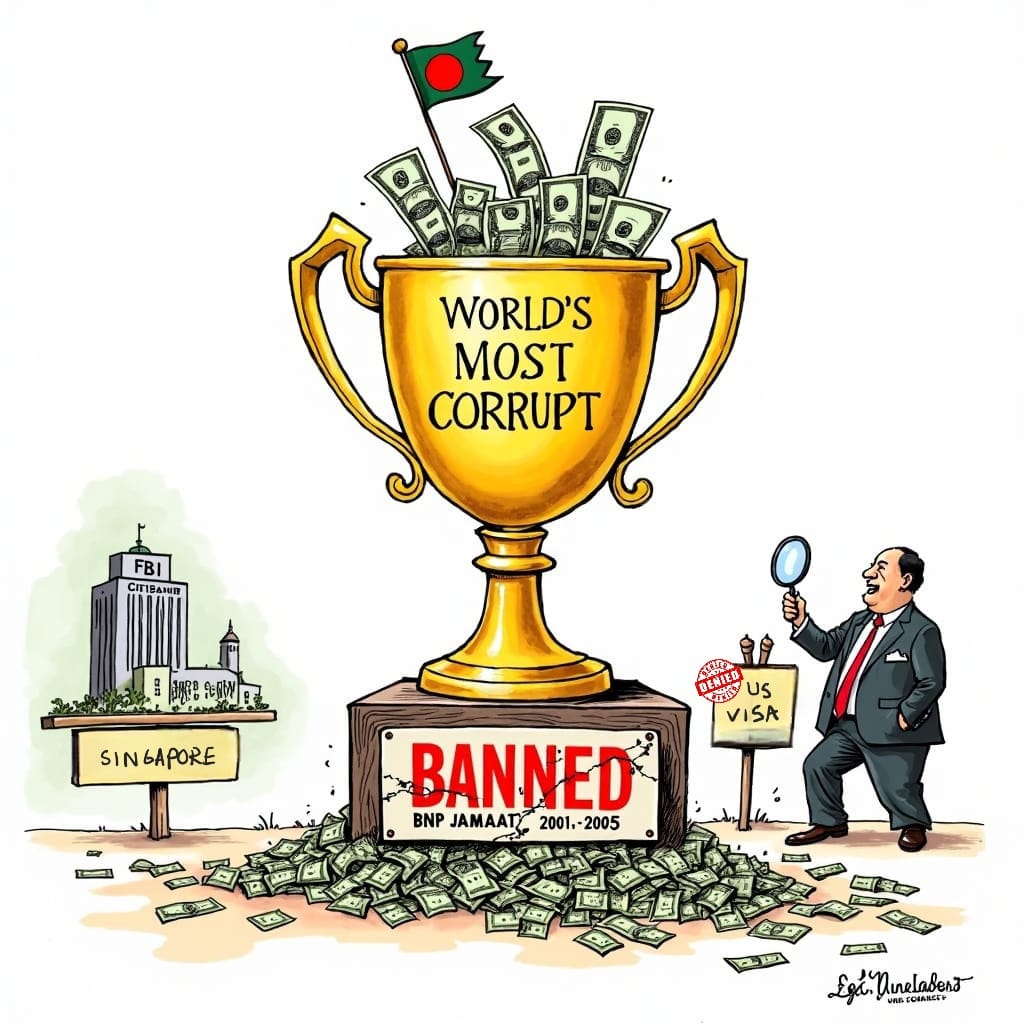
  • World Champion of Corruption: How BNP Made Bangladesh the Most Corrupt Country on Earth — and How the Money Trail Led to Singapore, the FBI, and a US Entry Ban

    World Champion of Corruption: How BNP Made Bangladesh the Most Corrupt Country on Earth — and How the Money Trail Led to Singapore, the FBI, and a US Entry Ban

    World Champion of Corruption: How BNP Made Bangladesh the Most Corrupt Country on Earth — and How the Money Trail Led to Singapore, the FBI, and a US Entry Ban

    For five consecutive years, one country held the unwanted title of “most corrupt nation in the world.” It wasn’t a failed state. It wasn’t a country at war. It was Bangladesh — under the BNP-Jamaat coalition government. And at the center of it all was one family, one shadow office, and a money trail that stretched from Dhaka to Singapore to the doorstep of the FBI.

    Five Years at the Bottom: The Transparency International Record

    Between 2001 and 2005, Transparency International’s Corruption Perceptions Index (CPI) — the most authoritative global measure of public sector corruption — ranked Bangladesh dead last. Not once. Not twice. Five consecutive years.

    To understand the scale of this achievement: of the 91 to 159 countries surveyed each year, Bangladesh scored at the very bottom. Lower than war zones. Lower than failed states. Lower than countries with no functioning judiciary.

    “Bangladesh is a developing nation in which systemic corruption has permeated all aspects of public life. Through 2006, the nation topped Transparency International’s ranking of the world’s most corrupt governments four years in a row.”

    US Embassy Cable 08DHAKA1143, classified confidential, sent by Ambassador James F. Moriarty to Washington, November 3, 2008 (released by WikiLeaks)

    The CPI scores tell the story:

    • 2001: Bangladesh ranked last (91st out of 91 countries surveyed) — CPI score: 0.4
    • 2002: Bangladesh ranked last (102nd out of 102) — CPI score: 1.2
    • 2003: Bangladesh ranked last (133rd out of 133) — CPI score: 1.3
    • 2004: Bangladesh ranked last (145th out of 145) — CPI score: 1.5
    • 2005: Bangladesh ranked last (158th out of 158) — CPI score: 1.7

    Every single year of BNP-Jamaat governance — from their election in October 2001 to the end of their term — the world’s foremost corruption watchdog placed Bangladesh at the absolute bottom.

    As The Daily Star later noted: “From being a world champion in corruption for five years in a row between 2001 and 2005, Bangladesh gradually improved its ranking until 2013.” That improvement only came after the BNP-Jamaat government fell.

    “In fact, corruption has lowered Bangladesh’s growth rate by two percent per year, according to experts.”

    US Embassy Cable 08DHAKA1143

    Two percent per year. In a country where millions lived below the poverty line, systemic corruption was stealing growth that could have lifted entire communities out of destitution.

    The Architect: Tarique Rahman and the Hawa Bhaban Shadow State

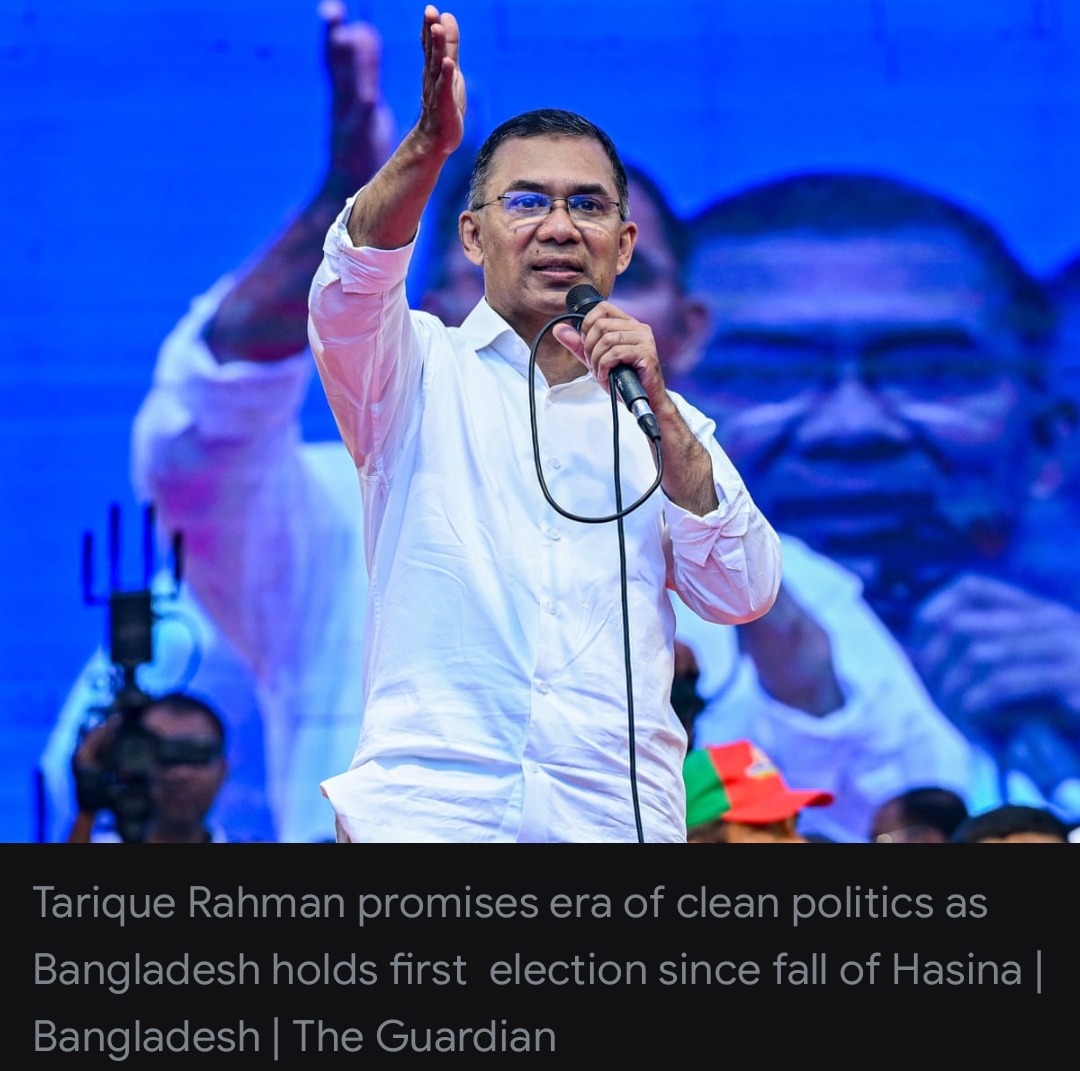
    At the epicenter of this corruption was Tarique Rahman — the eldest son of Prime Minister Khaleda Zia, Senior Joint Secretary General of BNP, and the man who operated the infamous Hawa Bhaban.

    Hawa Bhaban — literally “Air Building,” the BNP chairperson’s political office — became the parallel power center of the Bangladesh government. Government contracts, political appointments, business permits — nothing moved without Hawa Bhaban’s approval. And Hawa Bhaban’s approval came with a price tag.

    The US Embassy cable described Tarique in blunt terms that American diplomats rarely use:

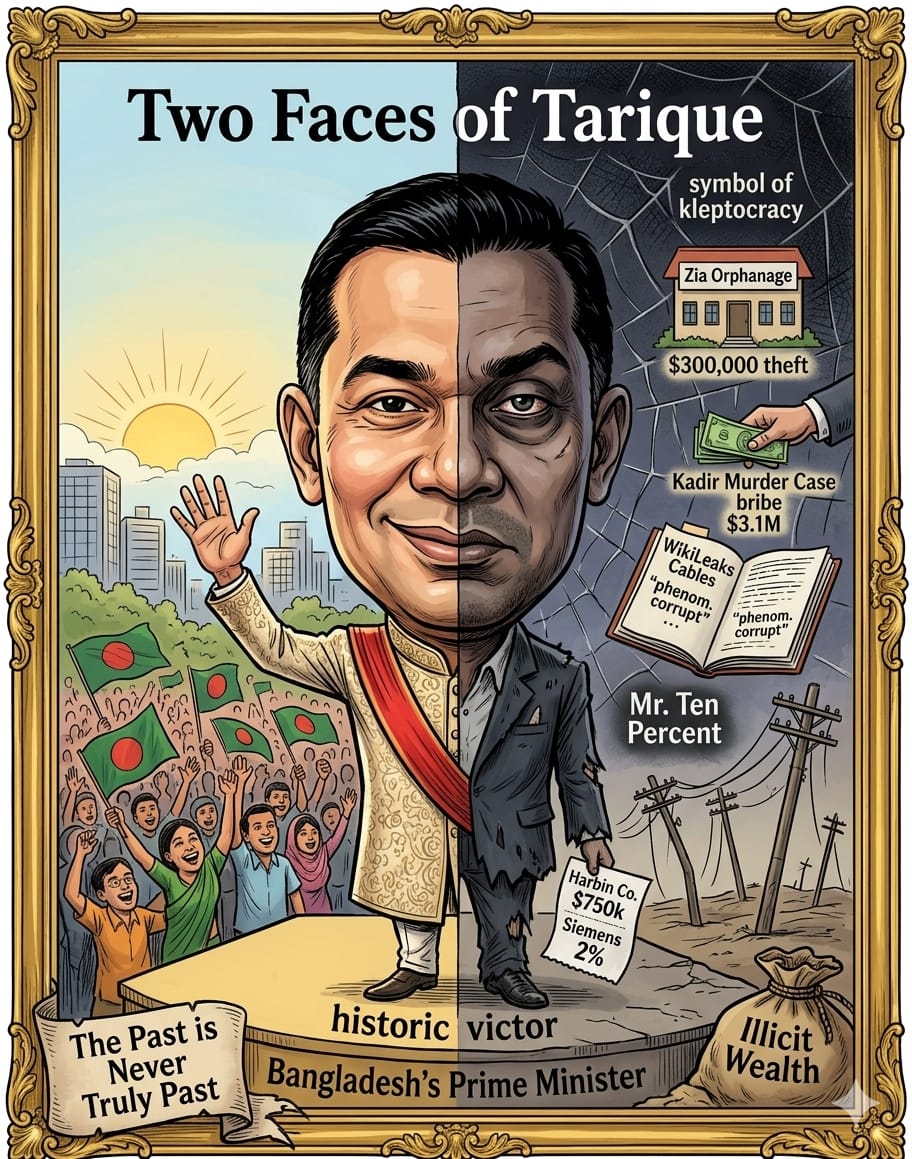
    “Tarique Rahman, the notorious and widely feared son of former Prime Minister Khaleda Zia… Notorious for flagrantly and frequently demanding bribes in connection with government procurement actions and appointments to political office, Tarique is a symbol of kleptocratic government and violent politics in Bangladesh.”

    Ambassador James F. Moriarty, Cable 08DHAKA1143

    “Symbol of kleptocratic government.” These are the words of the United States Ambassador — in an official, classified cable to Washington. Not a political rival. Not a newspaper editorial. The American government’s own assessment.

    The Money Trail: From Dhaka to Singapore’s Citibank

    Corruption on this scale doesn’t stay local. The money had to go somewhere — and it went to Singapore.

    The Tk 20.41 Crore Money Laundering Case

    The most documented case involves Giasuddin Al Mamun, Tarique’s close friend and business partner, and a scheme to launder bribes through Singapore’s banking system.

    Here’s what happened:

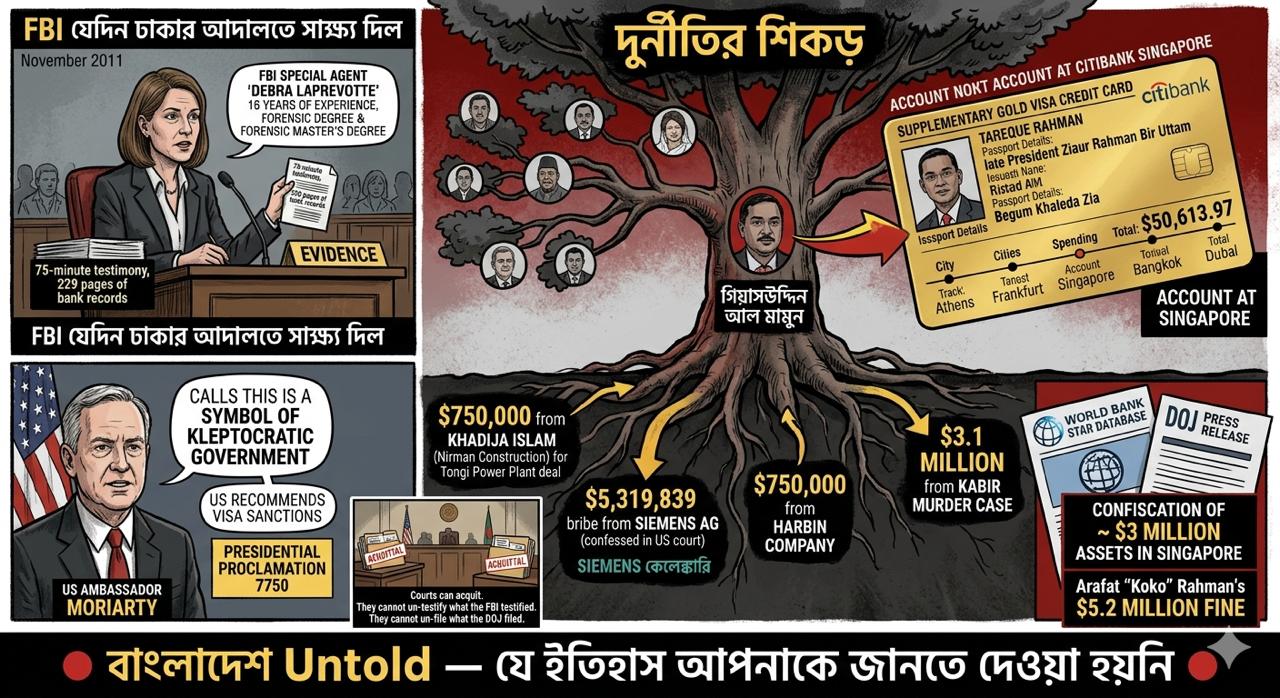
    • Khadiza Islam, chairman of Nirman Construction Company Ltd., paid Tk 20.41 crore ($2.5 million) to Mamun — in exchange for securing a contract for an 80MW power plant in Tongi
    • The money was transferred to a Citibank NA account in Singapore under Mamun’s name
    • A supplementary Gold Visa credit card (No. 4568-8170-1006-4122) was issued in Tarique Rahman’s name on that same Singapore Citibank account
    • A photocopy of Tarique’s passport (No. Y 0085483) was submitted to Citibank Singapore to obtain the card
    • Tarique used the credit card for travel expenses in Greece, Germany, Singapore, Thailand, and the UAE

    This wasn’t abstract corruption. This was the Prime Minister’s son carrying a credit card linked to a bribe-funded account in a foreign country, swiping it across luxury destinations worldwide.

    The FBI Enters the Picture

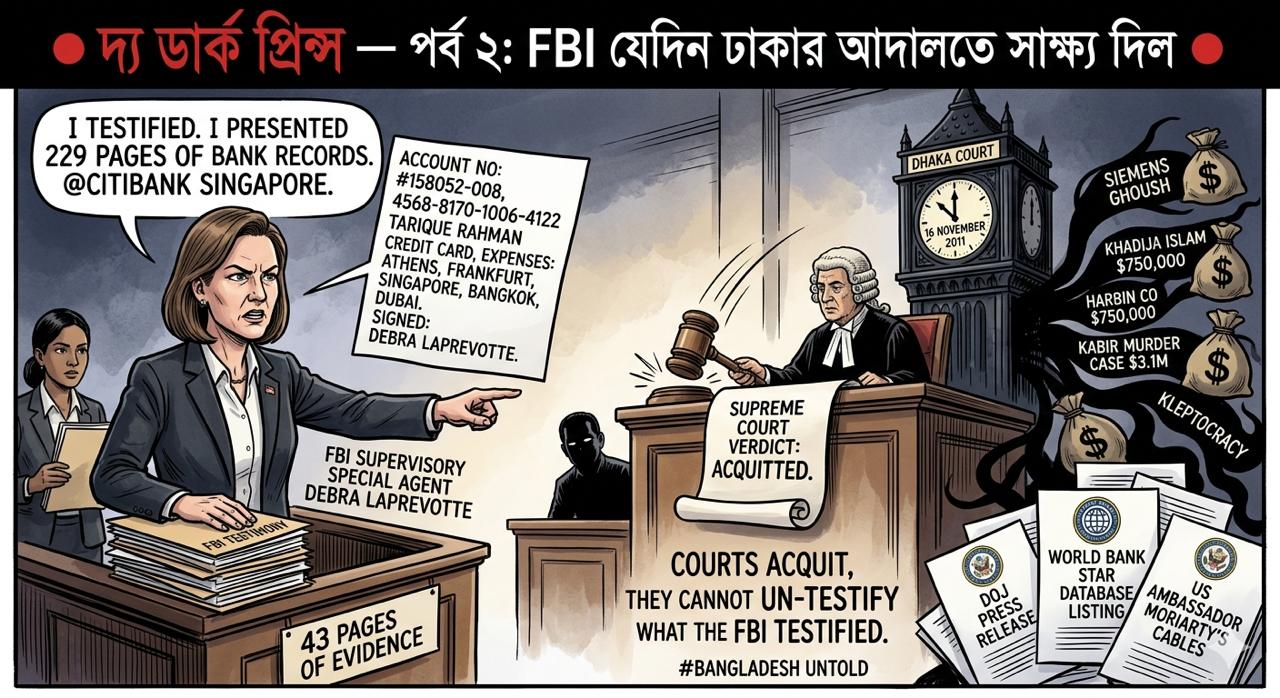
    For the first time in Bangladesh’s history, a special agent of the Federal Bureau of Investigation (FBI) testified in a Dhaka courtroom.

    FBI Agent Debra LaPrevotte, who conducted the investigation into Bangladeshi corruption, testified before a Bangladesh court that the FBI had traced bribe payments from Khadiza Islam’s OCBC Bank account in Singapore to Mamun’s Singapore Citibank account — the same account linked to Tarique Rahman’s credit card.

    The FBI’s testimony — a foreign intelligence agency producing evidence in a sovereign court — was unprecedented. It demonstrated just how far the corruption had spread internationally.

    The Court Verdicts

    • 2009: Anti-Corruption Commission (ACC) filed the money laundering case
    • 2013: Dhaka Special Judge’s Court-3 acquitted Tarique but sentenced Mamun to 7 years. The judge then fled to Malaysia days after the verdict — the Law Minister later stated Tarique was acquitted through judicial manipulation
    • 2016: Bangladesh High Court overturned the acquittal, found Tarique guilty, and sentenced him to 7 years’ imprisonment with a Tk 20 crore fine
    • 2007: The Singapore government returned the laundered Tk 20 crore to Bangladesh Bank

    The High Court’s observation was scathing:

    “It is to be noted with regret that Md Tarique Rahman belonging to a political class which was saddled with responsibility of directing the affairs of the country had acted as a conscious part of the financial crime.”

    Bangladesh High Court, Money Laundering Case Verdict, July 21, 2016

    “This manner of financial crimes, the upshot of achieving wealth in corrupt ways committed under political shield, is on increase. Time has come to get this type of criminal activities carried out by using political favour and patronisation halted for the cause of well-being of the country and its development process.”

    Bangladesh High Court

    Beyond Singapore: The Siemens Scandal and the US DOJ

    The Singapore money laundering was only one thread. The international corruption web stretched much further.

    The Siemens Bribes

    According to the US Embassy cable — citing ACC evidence — Siemens AG, the German industrial giant, paid bribes to the Zia family through intermediaries:

    “According to a witness who funneled bribes from Siemens to Tarique and his brother Koko, Tarique received a bribe of approximately two percent on all Siemens deals in Bangladesh (paid in US dollars). This case is currently being pursued by DOJ Asset Forfeiture and by the FBI.”

    Cable 08DHAKA1143

    Two percent on all Siemens deals in Bangladesh. A systematic commission on every contract, paid in US dollars.

    In December 2008, Siemens AG and three subsidiaries pleaded guilty to violations of the US Foreign Corrupt Practices Act (FCPA). Siemens Bangladesh admitted that from May 2001 to August 2006 — the exact period of BNP governance — it paid at least $5,319,839 in corrupt payments to Bangladeshi officials through intermediaries.

    The US Department of Justice Forfeiture Action

    On January 9, 2009, the US Department of Justice filed a civil forfeiture action against approximately $3 million in funds held in Singapore — linked primarily to bribes paid to Arafat “Koko” Rahman, Tarique’s younger brother, in connection with the Siemens and China Harbor Engineering Company projects.

    “This action shows the lengths to which U.S. law enforcement will go to recover the proceeds of foreign corruption, including acts of bribery and money laundering. Not only will the Department prosecute companies and executives who violate the Foreign Corrupt Practices Act, we will also use our forfeiture laws to recapture the illicit facilitating payments often used in such schemes.”

    Acting Assistant Attorney General Matthew Friedrich, US Department of Justice, January 9, 2009

    The DOJ stated that bribe payments from both Siemens and China Harbor were made in US dollars, flowing through US financial institutions before being deposited in Singapore accounts — giving the United States jurisdiction over the money trail.

    The Harbin Company Bribe

    The US Embassy cable documented yet another bribery case:

    “ACC sources report that the Harbin Company, a Chinese construction company, paid $750,000 to Tarique to open a plant. According to the ACC, one of Tarique’s cronies received the bribe and transported it to Singapore for deposit with Citibank.”

    Cable 08DHAKA1143

    The Kabir Murder Cover-Up Bribe

    Perhaps the most disturbing allegation: Tarique allegedly accepted a $3.1 million bribe to obstruct a murder prosecution.

    “The ACC has evidence that Tarique accepted a 210 million taka ($3.1 million USD) bribe to thwart the prosecution of a murder case against Sanvir Sobhan. Sanvir is the son of the chairman of the Bashundhara Group, one of the nation’s most prominent industrial conglomerates. Sanvir was accused in the killing of Humayun Kabir, a Bashundhara Group director. An investigation by the ACC confirmed Tarique had solicited the payment, promising to clear Sanvir of all charges.”

    Cable 08DHAKA1143

    Selling justice. Selling murder acquittals. This is the system that operated from Hawa Bhaban.

    Banned from America: The US Visa Prohibition

    Given everything documented above, the United States took a rare and decisive step: it moved to ban Tarique Rahman from entering the country.

    On November 3, 2008, Ambassador James F. Moriarty sent a classified cable to Washington formally requesting a security advisory opinion under Section 212(f) of the Immigration and Nationality Act and Presidential Proclamation 7750 — which authorizes the suspension of entry into the United States of foreign officials involved in corruption.

    “The Embassy believes Tarique is guilty of egregious political corruption that has had a serious adverse effect on U.S. national interests mentioned in Section 4 of the proclamation, namely the stability of democratic institutions and U.S. foreign assistance goals.”

    Ambassador James F. Moriarty, Cable 08DHAKA1143

    The cable went further — it laid out exactly why Tarique was a threat to American interests:

    “Tarique’s flagrant corruption has also seriously threatened specific US Mission goals. Embassy Dhaka has three key priorities for Bangladesh: democratization, development, and denial of space to terrorists. Tarique’s audaciously corrupt activities jeopardize all three.”

    And then, the most devastating line — the US Ambassador’s personal assessment:

    In short, much of what is wrong in Bangladesh can be blamed on Tarique and his cronies.

    Ambassador James F. Moriarty

    Six months after Moriarty’s cable, Chargé d’Affaires Geeta Pasi sent a follow-up cable to Washington confirming that the State Department was considering visa revocation for Tarique under the Presidential Proclamation.

    Tarique held a five-year multiple-entry B1/B2 US visa (issued May 11, 2005). The Embassy noted they believed that passport was being held by the Bangladesh government. But they also noted Tarique had multiple passports — including a new one with a UK visa.

    The message was clear: the United States of America considered Tarique Rahman so corrupt, so dangerous to democratic institutions, that he should be permanently barred from setting foot on American soil.

    “Hundreds of Millions” in Illicit Wealth

    The full scale of the alleged corruption is staggering. The US Embassy cable — based on ACC investigations — states plainly:

    “Tarique reportedly has accumulated hundreds of millions of dollars in illicit wealth.”

    Cable 08DHAKA1143

    Hundreds of millions. From a country where the average annual income was under $500.

    The documented cases include:

    • Siemens: ~2% commission on all Siemens deals in Bangladesh (2001-2006) — Siemens admitted to $5.3M+ in corrupt payments
    • China Harbor Engineering: Majority of ~$3M in forfeited Singapore accounts traced to this project
    • Harbin Company: $750,000 bribe deposited in Singapore Citibank
    • Nirman Construction / Power Plant: $2.5 million laundered through Singapore
    • Monem Construction: $450,000 bribe to secure contracts
    • Kabir Murder Case: $3.1 million bribe to obstruct a murder prosecution
    • Zia Orphanage Trust: $300,000 embezzled from an orphanage fund for land purchases and election campaigns
    • Systematic extortion: Multiple cases from business owners including Al Amin Construction ($150,000 extorted), Reza Construction, Mir Akhter Hossain Ltd., and others — “detailing a systematic pattern of extortion on a multi-million dollar scale”

    And these are just the cases that were documented and prosecuted. The Embassy’s assessment — “hundreds of millions” — suggests the full picture may be far larger.

    The Zia Orphanage Trust: Stealing from Orphans

    If one detail captures the character of this corruption, it is perhaps this: Tarique Rahman stole from an orphanage.

    “With the help of several accomplices, Tarique succeeded in looting 20 million taka ($300,000 USD) from the Zia Orphanage Trust fund. According to an ACC source, Tarique, who is a co-signer on the trust fund account, used funds from the trust for a land purchase in his hometown. He also provided signed checks drawn from the orphanage fund accounts to BNP party members for their 2006 election campaigns.”

    Cable 08DHAKA1143

    Money meant for orphaned children — used to buy personal property and fund political campaigns.

    The Judge Who Fled the Country

    One extraordinary detail reveals the depth of judicial corruption. When the money laundering case was first tried in 2013, Dhaka Special Judge’s Court-3 acquitted Tarique while convicting his co-accused Mamun.

    Days after delivering this verdict, the judge — Motahar Hossain — left Bangladesh for Malaysia with his family and never returned. The government issued a notice ordering him back to work. He never responded.

    Bangladesh’s Law Minister Anisul Huq later stated publicly that Tarique got acquitted by influencing the judge.

    The High Court subsequently overturned the acquittal in 2016, finding Tarique guilty and sentencing him to 7 years.

    What This Means

    This is not a political argument. This is a documented record:

    • Transparency International — ranked Bangladesh #1 most corrupt, five years running
    • The US Embassy — described Tarique as a “symbol of kleptocratic government” in a classified cable
    • The FBI — investigated the money trail, testified in a Dhaka courtroom, traced bribe payments through Singapore
    • The US Department of Justice — filed a $3 million forfeiture action against bribe proceeds in Singapore
    • Siemens AG — pleaded guilty to paying $5.3M+ in bribes to Bangladesh officials during BNP’s tenure
    • The US Ambassador — formally requested Tarique be banned from entering the United States under anti-corruption provisions
    • The Singapore government — returned Tk 20 crore in laundered funds to Bangladesh Bank
    • The Bangladesh High Court — convicted Tarique of money laundering and sentenced him to 7 years

    When the US Ambassador writes in a classified cable that “much of what is wrong in Bangladesh can be blamed on Tarique and his cronies” — that is not partisan politics. That is an intelligence assessment by the world’s most powerful nation.

    And when the same country that lectures the world about democracy and rule of law decides that one individual is too corrupt to be allowed on American soil — that tells you everything you need to know.


    Sources

    Every claim in this article is sourced from international organizations, US government documents, court records, or verified news reports from Bangladesh’s leading publications.

  • Operation Clean Heart: 44 Deaths in Custody, 11,000 Arrests, and an Indemnity Law That Legalized Murder

    Operation Clean Heart: 44 Deaths in Custody, 11,000 Arrests, and an Indemnity Law That Legalized Murder

    Bangladesh Army logo — 40,000 troops deployed in Operation Clean Heart

    “They said it was heart attacks. Forty-four heart attacks in 86 days — all in military custody. The youngest was sixteen.”

    On October 16, 2002, the BNP government of Prime Minister Khaleda Zia launched Operation Clean Heart — a joint military-police anti-crime operation that deployed over 40,000 security personnel across Bangladesh. The stated goal was to restore law and order. What followed was 86 days of mass arrests, systematic torture, and at least 44 deaths in custody — deaths the government blamed on “heart attacks.”

    When it ended on January 9, 2003, the BNP government passed an indemnity law granting blanket legal immunity to every security official involved. No one was ever prosecuted. The indemnity act stood for over a decade before Bangladesh’s High Court finally struck it down as unconstitutional in 2015 — by which point justice for the victims was a distant memory.

    This is the story of Operation Clean Heart: how the BNP government weaponized the military against civilians, killed at least 44 people in custody, and then legalized its own impunity.

    The Official Justification

    By mid-2002, Bangladesh was gripped by rising crime. The BNP government — already one year into its term — faced mounting criticism for its failure to maintain law and order. Armed robberies, kidnappings, and political violence had become daily occurrences.

    Rather than strengthen policing through institutional reform, the Khaleda Zia government chose a military solution. On October 16, 2002, Operation Clean Heart was launched with a massive deployment:

    • 24,023 army personnel
    • 339 navy personnel
    • Police, Ansar (paramilitary), and BDR (border guards)
    • Total: over 40,000 security personnel conducting sweeping operations nationwide

    The operation lasted 86 days, ending on January 9, 2003. Official statistics claimed impressive results:

    • 11,245 suspects arrested
    • 2,028 firearms seized
    • Nearly 30,000 rounds of ammunition recovered

    But behind the statistics lay a far darker reality.

    The Death Toll: “Heart Attacks” in Custody

    The BNP government officially acknowledged only 12 deaths during the entire operation — and claimed every single one died of “heart attacks.”

    Independent investigations told a radically different story:

    Source Reported Deaths
    Government official claim 12 (“all heart attacks”)
    The Daily Star / domestic media 44 died in custody
    Human Rights Watch At least 60 killed
    International Commission on Shari’ah for Finance (ICSF) At least 60 extrajudicially executed

    The World Organisation Against Torture (OMCT) published urgent interventions documenting 44 custody deaths, over 11,000 arrests, and widespread torture. OMCT explicitly warned of the “risk of impunity” — a warning that proved prophetic.

    The Victims: Names, Ages, Stories

    These were not abstract statistics. They were people — farmers, students, laborers, political activists, a film director, a rickshaw puller, a 73-year-old man, and a 16-year-old boy. Below are some of the documented cases:

    Shafiqul Islam — Age 16

    The youngest documented victim. A Jatiyotabadi Chattra Dol activist (the BNP’s own student wing), Shafiqul was killed when security forces fired on protesters in Bogra. Even supporters of the ruling party were not safe from the operation they ordered.

    Nabi Hossain Khan — Age 50

    A rickshaw puller from Narsinghdi. After being detained by the army, his body was found in a pond. The army claimed he had escaped custody.

    Rashedul Hasan — Age 35

    An assistant film director. Died on November 7, 2003, after being held in military custody. No explanation was provided for how a healthy 35-year-old suffered a fatal “heart attack” while detained.

    Haji Abul Kashem — Age 73

    The oldest documented victim. Died in Tangail General Hospital after being taken into custody by security forces. A 73-year-old man, detained in a supposed anti-crime sweep, dead in a hospital bed.

    Political Targeting

    The operation wasn’t just about crime. It was about politics. Among those detained:

    • Saber Hossain Chowdhury — Awami League leader, detained during the operation
    • Sheikh Fazlul Karim Selim — cousin of Sheikh Hasina, detained
    • The army raided the Awami League office and seized party documents
    • Multiple Awami League activists were among the dead — suggesting the operation was used as a tool of political repression

    This pattern — using state security operations to target political opponents under the cover of “law enforcement” — would become a hallmark of BNP governance.

    Shoot-at-Sight Orders

    DMP Commissioner Ashraful Huda — the same officer who would later be convicted (2 years) for his role in covering up the August 21, 2004 grenade attack — issued shoot-at-sight orders during the operation.

    Human Rights Watch‘s Asia Director Brad Adams publicly criticized the shoot-at-sight directive, calling it a license for extrajudicial killing. HRW documented that security forces used the broad mandate of the operation to settle personal and political scores.

    “The shoot-at-sight orders and complete lack of accountability created conditions for systematic abuse. Security forces operated with the understanding that they would never face consequences.”
    — Human Rights Watch assessment of Operation Clean Heart

    The Indemnity Act: Legalizing Murder

    What happened next was perhaps more shocking than the operation itself.

    On January 9, 2003 — the very day Operation Clean Heart officially ended — the BNP government issued the Joint Drive Indemnity Ordinance. On February 24, 2003, it was approved by parliament.

    The law provided blanket legal immunity to every security official who participated in the operation. Its language was sweeping:

    No member of the armed forces or law enforcement agencies shall be liable to any criminal prosecution or civil claim for any casualty, damage to life and property, violation… during the operation.
    — Joint Drive Indemnity Ordinance, 2003

    In plain language: the government killed at least 44 people, then passed a law making it illegal to prosecute anyone for those deaths.

    The United Nations Office of the High Commissioner for Human Rights (OHCHR) condemned the ordinance. International human rights experts expressed grave concern that the indemnity law would institutionalize impunity and prevent victims’ families from ever seeking justice.

    Prominent Bangladeshi voices also spoke out:

    • Sultana Kamal, one of Bangladesh’s most respected human rights activists, publicly criticized the indemnity ordinance as a violation of fundamental rights
    • Justice Shamsuddin Chowdhury Manik criticized both the military operation and the subsequent indemnity law

    The Indemnity Act Struck Down — 12 Years Later

    The indemnity ordinance stood as law for over a decade. During that time, not a single security official was ever prosecuted for the custody deaths.

    On June 14, 2012, lawyer Z.I. Khan Panna filed a petition challenging the constitutionality of the ordinance. On July 29, 2012, the High Court asked the government to explain why it should not declare the ordinance illegal and order Tk 1 billion in compensation to victims’ families.

    Finally, in November 2015, the High Court — in a landmark verdict by Justice Moyeenul Islam Chowdhury and Justice Ashraful Kamal — declared the Joint Drive Indemnity Ordinance unconstitutional and illegal, scrapping it entirely.

    But by 2015, the damage was permanent. Thirteen years had passed. Evidence had degraded. Witnesses had scattered. The families of the 44+ victims had lived for over a decade knowing that their government had legalized the killings of their loved ones. The High Court ruling was a moral victory — but no practical justice followed.

    The Pattern: Clean Heart → RAB

    Operation Clean Heart was not an isolated incident. It was a prototype.

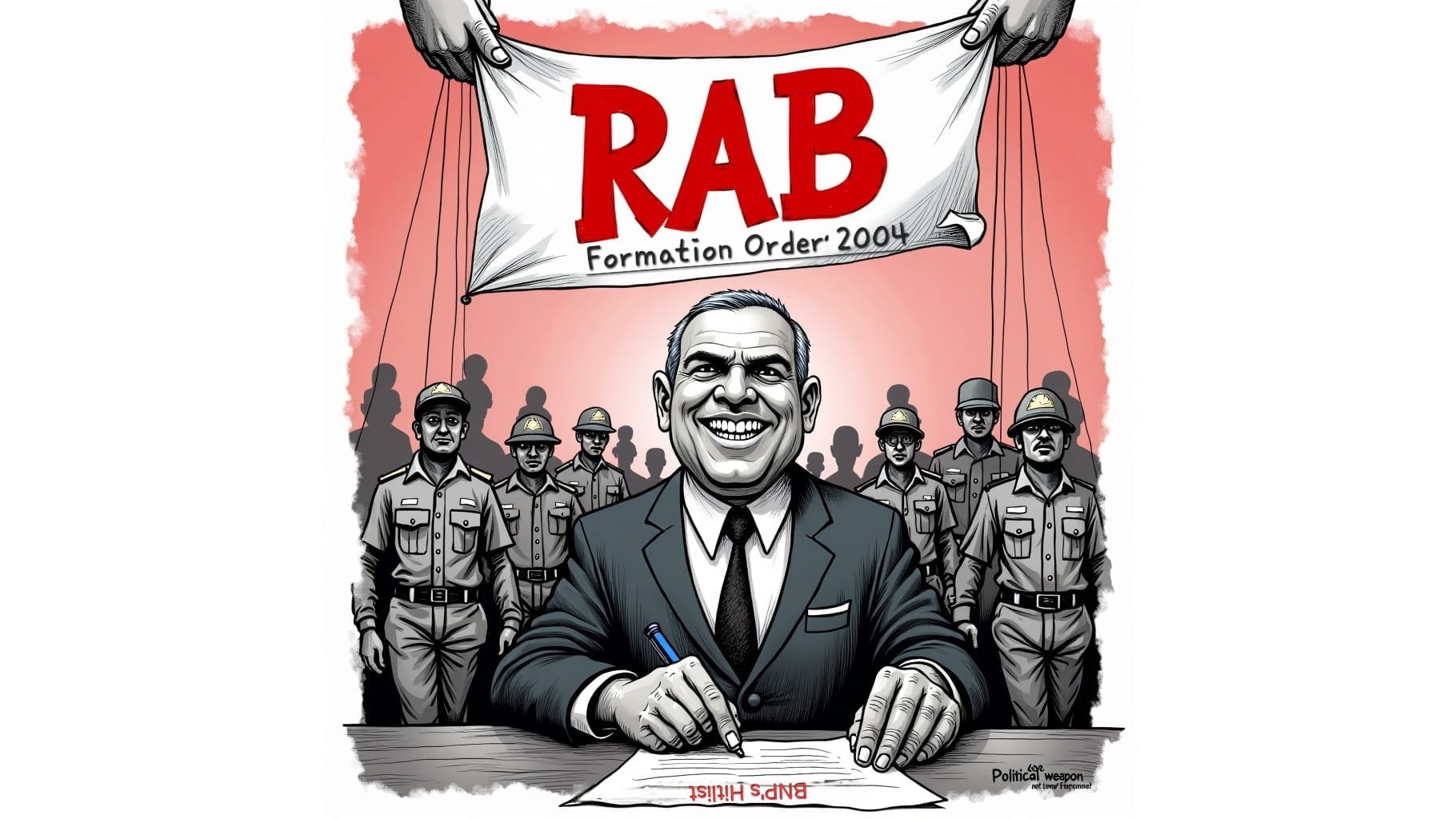
    When the operation ended in January 2003, the BNP government did not return to normal policing. Instead, it created something worse. In 2004, the government established the Rapid Action Battalion (RAB) — a permanent elite security force that institutionalized the same methods Operation Clean Heart had piloted: detention, torture, and extrajudicial execution.

    Under BNP rule (2004-2006), RAB killed at least 367 people in so-called “crossfire” encounters (Human Rights Watch). By March 2010, that number had reached 622 — per RAB’s own Director General’s admission. The youngest victim was 14 years old.

    In 2021, the US Treasury Department imposed Global Magnitsky sanctions on RAB and seven current and former officials for “serious human rights violations” — extrajudicial killings, enforced disappearances, and torture. The force that BNP created, America blacklisted.

    The thread from Operation Clean Heart to RAB to US sanctions is unbroken: a government that discovered it could kill with impunity in 2002 built a permanent institution to do so from 2004 onward.

    Context: What Was Really Happening in 2002

    Operation Clean Heart did not exist in a vacuum. It launched during a period when the BNP-Jamaat coalition was engaged in systematic state violence on multiple fronts:

    • 2001 Post-Election Violence: The BNP-Jamaat coalition’s victory was followed by targeted attacks on Hindu minorities — over 18,000 rapes, thousands of homes burned, temples destroyed. A judicial commission later identified 25 BNP-Jamaat ministers and MPs as complicit.
    • The Shamsunnahar Hall Raid (July 2002): Just months before Operation Clean Heart, Bangladesh Police — under State Home Minister Lutfozzaman Babar’s authority — raided a women’s dormitory at Dhaka University, assaulting over 200 female students.
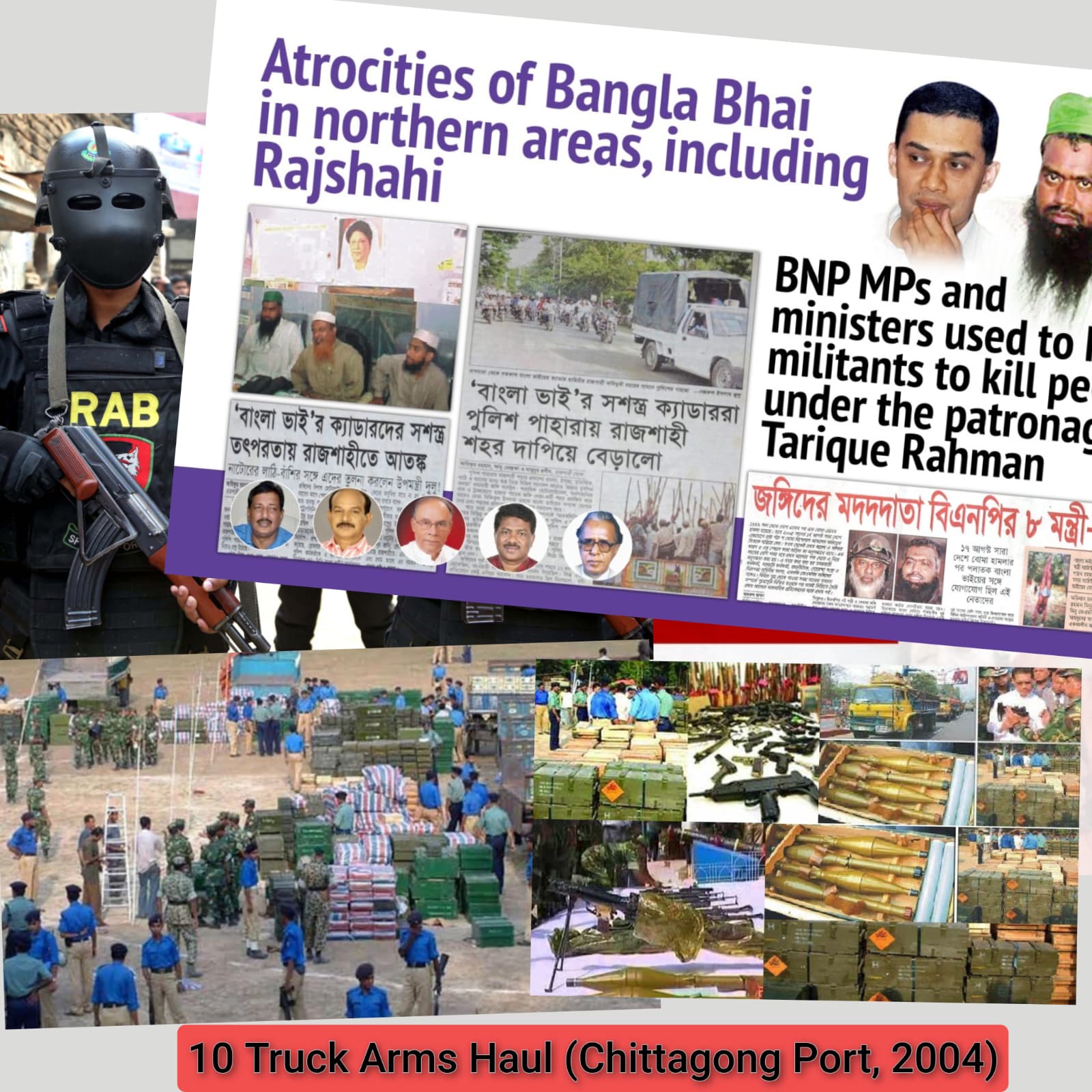
    • Rising Militancy: The BNP-Jamaat government was simultaneously providing tacit protection to Islamist militant groups including Harkat-ul-Jihad-al-Islami (HuJI) and Jamaat-ul-Mujahideen Bangladesh (JMB), which would later carry out the Chittagong arms haul and the August 21 grenade attack.

    The BNP’s record during this period reveals a government that used the military against its own citizens while simultaneously protecting terrorist organizations operating within its borders.

    What the International Community Said

    “The government’s Joint Drive Indemnity Ordinance, 2003, which shields from prosecution all military personnel who participated in Operation Clean Heart, sets a dangerous precedent and violates Bangladesh’s obligations under international human rights law.”
    — UN OHCHR statement, 2003

    “At least 44 people died in custody during Operation Clean Heart, with the government describing all deaths as resulting from ‘heart attacks’ — a claim that lacks any credibility.”
    — World Organisation Against Torture (OMCT), Urgent Intervention

    “Between January and October 2005 alone, an estimated 300 persons were killed at the hands of security forces.”
    — Human Rights Watch World Report 2006, documenting the escalation from Operation Clean Heart to RAB

    The Legacy

    Operation Clean Heart lasted 86 days. Its consequences lasted decades.

    It established a template that the BNP government would follow repeatedly: use overwhelming state force against civilians, deny accountability, and legislate impunity. The same pattern appears in the creation of RAB, in the cover-up of the August 21 grenade attack, and in the state facilitation of the Chittagong arms haul.

    For the families of the 44+ victims, there has been no justice. The indemnity act may have been struck down in 2015, but no prosecutions have followed. The perpetrators — from the security officers who carried out the killings to the political leaders who ordered the operation — have never faced accountability.

    The 44 who died in custody during Operation Clean Heart are among the forgotten victims of BNP rule. Their names appear in human rights reports and court filings, but never in the narratives that BNP and its allies promote about Bangladesh’s history.

    This article is for them.


    Sources

    Bangladesh Untold documents the BNP-Jamaat era (2001-2006) using international sources, court records, and verified reporting. Every claim is sourced. Read the full archive →

  • The Reform Betrayal: How BNP Won on the Promise of Change — Then Gutted Every Reform That Threatened Its Power

    The Reform Betrayal: How BNP Won on the Promise of Change — Then Gutted Every Reform That Threatened Its Power

    On February 12, 2026, Bangladesh voted. They voted for a new parliament. They voted “Yes” in a historic referendum on 84 reforms. And they voted for the Bangladesh Nationalist Party, which won a landslide 209 of 297 seats. Six weeks later, the BNP has refused the reform oath, blocked the Constitution Reform Council, and is systematically gutting every provision that would limit its power. The people voted for change. BNP is delivering the same old playbook.

    Bangladesh National Parliament Building (Jatiyo Sangsad Bhaban)
    The Jatiyo Sangsad Bhaban — where BNP MPs took one oath but refused the other, effectively blocking the constitutional reforms voters demanded. (Wikimedia Commons)

    What the People Voted For

    The February 12 referendum was the most significant democratic exercise in Bangladesh since independence. Held alongside the parliamentary election, it asked voters a simple question: do you approve the July National Charter — a package of 84 reforms, including 48 constitutional amendments, designed to prevent the concentration of power that had plagued Bangladesh for decades?

    The voters said “Yes.”

    The reforms they endorsed included:

    • Term limits for the Prime Minister — no person can serve more than two terms
    • Reduced PM powers — curbing the sweeping authority that allowed previous PMs to act as virtual dictators
    • Increased presidential powers — creating a genuine check on executive overreach
    • A bicameral parliament — with an upper house (Senate) elected through proportional representation
    • Upper house approval required for constitutional amendments — preventing any single party from rewriting the constitution at will
    • Independent appointment processes for the ombudsman, Public Service Commission, and Anti-Corruption Commission
    • Judicial independence reforms
    • Increased women’s representation

    These reforms were the product of months of negotiation — drafted by reform commissions, endorsed by 24 political parties, and ratified by the people in a national referendum. They were the mandate.

    The referendum refers political reforms that include prime ministerial term limits, stronger checks on executive power and other safeguards preventing parliamentary power consolidation.

    — PBS News, February 17, 2026

    The Reform Betrayal — politician shredding the Constitution while keeping only the parts that benefit BNP. One vote, two chambers — BNP's buy-one-get-one democracy. Limit the PM's power? Not when the PM is ours.
    “One vote, two chambers — BNP’s buy-one-get-one democracy.” / “Limit the PM’s power? Not when the PM is ours.”

    What BNP Is Actually Doing

    Within days of taking power, the BNP began systematically dismantling the reform framework it had publicly endorsed. The pattern is unmistakable: accept reforms that don’t threaten BNP’s power, reject every reform that does.

    The Refused Oath

    On February 17, 2026 — the swearing-in day — newly elected MPs were supposed to take two oaths:

    1. The parliamentary oath (as MPs)
    2. The reform council oath (as members of the Constitution Reform Council tasked with implementing the referendum reforms)

    Jamaat-e-Islami and the National Citizen Party (NCP) took both oaths. Every single BNP MP refused the second oath.

    Their excuse? BNP standing committee member Salahuddin Ahmed claimed the Constitution “contains no provision regarding the oath of members of such a council.” In other words: we’ll use constitutional technicalities to avoid implementing the constitution the people just voted to change.

    BNP MPs took the oath as MPs in line with the party decision, but they did not take the oath as members of the reform council. This shows the BNP has taken a “U-turn” after forming the government and moved to a completely opposite position, which is a betrayal of the nation and an insult to those who voted “Yes” in the referendum.

    — Hamidur Rahman Azad, Jamaat-e-Islami, reported by Prothom Alo (March 15, 2026)

    The Blocked Reform Council

    The July National Charter implementation order required the Constitution Reform Council to convene within 30 calendar days of the election results. That deadline was March 15, 2026.

    It was never convened.

    Because BNP MPs — who hold more than a two-thirds majority — refused to take the reform oath, the council couldn’t be fully constituted. No council = no reform implementation. The 180-day reform timeline? Dead before it started.

    BNP’s alternative proposal: “discussions on the Constitution Reform Council could take place on the floor of the house.” Translation: we’ll handle reforms through regular parliament, where our two-thirds majority means we control everything.

    The Cherry-Picked Constitution

    The most revealing part of BNP’s strategy is which reforms they oppose. It’s not random. It’s surgical:

    Reform Proposal BNP Position Why They Oppose It
    Reducing PM’s sweeping powers ❌ Opposed Tarique Rahman IS the PM — why limit his own power?
    Increasing presidential powers ❌ Opposed A strong president could check BNP’s PM
    Upper house via proportional representation ❌ Opposed PR gives seats to smaller parties; BNP wants upper house seats proportional to PARLIAMENTARY seats (guaranteeing BNP dominance in both chambers)
    Upper house approval for constitutional amendments ❌ Opposed Would prevent BNP from unilaterally amending the constitution
    Independent appointment of ombudsman, PSC, ACC ❌ Opposed BNP wants to control who watches them
    Term limits for PM ✅ Accepted (on paper) Doesn’t threaten current grip — Tarique’s first term
    Bicameral parliament (concept) ✅ Accepted BNP wants bicameralism — but with an upper house it controls

    See the pattern? Every reform that creates genuine checks on BNP’s power is rejected. Every reform that sounds democratic but doesn’t actually threaten their dominance is accepted.

    BNP’s Upper House Trick

    This deserves special attention. The referendum-approved charter says the upper house (Senate) should be elected through proportional representation of votes — meaning parties get Senate seats based on the percentage of total votes they received nationwide.

    BNP’s counter-proposal: Senate seats should be based on the proportion of parliamentary seats won.

    Why does this matter? Because Bangladesh uses first-past-the-post voting, where a party can win 70% of seats with 45% of votes. Under proportional representation, smaller parties would finally have meaningful representation in the upper house. Under BNP’s proposal, BNP would dominate BOTH chambers with the same lopsided majority.

    The BNP was unsupportive of changing the first-past-the-post system that favors larger parties like itself over proportional representation, which is better suited to multiparty democracy.

    — Fair Observer, “Mandate for Reform, Battle for Identity” (March 2026)

    The Journal of Democracy noted that BNP specifically “dissented from this model, proposing instead that upper-house composition be proportionately derived from the partisan seat distribution of the lower house.”

    In plain language: BNP wants a Senate that mirrors Parliament — giving them a supermajority in both houses, with zero new representation for anyone else.

    The BNP Playbook: A Pattern Across Decades

    This is not the first time BNP has used democratic language to consolidate undemocratic power. The pattern runs through every era of BNP governance:

    2001-2006: Democracy as Shield for Dictatorship

    2026: Same Pattern, New Vocabulary

    • Won elections on the promise of reform
    • Immediately refused the reform oath
    • Blocked the Constitution Reform Council
    • Cherry-picked only reforms that preserve BNP dominance
    • Cited “constitutional procedure” to delay reforms indefinitely
    • Used media trials to persecute political opponents while claiming rule of law

    The vocabulary changes. The technique doesn’t.

    What International Observers Are Saying

    The international community has noticed. Multiple independent analyses have flagged BNP’s selective approach to reform:

    A party that enjoys a decisive parliamentary majority can cite constitutional purity today and dilute reforms tomorrow.

    — The Daily Star editorial (February 21, 2026)

    BNP lawmakers, who control a large majority of seats, took only the constitutional oath required for MPs and declined the second.

    — Asia Times, “Bangladesh reform drive hits early constitutional roadblock” (March 2026)

    Asking MPs to take a second oath tied to an extra-constitutional institution raises questions about legality — this is the BNP’s argument. But the people voted for precisely this institution in a national referendum.

    — Analysis based on ConstitutionNet, Asia Times, and Al Jazeera reporting

    The International Republican Institute (IRI), the Journal of Democracy, Al Jazeera, Fair Observer, and ConstitutionNet have all published analyses highlighting the tension between BNP’s reform promises and its post-election actions.

    The 11-Party Alliance Pushback

    BNP’s coalition partners are not staying silent. The 11-party electoral alliance led by Jamaat-e-Islami has:

    • Demanded the Constitution Reform Council be convened immediately
    • Staged protests in parliament — walking out of the chamber on the opening day over the issue
    • Threatened street protests if reforms are not implemented
    • Called BNP’s refusal a “betrayal of the nation” and an “insult to referendum voters”

    Even the National Citizen Party (NCP) — formed by the very students who led the 2024 uprising against Hasina — has clashed with BNP over the reform stall.

    Why This Matters: The Referendum Was the People’s Voice

    The referendum was not a suggestion. It was a democratic mandate. The people of Bangladesh voted to constrain executive power, create genuine checks and balances, and ensure that no single party could monopolize governance.

    By refusing the reform oath, blocking the Constitution Reform Council, and cherry-picking only the reforms that preserve its dominance, BNP is sending a clear message: we accept democracy when it gives us power, and reject it when it limits our power.

    This is the same party that:

    The methods evolve. The goal never changes: absolute power, wrapped in democratic language.


    Sources:

    • Al Jazeera — “Bangladesh referendum: The big post-election flashpoint?” (Feb 19, 2026); “What does BNP’s landslide mean for Bangladesh’s post-uprising order?” (Feb 13, 2026); “Tarique Rahman sworn in as new Bangladesh prime minister” (Feb 17, 2026)
    • Prothom Alo — “Fresh tensions over Constitution Reform Council” (Mar 15, 2026)
    • The Daily Star — “The referendum mandate is real, but reform must return to the constitution” (Feb 21, 2026)
    • Asia Times — “Bangladesh reform drive hits early constitutional roadblock” (Mar 2026)
    • ConstitutionNet (IDEA) — “Bangladesh’s Referendum and Reforms: The Need to Return to a Constitutional Process” (Mar 4, 2026); “July Charter and Constitutional Reforms in Bangladesh” (Dec 1, 2025)
    • Journal of Democracy — “Will Bangladesh’s Massive Democratic Experiment Work?” (Feb 11, 2026)
    • Fair Observer — “Mandate for Reform, Battle for Identity: Bangladesh After the Election” (Mar 2026)
    • The Diplomat — “Plebiscite or Refounding?” (Feb 6, 2026); “Why Bangladesh’s Referendum is a Gamble” (Feb 9, 2026)
    • International Republican Institute — Pre-Election Assessment Mission findings (Nov 17, 2025)
    • PBS News — “New Bangladesh prime minister sworn in after party’s landslide win” (Feb 17, 2026)
    • bdnews24.com — “Two oaths for new lawmakers trigger constitutional debate” (Feb 17, 2026)
    • The Wire — “A Charter Without a Clear Path” (Mar 2026)
    • LSE South Asia Blog — “Bangladesh Elections: Democratic Transition or Ideological Shift?” (Feb 16, 2026)

    Read the full 1/11 Chronicle: Part 1 · Part 2 · Part 3 · Part 4 (Finale)

  • Trial by Headline: How Bangladesh’s Political Machine Convicts Before the Courtroom

    Trial by Headline: How Bangladesh’s Political Machine Convicts Before the Courtroom

    In Bangladesh, you don’t need a courtroom to destroy someone. You need a headline. For months — sometimes years — before an arrest, a coordinated media campaign plants a narrative so deeply into public consciousness that by the time handcuffs appear, the verdict is already in. This is the anatomy of a media trial — Bangladesh’s most sophisticated weapon of political persecution.

    Bangladesh National Press Club, Dhaka
    The National Press Club in Dhaka — where political narratives are born and amplified before they ever reach a courtroom. (Wikimedia Commons)
    Media Headline Machine — newspapers screaming 24,000 Crore Syndicate, Human Trafficking Mastermind, Crimes Against Humanity while a man is stamped CONVICTED before reaching the courtroom
    “In Bangladesh, you don’t need a courtroom to destroy someone. You need a headline.” — The Media Headline Machine churns out conviction before any court hears a single argument.

    The Evolution: From Joj Mia to the Modern Media Trial

    Bangladesh’s political establishment has a long history of manufacturing scapegoats. Under the BNP-Jamaat government (2001-2006), the method was crude but effective:

    1. Arrest a nobody
    2. Torture a confession
    3. Present it to the media
    4. Promote the officials who cooperated

    This is exactly what happened with “Joj Mia” — a pickpocket framed for the August 21 grenade massacre. It was crude. It eventually fell apart. And it took a change of government to expose the truth.

    But political operators learn from their mistakes. The new method is more sophisticated — and far more dangerous:

    1. Plant the narrative in media FIRST — months before any arrest
    2. Use emotionally loaded language — “human trafficking,” “manob pachar” (মানব পাচার), terms designed to make the accused indefensible
    3. Inflate the numbers beyond comprehension — figures so astronomical they become the headline themselves
    4. Saturate every outlet — repeat the narrative until it becomes accepted truth
    5. THEN arrest — now the “evidence” is “everyone already knows”

    The difference is devastating. In the old method, the fabrication had to withstand judicial scrutiny. In the new method, the court of public opinion has already convicted — the actual court is almost irrelevant.

    Case Study: The ৳24,000 Crore Headline

    In 2024-2026, Bangladesh saw one of the most systematic media trial campaigns in its recent history — targeting over 100 people connected to the manpower export sector, including former government officials, military officers, and their families.

    The Number: ৳24,000 Crore

    The figure “৳24,000 crore” became the defining headline. It appeared in every major Bangladeshi outlet — The Daily Star, Dhaka Tribune, The Business Standard, bdnews24, New Age — repeated hundreds of times before a single court heard a single argument.

    But look at what the actual investigations found:

    Source Alleged Amount Context
    Original case (Sept 2024) ৳24,000 crore Alleged total across ALL 103 accused over years
    CID investigation (Aug 2025) ৳100.75 crore The actual amount CID could trace in money laundering case
    ACC investigation (Mar 2025) ৳119 crore Amount attributed to one specific company

    Notice the pattern: the headline says ৳24,000 crore. The actual investigation found ৳100 crore. That’s a 240x discrepancy. But which number does the public remember? Which number has already convicted the accused in the minds of 170 million Bangladeshis?

    The ৳24,000 crore figure is the total alleged amount embezzled by a “syndicate” of 103 different people over multiple years across dozens of companies. But in headlines, it gets attached to individual names — creating the impression that one person stole ৳24,000 crore.

    No court has verified the ৳24,000 crore figure. No audit has confirmed it. No forensic accounting has been presented. Yet it has been printed as established fact in virtually every Bangladeshi media outlet.

    The Language: “মানব পাচার” (Human Trafficking)

    The choice of language is not accidental. The legal issue in these cases involves manpower export agencies — companies licensed by the Bangladeshi government to recruit workers for overseas employment, primarily in Malaysia. The allegations concern overcharging workers and financial irregularities.

    But in media coverage, “manpower recruitment fraud” was systematically replaced with “মানব পাচার” — human trafficking. The two are not the same:

    • Manpower recruitment fraud: Overcharging workers, financial irregularities in a licensed business — a serious but prosecutable financial crime
    • Human trafficking (মানব পাচার): The forcible trafficking of human beings — one of the most emotionally revulsive crimes imaginable

    By framing recruitment irregularities as “human trafficking,” the media narrative made it impossible for any accused person to publicly defend themselves. Who defends themselves against “human trafficking”? The mere denial sounds guilty.

    This is a deliberate strategic choice. It turns a white-collar financial case into an emotional human rights atrocity in the public mind — without a single court ruling establishing the facts.

    The Timeline: Narrative First, Arrest Later

    The timeline reveals the media trial methodology with surgical precision:

    Date Event Media Narrative Phase
    August 5, 2024 Government change — targets go into hiding after political violence Vulnerability established
    September 3, 2024 Case filed by Altaf Khan (a competing recruiting agency owner) naming 103 people The “৳24,000 crore” headline is born
    Oct-Nov 2024 Former minister Imran Ahmad arrested, remanded — media frenzy Narrative saturates all outlets
    August 28, 2025 CID files separate money laundering case — now targeting family members (wives, daughters) Net widens, narrative deepens
    March 2025 ACC announces intention to sue Institutional validation of narrative
    Late 2024 – Early 2026 Months of continuous media coverage — “syndicate,” “manob pachar,” “24,000 crore” repeated constantly Public conviction complete
    March 24, 2026 Late-night raid, arrest at home Arrest is now a formality — public already “knows”
    March 25-29, 2026 5-day remand, then fresh 6-day remand. DB says “11 cases filed” Case pile-on begins
    March 29, 2026 ICT moves to show accused as arrested in separate “crimes against humanity” case Political charges layered on top

    By the time the arrest happens — 18 months after the narrative first entered the media — the accused has been convicted in public opinion. The arrest isn’t news; it’s confirmation of what “everyone already knows.”

    The Methodology: How Media Trials Work

    Based on documented patterns in Bangladesh, media trials follow a consistent methodology:

    1. The Emotional Frame

    Choose language that makes the accused indefensible. “Human trafficking” instead of “recruitment fraud.” “Mass murder” instead of “political decision-making.” The emotional frame ensures that any public defense sounds like defending the indefensible.

    2. The Astronomical Number

    Cite a figure so large it shocks. ৳24,000 crore. ৳23,000 crore. The number doesn’t need to be verified — it just needs to be big enough that it becomes the headline itself. Nobody fact-checks the number because the number IS the story.

    3. The Competing Plaintiff

    Cases are often filed not by victims, but by business competitors or political operatives. In the manpower case, the original complaint was filed by Altaf Khan — the owner of Afia Overseas, a competing recruiting agency. This crucial detail is buried in the 15th paragraph of news reports, long after the ৳24,000 crore headline has done its work.

    4. The Family Drag

    Name not just the target, but their spouse and children in the case. This serves two purposes: it increases the sense of a “criminal syndicate” in public perception, and it creates maximum personal pressure on the accused by threatening their family.

    5. The Case Pile-On

    Once the narrative is established, multiply the cases. One case becomes five. Five becomes eleven. Each new case generates a fresh round of headlines, reinforcing the narrative. Even if each individual case is weak, the sheer volume creates an impression of overwhelming guilt.

    According to the DB, a total of 11 cases have so far been filed against the accused.

    — Dhaka Tribune, March 29, 2026

    6. The Political Layer

    Once the accused is in custody on financial charges, add political charges. In this case, the International Crimes Tribunal moved to show the accused as arrested in a separate “crimes against humanity” case — ensuring that the financial narrative and the political narrative merge into one overwhelming impression of guilt.

    The Broader Pattern: Who Gets Media-Trialed?

    Media trials in Bangladesh don’t target random individuals. They target people who are politically inconvenient:

    • Former government officials from the previous administration — prosecuted not for specific evidence but for association
    • Military officers who played roles in political transitions — particularly 1/11
    • Business people connected to the previous power structure — where financial allegations serve as proxies for political persecution
    • Family members — wives and children named in cases to maximize pressure

    The Global Centre for Democratic Governance documented that since August 2024, Bangladesh has seen:

    Pervasive surveillance, preemptive detention, and the deliberate criminalization of peaceful or symbolic acts of dissent.

    — Eurasia Review, “A Nation On Trial” (September 2025)

    Over 388 journalists have been implicated in fabricated criminal cases, with at least 38 imprisoned and repeatedly denied bail. When the media itself is under threat, who will question the narratives they are forced to publish?

    The International Standard: What Constitutes a Fair Trial?

    The International Covenant on Civil and Political Rights (ICCPR), to which Bangladesh is a signatory, establishes clear principles:

    • Article 14(2): “Everyone charged with a criminal offence shall have the right to be presumed innocent until proved guilty according to law”
    • Article 14(1): Right to “a fair and public hearing by a competent, independent and impartial tribunal”

    Media trials systematically violate both principles. When hundreds of articles establish “guilt” before a single hearing, presumption of innocence is destroyed. When judges read the same newspapers as everyone else, impartiality is compromised.

    Bangladesh’s own Constitution, Article 35(3), guarantees: “Every person accused of a criminal offence shall have the right to a speedy and public trial by an independent and impartial Court or tribunal established by law.”

    An independent trial is impossible when the trial has already been conducted in the media.

    The BNP Pattern: Old Wine, New Bottle

    The media trial is the evolution of BNP’s scapegoating playbook:

    Era Method Example
    2001-2006 (BNP-Jamaat) Arrest → Torture confession → Media Joj Mia framed for grenade massacre
    2001-2006 Scapegoat expendable figures Anwarullah blamed for 2001 hall raid violence
    2001-2006 Probe committee whitewash Chittagong Arms Haul cover-up
    2024-2026 Media narrative → Months of saturation → THEN arrest “৳24,000 crore manob pachar” campaign

    The formula has evolved, but the purpose is identical: use manufactured narratives to neutralize political opponents while maintaining a veneer of legal legitimacy.

    What Would Accountability Look Like?

    If the allegations were genuine and the process fair, we would expect to see:

    • Forensic audits verifying the specific amounts — not headlines citing unverified figures
    • Independent investigation — not cases filed by business competitors
    • Proportional charges — financial fraud charged as financial fraud, not repackaged as “human trafficking”
    • Presumption of innocence in media coverage — not 18 months of conviction-before-trial
    • Separation of financial and political charges — not layering unrelated cases to create an impression of overwhelming guilt
    • Family members named only with specific evidence — not dragnet inclusion to maximize pressure

    None of these conditions were met in the cases documented above.

    The Silence Problem

    Perhaps the most insidious aspect of the media trial is that it silences the accused and their supporters. When someone is publicly branded a “human trafficker” who stole “৳24,000 crore,” anyone who defends them risks being associated with those crimes. Family members who speak up are accused of “protecting criminals.” Lawyers who take the case face social pressure. Journalists who question the narrative face their own legal threats.

    This is by design. The media trial doesn’t just convict the accused — it creates a zone of silence around them, ensuring that the only narrative that reaches the public is the prosecution’s narrative.


    Sources:

    • The Daily Star — “CID files case against 33 recruiting agents” (Aug 28, 2025); “Ex-minister Imran placed on 3-day remand” (Oct 21, 2024); “DB seeks five-day remand” (Mar 25, 2026)
    • The Business Standard (TBS) — “CID sues 33 over Tk100cr laundering linked to Malaysian recruitment syndicate” (Aug 28, 2025); “Key 1/11 figure ex-Lt Gen Masud Uddin Chowdhury arrested” (Mar 25, 2026)
    • Dhaka Tribune — “Ex-MP Masud Uddin Chowdhury placed on 6-day fresh remand” (Mar 29, 2026); “ICT moves to show retired officers arrested” (Mar 29, 2026)
    • bdnews24.com — “Ex-general Masud Uddin Chowdhury, a key ‘1/11’ figure, held” (Mar 25, 2026)
    • BSS (Bangladesh Sangbad Sangstha) — “Masud Uddin remanded afresh in Tk 24,000-crore embezzlement case” (Mar 29, 2026)
    • Global Centre for Democratic Governance — “Press Under Siege” (Nov 2025)
    • Eurasia Review — “A Nation On Trial: Bangladesh Arrest Surge Threatens Democracy” (Sep 11, 2025)
    • Human Rights Watch — “No Place for Criticism: Bangladesh Crackdown on Social Media Commentary” (2018)
    • ICCPR — International Covenant on Civil and Political Rights, Articles 14(1), 14(2)
    • Constitution of Bangladesh — Article 35(3)
    • The Business Standard — “Is Media Trial culture in Bangladesh a hindrance to the justice system?” (Feb 2021)
    • SSRN — Hussain M.F. Bari, “Legal Aspects of Media Trial in Bangladesh: Free Press Versus Fair Trial Dilemma” (2019)

    Read how BNP invented a pickpocket to cover a massacre: The “Joj Mia” Fabrication

    Read how BNP’s terrorist militia operated: HuJI: The Terrorist Army BNP Kept in Its Backyard

    Read the full 1/11 Chronicle: Part 1 · Part 2 · Part 3 · Part 4 (Finale)

  • HuJI: The Terrorist Army BNP Kept in Its Backyard — From bin Laden’s Fighters to Tareq Zia’s Assassins

    HuJI: The Terrorist Army BNP Kept in Its Backyard — From bin Laden’s Fighters to Tareq Zia’s Assassins

    They met Osama bin Laden in Afghanistan. They bombed Bengali New Year celebrations. They tried to kill Sheikh Hasina — twice. And through it all, the BNP-Jamaat government gave them shelter, patronage, and political protection. This is the story of Harkat-ul-Jihad-al-Islami Bangladesh (HuJI-B) — the terrorist organization that operated as the BNP’s private militia.

    Ramna Park, Dhaka — site of the 2001 Bangla New Year bombing by HuJI
    Ramna Park, Dhaka — where HuJI bombed Bangla New Year celebrations in 2001, killing 10 and wounding dozens. (Wikimedia Commons)

    Born from Jihad: The Origins of HuJI-B

    The story begins not in Bangladesh, but in the mountains of Afghanistan during the Soviet-Afghan War. In the 1980s, thousands of young men from across the Muslim world — including Bangladesh — traveled to Pakistan and Afghanistan to fight the Soviets as mujahideen. Among them were Bangladeshi madrasa students and religious activists who would later form the deadliest terrorist organization in Bangladeshi history.

    The parent organization, Harkat-ul-Jihad-al-Islami (HuJI), was founded in 1984 in Pakistan by Fazlur Rehman Khalil and Qari Saifullah Akhtar. It had deep connections to Pakistan’s Inter-Services Intelligence (ISI), which used it as a proxy force.

    On April 30, 1992, the Bangladeshi branch — HuJI-B — was formally launched at the Jatiya Press Club in Dhaka by Maulana Abdus Salam and other Afghan war veterans. They held a press conference and publicly demanded the establishment of Islamic rule in Bangladesh.

    HuJI-B was established in 1992, reportedly with assistance from Osama bin Laden’s International Islamic Front.

    — US State Department, Country Reports on Terrorism

    This was not a fringe group operating in the shadows. HuJI-B’s founders openly announced their existence and their goal of establishing an Islamic state in Bangladesh.

    The al-Qaeda Connection: They Met bin Laden

    HuJI-B’s links to al-Qaeda were not hypothetical — they were direct and personal.

    In 1988, a delegation of HuJI-B leaders traveled to Afghanistan via Pakistan. They were hosted by Qari Saifullah Akhtar (HuJI Pakistan chief) and driven by Abdur Rahman Shahi, a Bangladeshi mujahideen, to meet Osama bin Laden himself.

    Among those who made the trip:

    • Muhammad Habibur Rahman (alias “Bulbuli Huzur”) — a senior HuJI leader and leader of Bangladesh Khelafat Majlish
    • Ataur Rahman Khan — who would later be elected to Bangladesh’s Parliament as a BNP member

    Let that sink in: a man who personally met Osama bin Laden later sat in Bangladesh’s Parliament, elected on a BNP ticket.

    Ataur Rahman Khan, a leader of Harkat-ul-Jihad-al-Islami Bangladesh, was elected member of parliament from Bangladesh Nationalist Party… In 1988, on a tour with senior leaders of HuJI-B, he visited Afghanistan and met with Osama bin Laden.

    — The Daily Star, “Target Taliban Rule” (April 7, 2013)

    A Decade of Terror: HuJI’s Trail of Blood

    From 1999 to 2005, HuJI-B carried out a systematic campaign of bombings, assassinations, and attacks that killed over 100 people and terrorized Bangladesh. Here is the documented record:

    1999: The Campaign Begins

    • January 18, 1999: Attempted assassination of Bangladesh’s greatest living poet, Shamsur Rahman — a secular intellectual who represented everything the jihadists despised
    • March 6, 1999: Bombing of the Udichi cultural event in Jessore — 10 killed, 150 wounded. Udichi, Bangladesh’s largest cultural organization, was targeted for celebrating secular Bengali culture
    • October 8, 1999: Bombing of an Ahmadiyya mosque in Khulna — targeting a religious minority

    2000-2001: Escalation

    • July 20, 2000: First assassination attempt on Sheikh Hasina — the Prime Minister of Bangladesh was targeted directly
    • January 20, 2001: Bombing of a Communist Party rally in Dhaka
    • April 14, 2001: Ramna Batamul bombing — HuJI bombed the Bengali New Year celebrations at Ramna Park, killing 10 people and injuring dozens. This was an attack on the very identity of Bengali secular culture
    • June 3, 2001: Bombing of a church service in Gopalganj — targeting Christians
    • June 16, 2001: Bombing of an Awami League office in Narayanganj
    • September 23, 2001: Bombing of an Awami League rally in Bagerhat

    2004: The Year of Grenades

    • May 21, 2004: Shah Jalal Shrine bombing in Sylhet — targeting the British High Commissioner. This attack would eventually lead to Mufti Hannan’s execution
    • June 21, 2004: Attack on a Suranjit Sengupta rally in Sunamganj
    • August 7, 2004: Attack on an Awami League rally in Sylhet
    • August 21, 2004: THE GRENADE ATTACKmilitary-grade Arges grenades killed 24 people and wounded 500+ at an Awami League rally, nearly assassinating Sheikh Hasina. This was HuJI’s most devastating operation — carried out under direct coordination with BNP leadership

    The pattern is unmistakable. HuJI-B targeted: secular culture, religious minorities, political opposition, foreign diplomats, and the Prime Minister herself. This was not random terrorism — it was a systematic campaign to destroy secular democracy in Bangladesh.

    BNP’s Terrorist Allies: The Patronage Network

    The most damning fact about HuJI-B is not what it did — but who protected it while it did it.

    During the BNP-Jamaat coalition government (2001-2006), HuJI-B didn’t just survive — it thrived under direct state patronage:

    HuJI Leaders in Parliament

    Ataur Rahman Khan, a founding member of HuJI-B who had personally met Osama bin Laden, was elected to Parliament on a BNP ticket. A terrorist leader sitting in the national legislature, protected by the ruling party.

    Coalition Partners with Militant Ties

    Islami Oikya Jote (IOJ), a coalition partner in the BNP-Jamaat government, had its chairman — Shaikhul Hadith Allama Azizul Haque — as a well-known leader of HuJI-B. The government’s own coalition partner had a militant chief at its helm.

    State Machinery as Shield

    During the BNP–Jamaat coalition government, extremist groups such as HuJI-B and JMB grew stronger with both open and hidden political support.

    — Global Centre for Democratic Governance, “Echoes of the BNP–Jamaat Era” (2025)

    The BNP government:

    • Denied HuJI-B’s existence — despite overwhelming evidence of its operations
    • Refused to ban the organization until 2005, and only then under extreme international pressure
    • Protected its operatives from prosecution through the intelligence apparatus
    • Used HuJI militants as mercenaries for political assassinations — most notably the August 21 grenade attack

    Mufti Hannan: Arrested but Protected

    The BNP government arrested HuJI chief Mufti Abdul Hannan on October 31, 2005 — two weeks after finally banning the organization under international pressure. But critically, Hannan was NOT linked to the August 21 grenade attack case. The government kept him in custody but ensured his confession would not expose the BNP leadership’s role in the assassination attempt.

    It was only after 1/11 — when the military-backed caretaker government took power in January 2007 — that Hannan was properly interrogated and revealed the full extent of BNP’s involvement.

    The Unveiling — 1/11 Investigation cartoon: BNP hiding behind Joj Mia while Bangladesh Army pulls back the curtain
    “The Unveiling” — How the 1/11 investigation pulled back the curtain on BNP’s Joj Mia fabrication, revealing the real perpetrators behind the August 21 grenade attack.

    The August 21 Connection: BNP Aimed, HuJI Fired

    The August 21, 2004 grenade attack — the deadliest terrorist strike in Bangladesh’s history — was the ultimate expression of the BNP-HuJI nexus.

    According to the charge sheet filed after the 1/11 investigation:

    Hannan and his men were used as mercenaries to carry out the August 21 grenade attack. They agreed to execute the plot to assassinate Hasina and other top AL leaders on assurance that they would be provided safety and allowed to continue their activities unhindered after completion of the task. The attack was the outcome of a collaboration between HuJI men, influential leaders of the BNP and the Jamaat-e-Islami, and some officials of the Home Ministry, Police, DGFI, NSI, and Prime Minister’s Office.

    — CID Charge Sheet, as reported by The Daily Star

    The deal was simple: HuJI would carry out the assassination. In return, the BNP government would guarantee their safety and allow them to continue operating freely.

    The key figures who coordinated the attack:

    • Tarique Rahman — BNP Acting Chairman, Khaleda Zia’s son (sentenced to life imprisonment)
    • Lutfozzaman Babar — State Minister for Home Affairs (sentenced to death)
    • Harris Chowdhury — Political Secretary to PM Khaleda Zia
    • Abdus Salam Pintu — Deputy Education Minister (sentenced to death)
    • Mufti Abdul Hannan — HuJI-B chief, operational commander of the attack

    The US Designation: America Saw What BNP Denied

    On March 5, 2008, the United States formally designated HuJI-B as a Foreign Terrorist Organization (FTO) and a Specially Designated Global Terrorist entity.

    The US State Department determination stated that HuJI-B “has committed, or poses a significant risk of committing, acts of terrorism that threaten the security of U.S. nationals or the national security, foreign policy, or economy of the United States.”

    The UK’s Terrorism Act 2000 also proscribed HuJI-B as a terrorist organization.

    Both designations came after 1/11, when the genuine investigation into Bangladesh’s militant networks finally produced evidence that could no longer be denied. For years, while BNP was in power, these international designations could not happen — because the Bangladeshi government itself was blocking the evidence.

    Mufti Hannan: Execution and al-Qaeda’s Response

    On April 12, 2017, Mufti Abdul Hannan was hanged at Kashimpur Prison along with his accomplice Sharif Shahedul (alias Bipul) at 10:01 PM. He was executed for the 2004 Shah Jalal Shrine bombing that targeted the British High Commissioner in Sylhet.

    Hannan was charged in 25 criminal cases involving terrorism. He had been sentenced to death for multiple attacks, including the 2001 Ramna Batamul bombing that killed 10 people during Bengali New Year celebrations.

    The execution triggered a response from al-Qaeda in the Indian Subcontinent (AQIS), which vowed to avenge Hannan’s death — confirming the direct organizational link between HuJI-B and al-Qaeda’s regional network.

    Why This Matters Today

    HuJI-B was not an independent terrorist organization that happened to exist in Bangladesh. It was a weapon wielded by the BNP-Jamaat government — deployed against political opponents, secular culture, religious minorities, and anyone who stood in the way of their power.

    The facts are documented:

    • HuJI leaders met Osama bin Laden — and then entered Parliament on BNP tickets
    • HuJI killed over 100 people in a systematic campaign of terror from 1999-2005
    • BNP protected HuJI operatives through state intelligence agencies
    • BNP used HuJI as mercenaries for the August 21 grenade attack that killed 24 people
    • BNP fabricated the “Joj Mia” story to cover up HuJI’s role and their own complicity
    • Only after 1/11 was HuJI properly investigated — which is why Tareq Zia despises 1/11

    When Tareq Rahman and his allies attack the legacy of 1/11, remember what 1/11 actually exposed: a government that kept an al-Qaeda-linked terrorist army in its backyard, used it to bomb civilians, and then covered up the evidence.

    The January 11, 2007 intervention didn’t just change government. It broke the BNP-HuJI nexus. It led to genuine investigations. It led to the 2018 verdict: 19 death sentences and Tarique Rahman’s life imprisonment.

    That is why they hate 1/11. Not because it was undemocratic. Because it was accountability.


    Sources:

    • US State Department — Country Reports on Terrorism (2008-2021); FTO Designation of HuJI-B (March 5, 2008)
    • US Federal Register — Vol. 73, No. 43 (March 5, 2008): Designation of HUJI-B as Specially Designated Global Terrorist
    • The Daily Star — “Target Taliban Rule” (April 7, 2013); “Huji kingpin Mufti Hannan hanged” (April 12, 2017); “Ferocious HuJI-B now on the wane” (August 21, 2016)
    • Dhaka Tribune — “Al-Qaeda vows to avenge Mufti Hannan execution” (July 3, 2017); “Bangladesh Islamist militants maintain links with al-Qaeda” (February 16, 2014)
    • International Crisis Group — “Countering Jihadist Militancy in Bangladesh,” Asia Report No. 295 (February 28, 2018)
    • South Asia Terrorism Portal (SATP) — HuJI-B Profile and Attack Database
    • Global Centre for Democratic Governance — “Echoes of the BNP–Jamaat Era” (2025)
    • Stanford University Mapping Militants Project — Harkat-ul-Jihadi al-Islami Profile
    • CID Investigation Reports — Charge sheets in the August 21, 2004 grenade attack case
    • UK Terrorism Act 2000 — Schedule 2: Proscribed Organisations
    • bdnews24.com — “Militant leader Mufti Hannan, his accomplices hanged” (April 12, 2017)
    • Speedy Trial Tribunal-1, Dhaka — Judgment of October 10, 2018 (August 21 case)

    Read the full story of the August 21 grenade attack: August 21, 2004: The Grenade Attack That Nearly Killed Democracy

    Read how BNP fabricated the Joj Mia story: The “Joj Mia” Fabrication: How Tareq Zia’s War on 1/11 Began with a Cover-Up

    Read the complete 1/11 Chronicle: Part 1 · Part 2 · Part 3 · Part 4 (Finale)

  • The “Joj Mia” Fabrication: How Tareq Zia’s War on 1/11 Began with a Fake Pickpocket and a Grenade Massacre Cover-Up

    The “Joj Mia” Fabrication: How Tareq Zia’s War on 1/11 Began with a Fake Pickpocket and a Grenade Massacre Cover-Up

    On August 21, 2004, grenades rained down on an Awami League rally in Dhaka, killing 24 people and wounding over 500. The attack was the most brazen assassination attempt in Bangladesh’s history — targeting Sheikh Hasina herself. But instead of finding the perpetrators, the BNP-Jamaat government manufactured a scapegoat: a petty criminal named “Joj Mia” who had nothing to do with the massacre. This is the story of how a government covered up its own complicity — and how the truth eventually broke through.

    Bangladesh High Court
    The Bangladesh judiciary would eventually unravel the fabricated investigation — but not before years of obstruction by the BNP government. (Wikimedia Commons)

    The Attack That Demanded Justice

    The August 21, 2004 grenade attack on the Awami League rally at Bangabandhu Avenue was not a random act of terrorism. It was a coordinated assassination attempt using military-grade Arges grenades — the same type found in the massive Chittagong arms haul just four months later. Twenty-four people died. Over 500 were injured. Sheikh Hasina survived only because her bodyguards shielded her with their bodies.

    The nation demanded answers. International observers called for a credible investigation. The pressure on the BNP-Jamaat government was immense.

    Their response was not to find the killers — but to invent a cover story.

    Enter the CID: An Investigation Designed to Fail

    In 2004, the government assigned the Crime Investigation Department (CID) to investigate the grenade attack. From the outset, the investigation was compromised. Rather than following the evidence — which pointed toward state-linked militant networks — the CID was directed to fabricate a false narrative that would shield the real perpetrators.

    “The investigation was not designed to find the truth. It was designed to bury it.”

    — Analysis based on subsequent court findings

    The CID concocted an elaborate fiction: that the attack was carried out by a ragtag group of criminals led by Subrata Bain’s “Seven Star terrorist group” — a local criminal gang with no connection to political violence or military-grade weaponry.

    Who Was “Joj Mia”?

    Joj Mia — real name Jamal Ahmed — was a petty criminal from Noakhali District. He was not a militant. He was not an explosives expert. He had no connection to Harkat-ul-Jihad-al-Islami (HuJI) or any political organization. He was, in the most literal sense, a pickpocket being framed for a massacre.

    According to the fabricated CID story:

    • Joj Mia and 14 other criminals from the Seven Star group carried out the grenade attack
    • They allegedly met at Moghbazar before the attack to coordinate
    • They had supposedly “rehearsed” the attack on a remote island

    The story was absurd on its face. A pickpocket and petty criminals obtaining military-grade Arges grenades? Rehearsing a precision attack on a political rally? None of it withstood scrutiny — but that wasn’t the point. The point was to create a narrative that diverted attention from the real perpetrators.

    The Arrest and Torture

    On June 10, 2005 — nearly a year after the attack — CID officials arrested Joj Mia from his home. What followed was a textbook case of state-sponsored fabrication:

    On June 26, 2005, under torture by security forces, Joj Mia was coerced into giving a false confession under Section 164 to a magistrate. The confession — extracted through physical abuse — implicated the Seven Star Group in the grenade attack.

    Shaibal Saha Partha: Another Victim

    Joj Mia was not the only victim. Shaibal Saha Partha was also arrested and tortured in custody, forced to give a false confessional statement corroborating the fabricated narrative. Though eventually released, Partha continues to suffer from post-traumatic stress caused by his ordeal at the hands of state security forces.

    The Supreme Court Bar Association’s investigation accused the government of destroying evidence related to the grenade attack.

    The Sham Judicial Commission

    To give the cover-up a veneer of legitimacy, the BNP government formed a one-man judicial probe led by Justice Joynal Abedin.

    The commission produced a report that was farcical even by the standards of political whitewashing. Rather than investigating the mounting evidence of state complicity, Justice Abedin’s report absurdly blamed the attack on “foreign and local enemies” — a meaningless catch-all designed to deflect responsibility.

    Element Reality
    Commission finding “Foreign and local enemies” responsible
    Evidence considered Selectively filtered to exclude state links
    Duration of investigation Minimal — designed for speed, not depth
    Consequence for Justice Abedin Elevated to Appellate Division of Supreme Court

    The reward was telling. Two years after producing his sham report, Justice Abedin was promoted to the Appellate Division of the Supreme Court — widely understood as a quid pro quo for his cooperation in the cover-up.

    The Daily Star described Abedin as a “shame” for the judiciary in Bangladesh.

    Two Years of Deliberate Delay

    For two full years (2004-2006), the CID failed to submit charge sheets against anyone. BNP leaders repeatedly claimed the investigation was “about to be completed” — a stalling tactic designed to run out the clock on public interest and international pressure.

    Meanwhile:

    • The government hurriedly buried two unidentified dead bodies connected to the attack in the middle of the night — destroying potential evidence
    • Evidence was systematically tampered with or destroyed
    • Witnesses were intimidated
    • The real perpetrators remained free — and in some cases, in government

    The Architects of the Cover-Up

    The fabrication was not the work of rogue investigators. It was orchestrated at the highest levels of the BNP government:

    Lutfozzaman Babar — State Minister for Home Affairs

    As the minister directly overseeing law enforcement, Babar was alleged to have:

    • Assured government support for the original attack
    • Coordinated with intelligence agencies (DGFI, NSI) to facilitate the plot
    • Used state machinery to obstruct the investigation
    • Orchestrated the “Joj Mia” false confession story specifically

    The Senior Police Officers

    The following officers were later convicted for their roles in fabricating the investigation:

    • Former IGP Khoda Baksh
    • SP Ruhul Amin
    • ASP Abdur Rashid
    • ASP Munshi Atikur Rahman

    All four received 2-year sentences for misleading the investigation and fabricating the Joj Mia story.

    How the Truth Emerged: The Post-1/11 Investigation

    Everything changed after January 11, 2007, when the military-backed caretaker government took power and launched genuine investigations into the corruption and criminality of the BNP-Jamaat era.

    July 2007: Fresh Investigation

    The CID initiated a completely new investigation, free from political interference.

    November 2007: Mufti Hannan Breaks His Silence

    Mufti Abdul Hannan, the leader of Harkat-ul-Jihad-al-Islami (HuJI), had been arrested by the BNP government in September 2005 — but was deliberately NOT linked to the August 21 case. Under the new investigation, Hannan revealed:

    • The attack was operated by HuJI, not the Seven Star group
    • He received support from Maulana Tajuddin, brother of BNP leader Abdus Salam Pintu
    • Abdus Salam Pintu had direct knowledge of the attack

    2008: CID Charge Sheet

    Lead investigator Mohammad Javed Patwary concluded that:

    • The attack aimed to kill Sheikh Hasina
    • It was guided by the common grievance of both Mufti Hannan and Abdus Salam Pintu against Hasina
    • Abdus Salam Pintu was personally responsible

    On June 11, 2008, CID submitted charge sheets against 22 people, including Mufti Hannan and Abdus Salam Pintu.

    2011: The Full Picture

    Mufti Hannan gave another confessional statement implicating the top leadership of BNP:

    • Tarique Rahman (BNP Acting Chairman, Khaleda Zia’s son)
    • Lutfozzaman Babar (State Minister for Home)
    • Harris Chowdhury (Political Secretary to PM Khaleda Zia)
    • Abdus Salam Pintu (Deputy Education Minister)
    • Senior officials of the Home Ministry, Police, DGFI, NSI, and Prime Minister’s Office

    The 2018 Verdict: Justice, 14 Years Late

    On October 10, 2018, Speedy Trial Tribunal-1 in Dhaka delivered its historic judgment. Judge Shahed Nuruddin ruled that the attack was “a well-orchestrated plan, executed through abuse of state power.”

    19 Sentenced to Death

    Among those sentenced to death:

    1. Lutfozzaman Babar — former State Minister for Home
    2. Abdus Salam Pintu — former Deputy Education Minister
    3. Major General (Retd) Rezzakul Haider Chowdhury — former DGFI Director General
    4. Brigadier General (Retd) Abdur Rahim — former NSI Director General
    5. 15 others including HuJI operatives and military-linked figures

    Sentenced for Life

    Tarique Rahman, acting chairman of BNP and son of Khaleda Zia, received a life sentence — cementing the court’s finding that the attack was directed from the very top of the party hierarchy.

    2 Years for the Fabricators

    Former IGP Khoda Baksh, SP Ruhul Amin, and ASPs Abdur Rashid and Munshi Atikur Rahman received 2-year sentences for misleading the investigation and fabricating the Joj Mia narrative.

    What the “Joj Mia” Fabrication Reveals

    The Joj Mia fabrication was not an isolated incident. It was part of a systematic pattern of the BNP-Jamaat government using expendable figures to absorb blame while protecting the political principals:

    In every case, the pattern was identical: arrest a nobody, extract a confession through torture, present it to the media, and promote the officials who cooperated.

    The Joj Mia fabrication stands as one of the most cynical episodes in Bangladesh’s political history — a government that orchestrated a grenade massacre against its own citizens, then tortured an innocent man into taking the blame. It took 14 years, a change of government, and the courage of investigators willing to follow the evidence for the truth to finally emerge.

    But the full reckoning is still incomplete. Tarique Rahman remains in London. Several convicted figures are fugitives. And the institutional reforms needed to prevent such abuses remain unfinished.


    Sources:

    • The Daily Star — Reporting on Justice Joynal Abedin’s role and the CID investigation failures
    • Speedy Trial Tribunal-1, Dhaka — Judgment of October 10, 2018 (Case No. 1/2015)
    • Supreme Court Bar Association — Investigation accusing the government of destroying evidence
    • CID Investigation Reports — Charge sheets of June 11, 2008 and supplementary sheets of July 2011
    • Human Rights Watch — Reports on extrajudicial activities during BNP-Jamaat rule
    • International Crisis Group — “Bangladesh: Getting Police Reform on Track” (2009)
    • bdnews24.com, Prothom Alo — Contemporary reporting on the Joj Mia arrest and confession

    Read the full timeline of the grenade attack: August 21, 2004: The Grenade Attack That Nearly Killed Democracy

    Read how the BNP government smuggled 10 truckloads of weapons: The Chittagong Arms Haul

    Read the full story of how Bangladesh reached the breaking point: The 1/11 Chronicle — Part 1

  • August 21, 2004: The Grenade Attack That Nearly Killed Democracy — Full Timeline

    August 21, 2004: The Grenade Attack That Nearly Killed Democracy — Full Timeline

    5:22 PM — The Moment Everything Changed

    August 21, 2004. A Saturday afternoon in Dhaka. Twenty thousand people packed Bangabandhu Avenue for an Awami League rally protesting terrorism. Sheikh Hasina, then Leader of the Opposition, addressed the crowd from the back of a truck.

    At 5:22 PM, as her speech was ending, Abu Jandal hurled the first grenade from a rooftop. Then came the second. Then a third. In less than sixty seconds, 13 military-grade Arges grenades rained down on a civilian crowd from the rooftops of surrounding buildings.

    24 people died. Over 500 were injured. Sheikh Hasina survived with permanent hearing damage she carries to this day.

    This was not the work of terrorists acting alone. As a court would later rule, it was “a well-orchestrated plan, executed through abuse of state power.”

    The grenades were military weapons. The planners sat in the Prime Minister’s office. The cover-up was run by the state itself. And for two years, the government blamed the attack on a pickpocket named Joj Mia.

    This is the full timeline — from planning to execution to cover-up to verdict to acquittal.


    The Background: Why Hasina Was the Target

    By mid-2004, Bangladesh under the BNP-Jamaat coalition was descending into organized chaos. The Chittagong arms haul had been intercepted just four months earlier — 10 truckloads of military weapons bound for Indian insurgents, smuggled under the supervision of intelligence agencies. Transparency International had ranked Bangladesh the most corrupt country on Earth for the third consecutive year.

    Sheikh Hasina’s Awami League was the only credible opposition. She had survived assassination attempts before. But the BNP-Jamaat alliance, operating through Tarique Rahman’s parallel power center at Hawa Bhaban and State Minister for Home Affairs Lutfozzaman Babar’s control of the security apparatus, decided that the opposition leader had to be eliminated.

    The instrument they chose was Harkat-ul-Jihad-al-Islami (HuJI) — a militant group that had been allowed to operate freely under BNP protection.

    The Planning: Meetings at Hawa Bhaban

    According to confessional statements given by Mufti Abdul Hannan, the chief of HuJI-Bangladesh, and corroborated by the 2018 court verdict, the attack was planned in a series of meetings at Hawa Bhaban — Tarique Rahman’s political office in Gulshan, Dhaka, which functioned as a parallel government.

    The attendees of these planning sessions included:

    • Tarique Rahman — Son of Prime Minister Khaleda Zia, de facto power center
    • Lutfozzaman Babar — State Minister for Home Affairs, with direct control over police and security forces
    • Harris Chowdhury — Political Secretary to PM Khaleda Zia
    • Ali Ahsan Mohammad Mojaheed — Secretary General of Jamaat-e-Islami, then Social Welfare Minister
    • Brig Gen (Retd) Abdur Rahim — Director General of National Security Intelligence (NSI)
    • Brig Gen (Retd) Rezzakul Haider Chowdhury — Director General of DGFI (military intelligence)
    • Kazi Shah Mofazzal Hossain Kaikobad — BNP lawmaker who arranged meetings between HuJI and the planners

    The liaison between BNP’s political leadership and HuJI’s operational team was Maulana Tajuddin — the brother of Abdus Salam Pintu, then Deputy Minister for Education. Planning meetings were also held at Pintu’s Dhanmondi residence.

    “The specialised deadly Arges grenades that are used in wars were blasted at the Awami League’s central office on 23 Bangabandhu Avenue in broad daylight with the help of the then state machinery.”
    Judge Shahed Nuruddin, Speedy Trial Tribunal-1, October 2018

    The Weapons: Military-Grade Arges Grenades

    The grenades used in the attack were Arges grenades — military-grade, war-specification fragmentation grenades that are not available in civilian markets anywhere in the world. Their presence on the streets of Dhaka pointed directly to state-level arms procurement channels.

    According to the confessional statement of Abdul Majed Bhat (alias Yusuf Bhat), a Pakistani terrorist:

    • Muzaffar Ahmad Shah of Pakistan-based Tehrik-e-Jihad Islami (TEJI) originally provided the grenades to Maulana Tajuddin
    • Tajuddin was supposed to forward them to Indian militant groups but kept them
    • The grenades were later handed over to Mufti Hannan for the operation against Hasina

    15 Arges grenades were distributed to a 12-person attack team. 13 were thrown into the crowd. 4 were later recovered intact — crucial physical evidence that would eventually help unravel the conspiracy.

    The Day Before: August 20, 2004

    On the eve of the attack, HuJI operatives Kajol and Abu Jandal went to Bangabandhu Avenue to scout the attack scene. They mapped rooftop positions, entry and exit routes, and the layout of the rally stage.

    The operation had a code name: “Light Snacks for Sheikh Hasina” (Bengali: “Sheikh Hasina Ke Nashta Korano”).

    August 21, 2004: Minute by Minute

    Morning

    The 12 designated attackers met at a house in Badda, a residential neighborhood in eastern Dhaka. They prayed together and had lunch. Maulana Sayeed delivered a sermon on jihad to steel their resolve.

    Early Afternoon

    Mufti Hannan personally handed over 15 Arges grenades to the 12 attackers. Some carried two.

    After Asr Prayers (~4:00 PM)

    The attackers regrouped near Golap Shah Mazar, close to the rally site. They took up their assigned positions around the truck-stage and on rooftops of surrounding buildings.

    A critical detail: the volunteer security groups — Sechchasebak League and Chhatra League members who normally secured the rooftops at Awami League rallies — were not allowed access. The rooftops had been closed off. This meant state security agencies or their proxies had cleared the way for the attackers to take position.

    5:22 PM — The Attack

    As Sheikh Hasina finished her speech, the grenades came.

    Abu Jandal hurled the first grenade. Within seconds, 12 more followed — a cascade of explosions ripping through a crowd of 20,000 people. At least 16 people died on the spot. The death toll would eventually reach 24. Over 500 people were injured, many grievously.

    Sheikh Hasina was shielded by party workers who threw themselves over her. She survived with ear injuries that have caused permanent hearing damage — a condition she lives with to this day.

    Immediate Aftermath

    What happened next revealed the depth of state complicity:

    • Police on duty fired tear gas shells and charged with batons — not at the attackers, but at Awami League members who were rescuing the injured
    • The attackers received help from security and intelligence officials to flee the scene
    • The BNP government initially refused to hand over the bodies of the victims to their families

    The 24 Martyrs

    The attack killed 24 Awami League leaders, activists, and supporters. Among them:

    Ivy Rahman (née Jebun Nahar Ivy) — Awami League Women’s Affairs Secretary and wife of Zillur Rahman (who would later become President of Bangladesh). She was critically injured on August 21 and died three days later on August 24, making her death even more agonizing for her family and the nation.

    Mahbubur Rahman — Sheikh Hasina’s bodyguard, who died shielding her from the grenades.

    The remaining 22 victims were local-level party leaders, activists, and ordinary citizens who had come to a peaceful rally — and never went home.

    The Cover-Up: A Masterclass in State-Sponsored Obstruction

    Step 1: Destroy the Evidence

    Within hours of the attack, the entire crime scene was washed with water and detergent — destroying forensic evidence. Recovered grenade fragments were deliberately destroyed rather than preserved for investigation. The Supreme Court Bar Association later accused the government of systematically destroying evidence.

    Step 2: Block the Investigation

    Bangladesh Police refused to register any criminal case filed by the Awami League. Only a general diary entry was made — a procedural formality with no investigative teeth. The message was clear: there would be no real investigation.

    Step 3: The “Joj Mia” Fabrication

    This is perhaps the most brazen element of the cover-up.

    The BNP government assigned the Crime Investigation Department (CID) to investigate. Rather than pursuing the real perpetrators, CID fabricated an entirely false narrative:

    • They claimed that Joj Mia (real name Jamal Ahmed), a petty criminal from Noakhali District, along with 14 others from the “Seven Star” terrorist group led by Subrata Bain, had carried out the attack
    • On June 10, 2005, Joj Mia was arrested from his home
    • On June 26, 2005, under torture by security forces, he was coerced into giving a false confession under Section 164 to a magistrate
    • Another man, Shaibal Saha Partha, was also arrested and tortured in custody, forced to give a false statement. He was eventually released but continues to suffer from post-traumatic stress

    The story collapsed when investigative journalism exposed the holes in the official narrative. A pickpocket and a small-time gang did not have access to military-grade Arges grenades.

    Step 4: The Sham Judicial Probe

    The BNP government formed a one-man judicial commission led by Justice Joynal Abedin. The commission produced a report that absurdly blamed the attack on “foreign and local enemies” — a vague formulation designed to point fingers everywhere except at the government itself.

    The Daily Star described Justice Abedin as a “shame” for the judiciary in Bangladesh.

    Two years after the commission submitted its report, Justice Abedin was elevated to the Appellate Division of the Supreme Court — widely seen as his reward for producing the desired cover story.

    Step 5: Run Out the Clock

    For two full years (2004-2006), the CID failed to submit charge sheets despite BNP leaders repeatedly claiming the probe was “about to be completed.” The goal was simple: delay until the story faded from public memory.

    The Truth Comes Out: Post-1/11 Investigation

    Everything changed after January 11, 2007, when the military-backed caretaker government took over from the BNP.

    July 2007

    Under the new caretaker government, CID initiated a fresh investigation from scratch.

    November 2007

    Mufti Abdul Hannan — who had been arrested by the BNP government in 2005 but deliberately not linked to the August 21 case — finally revealed the truth:

    • The attack was operated by HuJI
    • He received operational support from Maulana Tajuddin, brother of BNP’s Abdus Salam Pintu
    • Abdus Salam Pintu had direct knowledge of the attack plan

    2008

    Lead CID investigator Mohammad Javed Patwary concluded that the attack was specifically designed to kill Sheikh Hasina, guided by the shared grievance of both Mufti Hannan and Abdus Salam Pintu against the Awami League leader.

    On June 11, 2008, CID submitted charge sheets accusing 22 people, including Mufti Hannan and Abdus Salam Pintu.

    2009-2011

    The Awami League government, now in power after the December 2008 elections, launched a further investigation under retired CID official Abdul Kahar Akhand.

    In 2011, Mufti Hannan gave another confessional statement — this time implicating the full chain of command:

    • Tarique Rahman
    • Lutfozzaman Babar
    • Harris Chowdhury
    • Abdus Salam Pintu
    • Senior officials of the Home Ministry, Police, DGFI, NSI, and the Prime Minister’s Office

    In July 2011, CID submitted a supplementary charge sheet against 30 accused. By March 2012, the tribunal had indicted 52 persons on murder charges.

    The 2018 Verdict: Justice Delivered

    On October 10, 2018, after years of trial, Judge Shahed Nuruddin of Speedy Trial Tribunal-1 in Dhaka delivered one of the most consequential verdicts in Bangladesh’s history.

    19 Sentenced to Death

    # Name Role
    1 Lutfozzaman Babar Former State Minister for Home Affairs
    2 Abdus Salam Pintu Former Deputy Minister for Education
    3 Maj Gen (Retd) Rezzakul Haider Chowdhury Former DG of DGFI
    4 Brig Gen (Retd) Abdur Rahim Former DG of NSI
    5 Maulana Md Tajuddin HuJI-BNP liaison, brother of Pintu
    6 Md Hanif Operative
    7 Maulana Sheikh Abdus Salam Operative
    8 Md Abdul Mazed Bhat (alias Yusuf Bhat) Pakistani operative
    9 Abdul Malek (alias GM) Operative
    10 Maulana Shawkat Hossain (alias Sheikh Farid) Operative
    11 Mahibullah (alias Ovi) Operative
    12 Maulana Abu Sayeed (alias Jafar) Operative
    13 Abul Kalam Azad (alias Bulbul) Operative
    14 Md Jahangir Alam Operative
    15 Hafiz Maulana Abu Taher Operative
    16 Hossain Ahmed Tamim Operative
    17 Main Uddin Sheikh (alias Abu Jandal) Attack team leader, threw first grenade
    18 Md Rafiqul Iqbal Islam (alias Sabuj) Operative
    19 Md Ujjal (alias Ratan) Operative

    19 Sentenced to Life Imprisonment

    Including three of the most powerful figures in the conspiracy:

    • Tarique Rahman — BNP Senior Vice Chairman, son of PM Khaleda Zia
    • Harris Chowdhury — Political Secretary to the Prime Minister
    • Kazi Shah Mofazzal Hossain Kaikobad — BNP lawmaker

    Additional Sentences

    • Former IGPs Ashraful Huda and Shahudul Haque — 2 years for harboring offenders
    • Lt Commander (Retd) Saiful Islam Duke (Khaleda Zia’s nephew), Saiful Islam Joarder (former DGFI), and Maj Gen (Retd) ATM Amin (former DGFI) — 4 years for harboring and protecting offenders
    • Former IGP Khoda Baksh, SP Ruhul Amin, ASPs Abdur Rashid and Munshi Atikur Rahman — 2 years for misleading the investigation and fabricating the “Joj Mia” story

    International Condemnation

    The August 21 grenade attack drew immediate international condemnation:

    • US President George W. Bush expressed “shock” at the attack — the message was conveyed through Secretary of State Colin Powell
    • United Kingdom, Netherlands, Denmark, France, Germany, Italy, and Sweden all condemned the attack
    • The FBI and Interpol made repeated visits to Bangladesh to provide technical investigative support

    Yet despite this international attention, the BNP government continued its cover-up for the remaining two years of its term, brazenly obstructing justice under the world’s gaze.

    The 2024 Acquittal: Justice Undone

    On December 1, 2024, following the ouster of the Awami League government in the July 2024 uprising, a reconstituted High Court acquitted all 49 accused — including Tarique Rahman, Lutfozzaman Babar, and every person convicted in 2018.

    On September 4, 2025, the Appellate Division of the Supreme Court dismissed petitions for retrial, upholding the acquittal.

    Tarique Rahman — sentenced to life imprisonment for masterminding the assassination attempt that killed 24 people — was cleared of all charges. He returned to Bangladesh and was sworn in as Prime Minister on February 17, 2026.

    The 24 victims remain dead. Their families have received no justice. The man whom a court found complicit in their murders now leads the country.

    The Pattern

    The August 21 grenade attack was not an isolated incident. It was part of a documented pattern of state-sponsored violence under the BNP-Jamaat coalition:

    • October 2001: Post-election genocide against Hindus — 18,000+ rapes, 600 women assaulted in Bhola alone
    • October 2002 – January 2003: Operation Clean Heart — 44+ killed in custody, 11,000 arrested
    • April 2004: Chittagong arms haul — 10 truckloads of weapons for Indian insurgents, smuggled with intelligence agency supervision
    • August 2004: This grenade attack — 24 killed, 500+ injured, state-run cover-up
    • August 2005: JMB bombed 63 districts in a single day under state protection

    Each crime was followed by the same playbook: fabricate a scapegoat, obstruct the investigation, protect the real perpetrators, and run out the clock.

    And in 2024, the clock finally ran out — on justice itself.


    Sources

    • Speedy Trial Tribunal-1, Dhaka — Verdict of October 10, 2018 (Judge Shahed Nuruddin)
    • Human Rights Watch — “Bangladesh: Political Violence on All Sides” (2008)
    • BBC News — Coverage of the August 21, 2004 attack and subsequent trials
    • The Daily Star — Extensive reporting on the investigation, trial, and verdict (2004-2018)
    • AFP — Reporting on Mufti Hannan’s confessions and court proceedings
    • US Department of State — Statement of President George W. Bush condemning the attack
    • International Crisis Group — Asia Reports on Bangladesh’s political violence
    • Amnesty International — Documentation of political violence in Bangladesh
    • Supreme Court Bar Association investigation findings on evidence destruction
    • CID charge sheets and supplementary charge sheets (2008, 2011)
    • Appellate Division, Supreme Court of Bangladesh — September 4, 2025 ruling