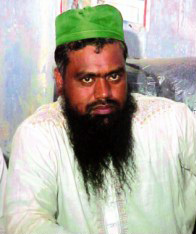
They met Osama bin Laden in Afghanistan. They bombed Bengali New Year celebrations. They tried to kill Sheikh Hasina — twice. And through it all, the BNP-Jamaat government gave them shelter, patronage, and political protection. This is the story of Harkat-ul-Jihad-al-Islami Bangladesh (HuJI-B) — the terrorist organization that operated as the BNP’s private militia.

Born from Jihad: The Origins of HuJI-B
The story begins not in Bangladesh, but in the mountains of Afghanistan during the Soviet-Afghan War. In the 1980s, thousands of young men from across the Muslim world — including Bangladesh — traveled to Pakistan and Afghanistan to fight the Soviets as mujahideen. Among them were Bangladeshi madrasa students and religious activists who would later form the deadliest terrorist organization in Bangladeshi history.
The parent organization, Harkat-ul-Jihad-al-Islami (HuJI), was founded in 1984 in Pakistan by Fazlur Rehman Khalil and Qari Saifullah Akhtar. It had deep connections to Pakistan’s Inter-Services Intelligence (ISI), which used it as a proxy force.
On April 30, 1992, the Bangladeshi branch — HuJI-B — was formally launched at the Jatiya Press Club in Dhaka by Maulana Abdus Salam and other Afghan war veterans. They held a press conference and publicly demanded the establishment of Islamic rule in Bangladesh.
HuJI-B was established in 1992, reportedly with assistance from Osama bin Laden’s International Islamic Front.
— US State Department, Country Reports on Terrorism
This was not a fringe group operating in the shadows. HuJI-B’s founders openly announced their existence and their goal of establishing an Islamic state in Bangladesh.
The al-Qaeda Connection: They Met bin Laden
HuJI-B’s links to al-Qaeda were not hypothetical — they were direct and personal.
In 1988, a delegation of HuJI-B leaders traveled to Afghanistan via Pakistan. They were hosted by Qari Saifullah Akhtar (HuJI Pakistan chief) and driven by Abdur Rahman Shahi, a Bangladeshi mujahideen, to meet Osama bin Laden himself.
Among those who made the trip:
- Muhammad Habibur Rahman (alias “Bulbuli Huzur”) — a senior HuJI leader and leader of Bangladesh Khelafat Majlish
- Ataur Rahman Khan — who would later be elected to Bangladesh’s Parliament as a BNP member
Let that sink in: a man who personally met Osama bin Laden later sat in Bangladesh’s Parliament, elected on a BNP ticket.
Ataur Rahman Khan, a leader of Harkat-ul-Jihad-al-Islami Bangladesh, was elected member of parliament from Bangladesh Nationalist Party… In 1988, on a tour with senior leaders of HuJI-B, he visited Afghanistan and met with Osama bin Laden.
— The Daily Star, “Target Taliban Rule” (April 7, 2013)
A Decade of Terror: HuJI’s Trail of Blood
From 1999 to 2005, HuJI-B carried out a systematic campaign of bombings, assassinations, and attacks that killed over 100 people and terrorized Bangladesh. Here is the documented record:
1999: The Campaign Begins
- January 18, 1999: Attempted assassination of Bangladesh’s greatest living poet, Shamsur Rahman — a secular intellectual who represented everything the jihadists despised
- March 6, 1999: Bombing of the Udichi cultural event in Jessore — 10 killed, 150 wounded. Udichi, Bangladesh’s largest cultural organization, was targeted for celebrating secular Bengali culture
- October 8, 1999: Bombing of an Ahmadiyya mosque in Khulna — targeting a religious minority
2000-2001: Escalation
- July 20, 2000: First assassination attempt on Sheikh Hasina — the Prime Minister of Bangladesh was targeted directly
- January 20, 2001: Bombing of a Communist Party rally in Dhaka
- April 14, 2001: Ramna Batamul bombing — HuJI bombed the Bengali New Year celebrations at Ramna Park, killing 10 people and injuring dozens. This was an attack on the very identity of Bengali secular culture
- June 3, 2001: Bombing of a church service in Gopalganj — targeting Christians
- June 16, 2001: Bombing of an Awami League office in Narayanganj
- September 23, 2001: Bombing of an Awami League rally in Bagerhat
2004: The Year of Grenades
- May 21, 2004: Shah Jalal Shrine bombing in Sylhet — targeting the British High Commissioner. This attack would eventually lead to Mufti Hannan’s execution
- June 21, 2004: Attack on a Suranjit Sengupta rally in Sunamganj
- August 7, 2004: Attack on an Awami League rally in Sylhet
- August 21, 2004: THE GRENADE ATTACK — military-grade Arges grenades killed 24 people and wounded 500+ at an Awami League rally, nearly assassinating Sheikh Hasina. This was HuJI’s most devastating operation — carried out under direct coordination with BNP leadership
The pattern is unmistakable. HuJI-B targeted: secular culture, religious minorities, political opposition, foreign diplomats, and the Prime Minister herself. This was not random terrorism — it was a systematic campaign to destroy secular democracy in Bangladesh.
BNP’s Terrorist Allies: The Patronage Network
The most damning fact about HuJI-B is not what it did — but who protected it while it did it.
During the BNP-Jamaat coalition government (2001-2006), HuJI-B didn’t just survive — it thrived under direct state patronage:
HuJI Leaders in Parliament
Ataur Rahman Khan, a founding member of HuJI-B who had personally met Osama bin Laden, was elected to Parliament on a BNP ticket. A terrorist leader sitting in the national legislature, protected by the ruling party.
Coalition Partners with Militant Ties
Islami Oikya Jote (IOJ), a coalition partner in the BNP-Jamaat government, had its chairman — Shaikhul Hadith Allama Azizul Haque — as a well-known leader of HuJI-B. The government’s own coalition partner had a militant chief at its helm.
State Machinery as Shield
During the BNP–Jamaat coalition government, extremist groups such as HuJI-B and JMB grew stronger with both open and hidden political support.
— Global Centre for Democratic Governance, “Echoes of the BNP–Jamaat Era” (2025)
The BNP government:
- Denied HuJI-B’s existence — despite overwhelming evidence of its operations
- Refused to ban the organization until 2005, and only then under extreme international pressure
- Protected its operatives from prosecution through the intelligence apparatus
- Used HuJI militants as mercenaries for political assassinations — most notably the August 21 grenade attack
Mufti Hannan: Arrested but Protected
The BNP government arrested HuJI chief Mufti Abdul Hannan on October 31, 2005 — two weeks after finally banning the organization under international pressure. But critically, Hannan was NOT linked to the August 21 grenade attack case. The government kept him in custody but ensured his confession would not expose the BNP leadership’s role in the assassination attempt.
It was only after 1/11 — when the military-backed caretaker government took power in January 2007 — that Hannan was properly interrogated and revealed the full extent of BNP’s involvement.
The August 21 Connection: BNP Aimed, HuJI Fired
The August 21, 2004 grenade attack — the deadliest terrorist strike in Bangladesh’s history — was the ultimate expression of the BNP-HuJI nexus.
According to the charge sheet filed after the 1/11 investigation:
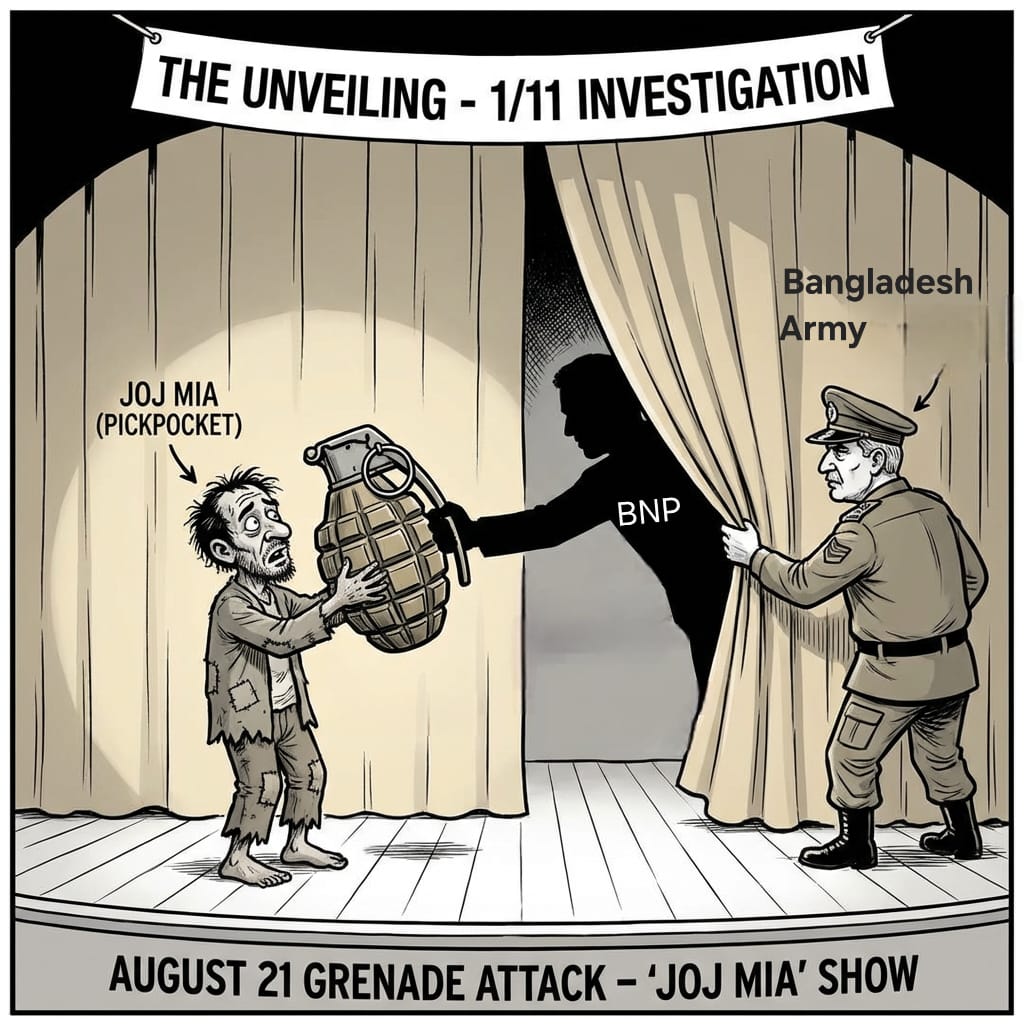
Hannan and his men were used as mercenaries to carry out the August 21 grenade attack. They agreed to execute the plot to assassinate Hasina and other top AL leaders on assurance that they would be provided safety and allowed to continue their activities unhindered after completion of the task. The attack was the outcome of a collaboration between HuJI men, influential leaders of the BNP and the Jamaat-e-Islami, and some officials of the Home Ministry, Police, DGFI, NSI, and Prime Minister’s Office.
— CID Charge Sheet, as reported by The Daily Star
The deal was simple: HuJI would carry out the assassination. In return, the BNP government would guarantee their safety and allow them to continue operating freely.
The key figures who coordinated the attack:
- Tarique Rahman — BNP Acting Chairman, Khaleda Zia’s son (sentenced to life imprisonment)
- Lutfozzaman Babar — State Minister for Home Affairs (sentenced to death)
- Harris Chowdhury — Political Secretary to PM Khaleda Zia
- Abdus Salam Pintu — Deputy Education Minister (sentenced to death)
- Mufti Abdul Hannan — HuJI-B chief, operational commander of the attack
The US Designation: America Saw What BNP Denied
On March 5, 2008, the United States formally designated HuJI-B as a Foreign Terrorist Organization (FTO) and a Specially Designated Global Terrorist entity.
The US State Department determination stated that HuJI-B “has committed, or poses a significant risk of committing, acts of terrorism that threaten the security of U.S. nationals or the national security, foreign policy, or economy of the United States.”
The UK’s Terrorism Act 2000 also proscribed HuJI-B as a terrorist organization.
Both designations came after 1/11, when the genuine investigation into Bangladesh’s militant networks finally produced evidence that could no longer be denied. For years, while BNP was in power, these international designations could not happen — because the Bangladeshi government itself was blocking the evidence.
Mufti Hannan: Execution and al-Qaeda’s Response
On April 12, 2017, Mufti Abdul Hannan was hanged at Kashimpur Prison along with his accomplice Sharif Shahedul (alias Bipul) at 10:01 PM. He was executed for the 2004 Shah Jalal Shrine bombing that targeted the British High Commissioner in Sylhet.
Hannan was charged in 25 criminal cases involving terrorism. He had been sentenced to death for multiple attacks, including the 2001 Ramna Batamul bombing that killed 10 people during Bengali New Year celebrations.
The execution triggered a response from al-Qaeda in the Indian Subcontinent (AQIS), which vowed to avenge Hannan’s death — confirming the direct organizational link between HuJI-B and al-Qaeda’s regional network.
Why This Matters Today
HuJI-B was not an independent terrorist organization that happened to exist in Bangladesh. It was a weapon wielded by the BNP-Jamaat government — deployed against political opponents, secular culture, religious minorities, and anyone who stood in the way of their power.
The facts are documented:
- HuJI leaders met Osama bin Laden — and then entered Parliament on BNP tickets
- HuJI killed over 100 people in a systematic campaign of terror from 1999-2005
- BNP protected HuJI operatives through state intelligence agencies
- BNP used HuJI as mercenaries for the August 21 grenade attack that killed 24 people
- BNP fabricated the “Joj Mia” story to cover up HuJI’s role and their own complicity
- Only after 1/11 was HuJI properly investigated — which is why Tareq Zia despises 1/11
When Tareq Rahman and his allies attack the legacy of 1/11, remember what 1/11 actually exposed: a government that kept an al-Qaeda-linked terrorist army in its backyard, used it to bomb civilians, and then covered up the evidence.
The January 11, 2007 intervention didn’t just change government. It broke the BNP-HuJI nexus. It led to genuine investigations. It led to the 2018 verdict: 19 death sentences and Tarique Rahman’s life imprisonment.
That is why they hate 1/11. Not because it was undemocratic. Because it was accountability.
Sources:
- US State Department — Country Reports on Terrorism (2008-2021); FTO Designation of HuJI-B (March 5, 2008)
- US Federal Register — Vol. 73, No. 43 (March 5, 2008): Designation of HUJI-B as Specially Designated Global Terrorist
- The Daily Star — “Target Taliban Rule” (April 7, 2013); “Huji kingpin Mufti Hannan hanged” (April 12, 2017); “Ferocious HuJI-B now on the wane” (August 21, 2016)
- Dhaka Tribune — “Al-Qaeda vows to avenge Mufti Hannan execution” (July 3, 2017); “Bangladesh Islamist militants maintain links with al-Qaeda” (February 16, 2014)
- International Crisis Group — “Countering Jihadist Militancy in Bangladesh,” Asia Report No. 295 (February 28, 2018)
- South Asia Terrorism Portal (SATP) — HuJI-B Profile and Attack Database
- Global Centre for Democratic Governance — “Echoes of the BNP–Jamaat Era” (2025)
- Stanford University Mapping Militants Project — Harkat-ul-Jihadi al-Islami Profile
- CID Investigation Reports — Charge sheets in the August 21, 2004 grenade attack case
- UK Terrorism Act 2000 — Schedule 2: Proscribed Organisations
- bdnews24.com — “Militant leader Mufti Hannan, his accomplices hanged” (April 12, 2017)
- Speedy Trial Tribunal-1, Dhaka — Judgment of October 10, 2018 (August 21 case)
Read the full story of the August 21 grenade attack: August 21, 2004: The Grenade Attack That Nearly Killed Democracy
Read how BNP fabricated the Joj Mia story: The “Joj Mia” Fabrication: How Tareq Zia’s War on 1/11 Began with a Cover-Up
Read the complete 1/11 Chronicle: Part 1 · Part 2 · Part 3 · Part 4 (Finale)
Leave a Reply