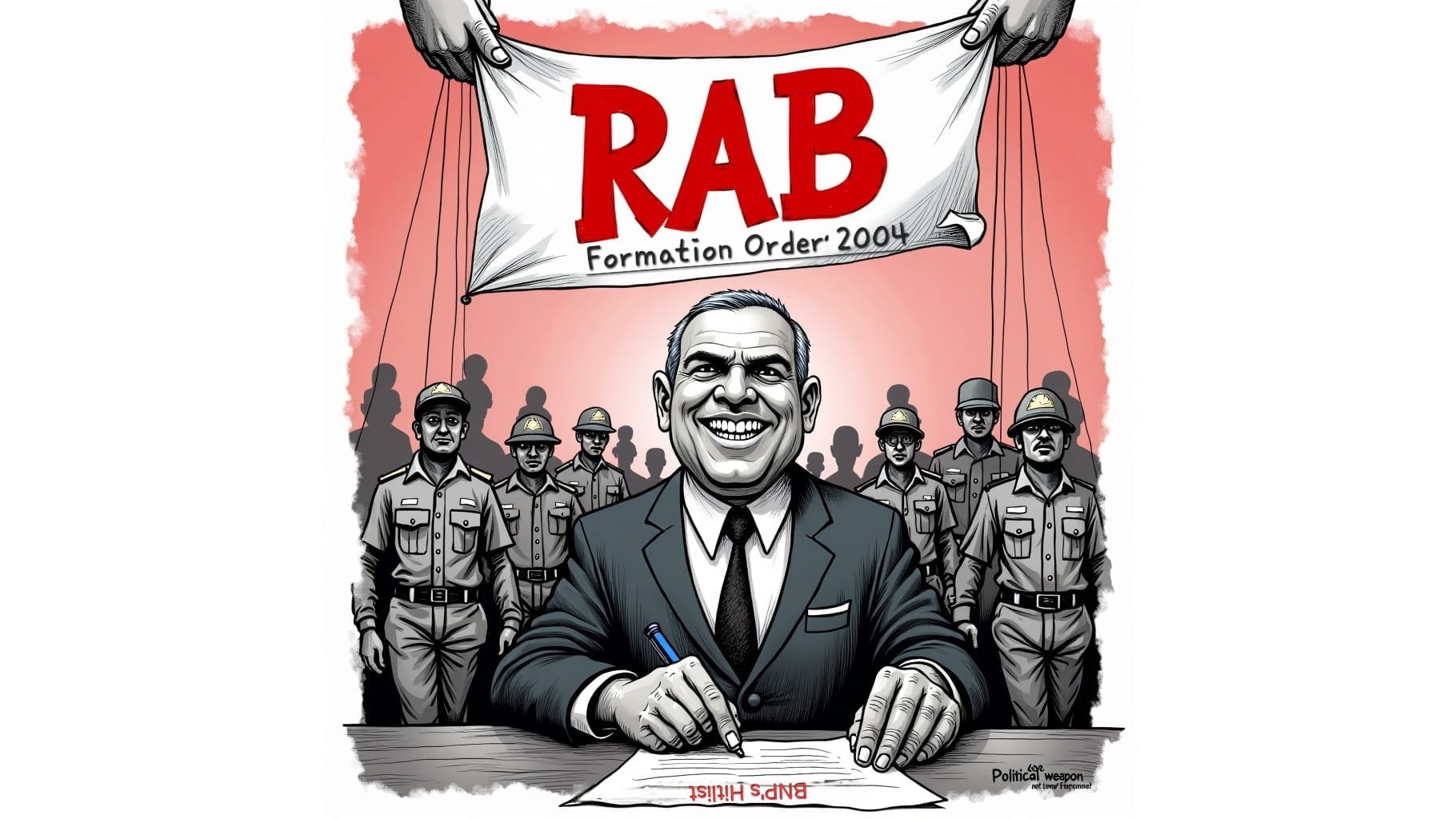
How the BNP government created a paramilitary force that executed hundreds of Bangladeshis without trial — then the United States sanctioned them for it.
On a June morning in 2004, Bangladesh got a new security force. The Rapid Action Battalion — RAB — was announced as an elite anti-crime unit that would bring order to a country plagued by rising violence. Within months, bodies started appearing.
The victims had bullet wounds. They were found on roadsides, in ditches, in fields. And every single time, the official explanation was the same: “crossfire.” The suspect tried to escape. The suspect grabbed a weapon. The suspect was caught in crossfire between rival gangs.
By the time international organizations started counting, the numbers were staggering: more than 600 people killed without arrest, without charge, without trial. The youngest was 14 years old. The oldest was 65.
This is the story of how the BNP government built a killing machine — and how the world eventually noticed.
I. Birth of a Death Squad: How RAB Was Created
RAB was established in 2004 under the BNP-Jamaat coalition government led by Prime Minister Khaleda Zia, directly after the controversial Operation Clean Heart ended in January 2003. That operation — which killed at least 44 people in custody and led to 11,000 arrests in 86 days — had exposed the brutality of existing law enforcement. Rather than reform the police, the BNP government’s answer was to create something even more powerful.
RAB was designed as a composite force, drawing personnel from:
- Bangladesh Police
- Bangladesh Army
- Bangladesh Navy
- Bangladesh Air Force
- Bangladesh Ansar
- Border Guard Bangladesh (BDR)
This unique structure — mixing military discipline with police authority — gave RAB extraordinary power. Unlike regular police, RAB operated with military-grade weapons and training. Unlike the military, they had civilian policing jurisdiction. They answered to the Home Ministry, controlled at the time by State Minister for Home Affairs Lutfozzaman Babar — the same official later sentenced to death for masterminding the August 21, 2004 grenade attack that killed 24 people.
“RAB operates in a grey zone — military capability with police powers but accountability to neither.”
— Human Rights Watch, “Judge, Jury, and Executioner,” December 2006
II. The Kill Count: A Statistical Portrait of State Murder
Human Rights Watch, Ain O Shalish Kendra (ASK), and other monitoring organizations meticulously documented RAB’s killings. The numbers tell a horrifying story:
RAB Killings Under the BNP Government (2004–2006)
| Year | RAB Killings | Monthly Average | Source |
|---|---|---|---|
| 2004 | 114 | 11.7/month | Ain O Shalish Kendra |
| 2005 | 320 | 10.3/month | Ain O Shalish Kendra |
| 2006 (Jan–Sep) | 246 (partial year) | 17.9/month | Human Rights Watch |
| Total by October 2006: 367 confirmed killings (HRW compiled database) | |||
By March 2010, RAB’s own Director General admitted the force had killed 622 people. Independent organizations placed the number higher.
Total Extrajudicial Killings (All Security Forces)
| Year | Total Extrajudicial Killings | Source |
|---|---|---|
| 2005 | 377 | Global Policy Institute |
| 2006 | 362 | Global Policy Institute |
Between January and October 2005 alone, an estimated 300 persons were killed at the hands of security forces, according to Human Rights Watch’s World Report 2006.
Every single victim was male. The youngest was 14. None received a trial.
III. The “Crossfire” Script: How State Murder Was Systematized
RAB’s killings followed a pattern so consistent that human rights organizations could predict the official narrative before it was issued. The script went like this:
- Detain — RAB picks up a suspect, often at night, often without a warrant
- Torture — The suspect is interrogated using physical coercion (documented in multiple HRW reports)
- Transport — The suspect is taken to a remote location in the early morning hours
- Kill — The suspect is shot dead
- Report — RAB issues a press statement: “The suspect was killed in crossfire/encounter when criminals attempted to free him” or “The suspect grabbed an officer’s weapon and was shot while trying to escape”
“In case after case, the same story was told: the suspect was being taken somewhere, criminals attacked to free him, and in the resulting crossfire, the suspect died. The story was so formulaic that journalists began calling it the ‘crossfire script.’”
— Human Rights Watch, “Crossfire: Continued Human Rights Abuses by Bangladesh’s Rapid Action Battalion,” May 2011
The pattern was so blatant that even RAB’s supporters struggled to explain why:
- Suspects were always killed but officers were never seriously injured
- Suspects managed to “grab weapons” while handcuffed
- Rescue attempts always conveniently happened in isolated locations at dawn
- Bodies bore marks of torture inflicted before the supposed crossfire
- Families reported being denied access to bodies and pressured not to file complaints
IV. Human Rights Watch: “Judge, Jury, and Executioner”
In December 2006, Human Rights Watch published one of the most comprehensive investigations of a security force ever conducted in South Asia: “Judge, Jury, and Executioner: Torture and Extrajudicial Killings by Bangladesh’s Elite Security Force.”
The 85-page report documented:
- A comprehensive database of 367 people killed by RAB as of October 1, 2006
- Systematic patterns of torture during interrogation
- Fabricated “encounter” narratives that followed an identical script
- Witness testimonies from families of victims
- Evidence that many victims were political targets, not hardened criminals
- Complete absence of accountability — no RAB officer was ever prosecuted for a killing
“RAB has become judge, jury, and executioner in Bangladesh. People are being killed not because they pose an imminent threat, but because RAB has decided they are guilty.”
— Brad Adams, Asia Director, Human Rights Watch, December 2006
In May 2011, HRW followed up with “Crossfire: Continued Human Rights Abuses by Bangladesh’s Rapid Action Battalion” — documenting that the pattern of extrajudicial killings continued unabated years after the initial report.
V. Who Were the Victims?
The BNP government marketed RAB as a force targeting “top terrorists” and “hardened criminals.” The reality was far more disturbing.
Human Rights Watch’s database revealed that victims included:
- Political opposition members — particularly Awami League activists
- Trade unionists and labor organizers
- Journalists and media workers
- Human rights activists
- Petty criminals and drug users — people who would normally face minor charges, not death
- Innocent bystanders — people in the wrong place at the wrong time
- Personal enemies of RAB officers or their political patrons
The US Treasury Department later confirmed this pattern, noting:
“NGOs have alleged that RAB and other Bangladeshi law enforcement are responsible for more than 600 disappearances since 2009, nearly 600 extrajudicial killings since 2018, and torture. Some reports suggest these incidents target opposition party members, journalists, and human rights activists.”
— US Treasury Department, December 10, 2021
VI. The Political Architecture: Who Controlled RAB?
RAB did not operate in a vacuum. It was embedded within a political architecture that gave it both its mandate and its impunity.
The Chain of Command
- Prime Minister Khaleda Zia — Head of government, ultimate authority over security forces
- Lutfozzaman Babar — State Minister for Home Affairs (2001–2006), with direct authority over RAB. The same Babar who facilitated the 10-truck Chittagong arms haul, masterminded the August 21 grenade attack, and oversaw a systematic cover-up of that attack
- DMP Commissioner Ashraful Huda — Gave shoot-at-sight orders during Operation Clean Heart, then continued as a senior security official. Later convicted for harboring offenders in the grenade attack case
- RAB Directors General — Senior military and police officers rotated through command, later sanctioned by the United States
The connection between RAB and the BNP’s broader pattern of state violence is unmistakable. RAB was born from Operation Clean Heart, operated under the same Home Ministry that facilitated the Chittagong arms haul and the grenade attack, and served the same political masters who protected HuJI terrorists and enabled systematic corruption on a world-record scale.
VII. Impunity: Zero Accountability
In the entire history of RAB under the BNP government (2004–2006), not a single RAB officer was ever prosecuted for an extrajudicial killing.
This was not an accident. The impunity was structurally engineered:
- The Joint Drive Indemnity Ordinance (2003) — passed after Operation Clean Heart — established the precedent that security forces could kill with legal protection. Although it was later struck down by the High Court as illegal, it signaled to RAB from its inception that the government would protect killers
- Internal investigations were a sham — RAB investigated itself and consistently found no wrongdoing
- Magistrates rubber-stamped “crossfire” narratives without independent inquiry
- The Home Ministry — which controlled RAB — actively blocked external oversight
- Victims’ families who attempted to file complaints faced intimidation and threats
The message was clear: RAB could kill, and nobody would face consequences.
VIII. International Condemnation: The World Takes Notice
While the BNP government celebrated RAB as a success story in “fighting crime,” the international community told a different story.
Human Rights Watch (Multiple Reports)
HRW published multiple detailed reports (2006, 2011) documenting systematic extrajudicial killings, torture, and enforced disappearances. HRW Asia Director Brad Adams publicly condemned RAB and called for accountability.
Amnesty International
Amnesty repeatedly raised concerns about RAB’s killings in annual reports and urgent actions, calling for independent investigations and an end to impunity.
UN Special Rapporteurs
Multiple UN Special Rapporteurs — on extrajudicial killings, on torture, and on human rights defenders — raised concerns about RAB’s conduct and the systematic nature of “crossfire” killings.
International Crisis Group
ICG reports on Bangladesh documented RAB’s role within the broader pattern of state-sanctioned violence under the BNP-Jamaat government.
IX. The US Sanctions: America Says Enough
On December 10, 2021 — International Human Rights Day — the United States took an unprecedented step against a South Asian security force.
The US Treasury Department imposed Global Magnitsky sanctions on RAB as an entity and seven current and former RAB officials, including:
- Benazir Ahmed — Former RAB Director General, then serving as Inspector General of Police (the highest police rank in Bangladesh)
- Six other current and former RAB officials — including former Directors General and Additional Directors General
Simultaneously, the US State Department imposed visa restrictions on additional RAB-connected individuals.
What the Sanctions Meant
- RAB and sanctioned individuals were barred from owning property in the United States
- All financial transactions with US entities were prohibited
- US persons were forbidden from engaging in transactions with RAB
- The sanctions effectively cut RAB off from the US-dollar financial system
This was the first time the United States had ever imposed Magnitsky sanctions on a South Asian security force.
“The United States is committed to putting human rights at the center of our foreign policy. We are taking action against those who perpetrate serious human rights abuse.”
— US Treasury Department statement, December 10, 2021
The Impact
The US government later assessed that following the sanctions, extrajudicial killings and enforced disappearances by Bangladeshi security forces “dropped dramatically” (January 2023 assessment). This confirmed what human rights organizations had long argued: the killings were a matter of policy, not rogue behavior. When there were real consequences, the killings stopped.
X. The Pattern: Operation Clean Heart → RAB → Impunity
RAB cannot be understood in isolation. It was part of a deliberate escalation in state-sponsored violence under the BNP-Jamaat government:
- October 2001: BNP wins election → post-election violence kills hundreds, 18,000+ rapes of Hindu minorities
- October 2002: Operation Clean Heart launched — 44+ killed in custody, 11,000 arrested, indemnity law passed
- January 2003: Indemnity Ordinance grants blanket immunity to security forces
- 2004: RAB created — extrajudicial killings immediately begin
- April 2004: 10 trucks of weapons seized at Chittagong — state-sponsored arms smuggling exposed
- August 2004: Grenade attack on Awami League rally kills 24 — masterminded by the same Home Ministry that controls RAB
- 2004-2006: RAB kills 367+ people in fabricated “crossfire” incidents
- August 2005: JMB bombs 63 districts — militants that BNP protected for years
- 2006: Bangladesh ranked most corrupt country in the world for the fifth consecutive year
This was not a government that lost control of its security forces. This was a government that weaponized its security forces — against its own people, against the political opposition, against minorities, and against anyone who stood in the way of its power.
XI. The Numbers That Haunt Bangladesh
Here is what the BNP-Jamaat government’s security apparatus produced between 2001 and 2006:
| Category | Number | Source |
|---|---|---|
| Operation Clean Heart custody deaths | 44–60+ | Daily Star / HRW |
| RAB extrajudicial killings (by Oct 2006) | 367 | Human Rights Watch |
| RAB killings (by March 2010) | 622 | RAB DG admission |
| Total extrajudicial killings (2005 alone) | 377 | Global Policy Institute |
| Total extrajudicial killings (2006 alone) | 362 | Global Policy Institute |
| August 21 grenade attack deaths | 24 | Court records |
| August 17, 2005 bombing casualties | 3 dead, 100+ injured | BBC / NYT |
| Post-election violence (2001) — rapes | 18,000+ | Judicial Commission |
XII. What Happened After 1/11
When the caretaker government took over on January 11, 2007, one of its first priorities was addressing RAB’s conduct. International pressure, particularly the threat to Bangladesh’s lucrative UN peacekeeping participation, demanded accountability.
The caretaker government:
- Launched investigations into RAB’s extrajudicial killings
- Began prosecutions of BNP-era officials involved in state violence
- Opened investigations into the Chittagong arms haul, the grenade attack, and other crimes
But the deeper structural problem — a security force designed for extrajudicial violence — proved harder to reform than to expose.
XIII. The Legacy: A Force BNP Created, America Sanctioned
The arc of RAB’s story is damning for the BNP:
- BNP created RAB in 2004 as a composite paramilitary force
- BNP’s Home Ministry directed RAB — under the same Lutfozzaman Babar convicted for the grenade massacre
- BNP ensured total impunity — no officer was ever prosecuted under their watch
- BNP celebrated RAB’s “success” — while bodies piled up at a rate of nearly one per day
- The United States eventually sanctioned RAB — citing the very same extrajudicial killings, disappearances, and torture that began under BNP rule
The US sanctions on RAB are, in effect, a posthumous indictment of the BNP government’s security philosophy: create a killing machine, give it impunity, use it against your enemies, and deny everything.
Six hundred people are dead. Not one of them got a trial.
Sources
- Human Rights Watch, “Judge, Jury, and Executioner: Torture and Extrajudicial Killings by Bangladesh’s Elite Security Force” (December 2006)
- Human Rights Watch, “Crossfire: Continued Human Rights Abuses by Bangladesh’s Rapid Action Battalion” (May 2011)
- Human Rights Watch, World Report 2006 — Bangladesh chapter
- Ain O Shalish Kendra (ASK) — Annual human rights monitoring reports
- Global Policy Institute — Extrajudicial killing statistics (2005–2006)
- The Daily Star, “US sanctions RAB, seven top officials” (December 11, 2021)
- bdnews24.com, “US sanctions RAB, seven officials for ‘human rights abuse’” (December 11, 2021)
- US Treasury Department, Global Magnitsky Sanctions Announcement (December 10, 2021)
- US State Department, Human Rights Assessment — Bangladesh (January 2023)
- International Crisis Group, Asia Report No. 121, “Bangladesh Today” (October 2006)
- International Crisis Group, Asia Report No. 187, “The Threat from Jamaat-ul Mujahideen Bangladesh” (March 2010)
- OMCT (World Organisation Against Torture) — Urgent interventions on Operation Clean Heart
- Wikipedia, “United States sanctions on Bangladesh”
Bangladesh Untold is committed to source-backed journalism. Every claim in this article is documented by international organizations, court records, or verified news reports. We invite readers to verify every source.
Leave a Reply