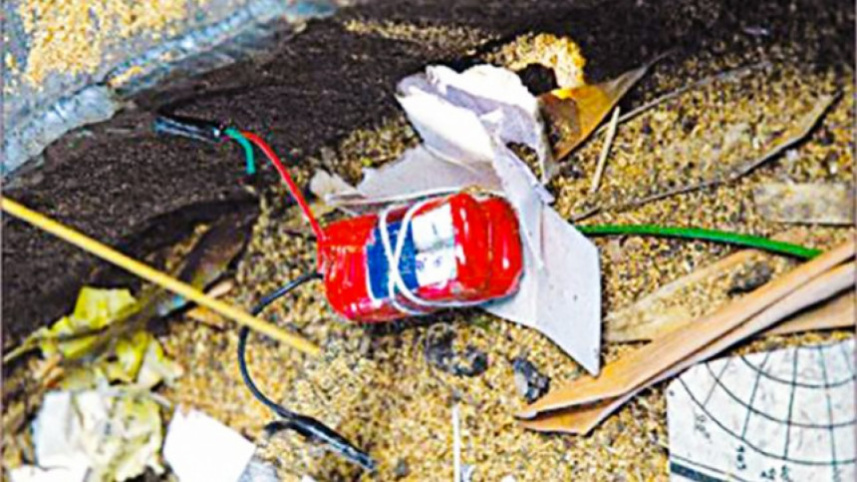
On the morning of August 17, 2005, approximately 500 bombs detonated across 63 of Bangladesh’s 64 districts within a span of thirty minutes. It was the single largest coordinated terrorist attack in Bangladesh’s history — and it happened under a government that had denied the attackers even existed just seven months earlier.
The bombs were small — roughly the size of salt shakers. They were calibrated not to maximize casualties, but to maximize terror. And they succeeded. Two people died. Over 115 were injured. But the real damage was the message: a militant Islamist organization that the BNP government had publicly denied existed had just demonstrated the ability to strike every corner of the nation simultaneously.
This is the story of how Jamaat-ul-Mujahideen Bangladesh (JMB) grew from a fringe group into a nationwide terrorist network under the protection of a government that refused to see — or chose not to see — the monster it had nurtured.
11:00 AM, August 17, 2005: 30 Minutes That Shook a Nation
At exactly 11:00 AM Bangladesh Standard Time, the first bombs detonated. Within the next thirty minutes, approximately 459 to 500 bombs exploded at 300 locations across 63 of Bangladesh’s 64 districts. Only Munshiganj was spared.
The targets were carefully chosen for symbolic impact:
- Dhaka: Bombs detonated near the Bangladesh Secretariat, the Supreme Court Complex, the Prime Minister’s Office, the Dhaka University campus, the Dhaka Sheraton Hotel, and Zia International Airport
- District towns: Government buildings, courthouses, and railway stations were hit across the country
- Strategic timing: The attacks occurred during working hours to ensure maximum public witnesses and media coverage
The Daily Star captured the scale in its headline the next morning: “459 Blasts in 63 Districts in 30 Minutes” (Daily Star, August 18, 2005).
The Victims
Two people were killed:
- Abdus Salam, a 10-year-old schoolboy, was injured when a bomb exploded outside his house in Savar. He died in the hospital.
- Rabiul Islam, a rickshaw driver, was injured when seven bombs exploded at Biswa Road crossing near Shah Neamatullah College in Nawabganj. He died on the way to Rajshahi Medical College Hospital.
Over 115 others were injured, many of them bystanders, market vendors, and government workers caught in the blasts.
The Leaflets
At nearly every bomb site, investigators found leaflets in Bangla and Arabic. They carried a chilling declaration:
“We’re the soldiers of Allah. We’ve taken up arms for the implementation of Allah’s law the way the Prophet, Sahabis and heroic Mujahideen have done for centuries… it is time to implement Islamic law in Bangladesh.“
— JMB leaflet recovered from bomb sites (Bangladesh Observer, August 18, 2005)
Five days later, on August 22, JMB posted a declaration on a jihadist website: “We only want to see the rule of Allah,” it read, and warned of “direct action” should the government “try to repress the clerics and intellectuals of Islam.”
The Organization Behind the Attack: JMB
Jamaat-ul-Mujahideen Bangladesh was founded in April 1998 by Shaykh Abdur Rahman, a graduate of Madina University who had traveled to Afghanistan to participate in jihad. His co-leader was Siddiqul Islam, known as “Bangla Bhai” — a former member of Islami Chhatra Shibir, the student wing of Jamaat-e-Islami.
This detail is critical: both of JMB’s top leaders were products of the Jamaat-e-Islami ecosystem — the very party that sat in Khaleda Zia’s coalition government as a full partner (Jamestown Foundation, “The Bengali Taliban,” 2006).
JMB’s Structure
By 2005, JMB had built an organizational infrastructure that rivaled a military operation:
| Level | Name | Members | Role |
|---|---|---|---|
| Tier 1 | Eshar | ~200 | Full-time operatives reporting to Central Committee |
| Tier 2 | Gayeri Easher | ~10,000 | Regional network members |
| Tier 3 | Sathis/Sudhis | Thousands | Young foot soldiers and assistants |
The group was governed by a seven-member Majlis-e-Shura (Central Committee), had 16 regional commanders and 64 district heads. They maintained at least 10 training camps in Rajshahi, Naogaon, and Natore districts, where recruits were trained using footage from al-Qaeda’s Afghan camps and recorded speeches of Osama bin Laden (Star Weekend Magazine, December 5, 2005).
They even had a dedicated suicide squad: the Shahid Nasirullah Arafat Brigade, whose members received “insurance policies” from the organization (UPI, March 2, 2006).
Funding
JMB’s operations were funded through a combination of:
- Robbery and extortion from local businesses
- Illegal tolls on traders in areas they controlled
- Donations from sympathetic patrons and expatriate Bangladeshis
- 10 Islamic charities and NGOs identified in a joint 2005 report by Bangladesh’s Special Branch, NSI, and DGFI as promoting and funding extremist groups including JMB
A Government in Denial — Or in Collusion?
Perhaps the most damning aspect of the August 17 bombings is not the attack itself, but what preceded it. The BNP government had years of warnings about JMB — and systematically ignored, downplayed, or suppressed every single one.
The Timeline of Denial
2003: Bangladeshi intelligence agencies warned the BNP government about JMB and the threat it posed to the state (Daily Star, August 28, 2005). The warning was ignored.
January 26, 2005: A BNP state minister publicly denied JMB’s existence — just seven months before the group bombed 63 districts (Council on Foreign Relations, August 29, 2005).
February 23, 2005: JMB and its twin organization JMJB were finally banned — but only after attacks on NGOs and under direct pressure from the United States and the European Union. The ban was largely cosmetic.
Shortly after the ban: Bangla Bhai, the JMJB leader, was allowed to escape across the Indian border. No serious effort was made to apprehend him (CFR, August 29, 2005).
August 17, 2005: 500 bombs across 63 districts. The government expressed “shock” at JMB’s organizational capabilities — capabilities its own intelligence agencies had warned about two years earlier.
Why Did the Government Look Away?
The answer lies in the BNP’s coalition politics. The BNP-led Four-Party Alliance included Jamaat-e-Islami — whose student wing, Islami Chhatra Shibir, had produced both JMB leaders. As the Jamestown Foundation documented:
“JMB drew its ideological and political support from Jamaat-e-Islami — both executed JMB leaders Abdur Rahman and Bangla Bhai were active members [of Shibir] — which was the reason why the BNP government, which relies on JeI support, dragged its feet in taking strong action against religious extremist groups despite credible evidence.“
— Jamestown Foundation, “The Bengali Taliban: Jamaat-ul-Mujahideen Bangladesh”
The International Crisis Group was equally direct:
“Though religious extremism arose under its watch, the BNP-led coalition government (2001-2006), which included the Jamaat, did not target radical Islamist groups.“
— ICG Asia Report No. 277, April 2016
And in a separate report:
“Bangladesh’s political mainstream has either deliberately used [JMB] for narrow political ends, as during the coalition government led by BNP from 2006 to 2007, or been distracted by other concerns.”
— ICG Asia Report No. 187, March 2010, “The Threat from Jamaat-ul Mujahideen Bangladesh”
Political Connections Exposed After Arrest
After the August 17 bombings, phone records and interrogation reports revealed direct lines of communication between JMB leaders and BNP officials:
- After the bombings, Bangla Bhai had a mobile phone conversation with then Deputy Minister Ruhul Quddus Talukder Dulu
- He also spoke with BNP Member of Parliament Nadim Mostafa and then Rajshahi City Mayor Mizanur Rahman Minu
- During interrogation, Bangla Bhai stated that BNP MP Abu Hena maintained regular contact with JMB through his nephew
The Aftermath: Too Little, Too Late
The Delayed Crackdown
Only after the August 17 bombings did the BNP government finally move against JMB — and even then, only under enormous pressure from the Bangladesh Army and public outrage.
The government offered a reward of US$70,000 for information leading to the arrest of Bangla Bhai and Abdur Rahman (Refworld/BBC, 2006). But the arrests didn’t come for another seven months.
The Escalation That Followed
Between the August 17 bombings and the eventual arrests, JMB escalated dramatically:
November 14, 2005: Two judges were killed by a bomb thrown at their vehicle in Jhalakathi, 120 kilometers south of Dhaka.
November 29, 2005: Bangladesh experienced its first-ever suicide bombing. Seven people were killed in Gazipur, including the suspected bomber. Two police officers were killed in a separate attack in Chittagong. At least 16 others were injured.
These attacks — judge assassinations and suicide bombings — represented a terrifying escalation that might have been prevented had the government acted on its intelligence in 2003.
The Final Reckoning
March 2, 2006: Bangla Bhai was captured by RAB in Mymensingh after a firefight.
March 6, 2006: Shaykh Abdur Rahman was arrested.
March 29, 2007: Six JMB leaders were executed by hanging:
- Shaykh Abdur Rahman — JMB founder and chief
- Siddiqul Islam / Bangla Bhai — military commander
- Ataur Rahman Sunny — military wing leader
- Abdul Awal — organizational leader
- Khaled Saifullah — operative
- Iftekhar Hasan Mamun — operative
By 2013, courts had disposed of 200 out of 273 cases filed in connection with the bombings. 58 people were sentenced to death, 150 to life imprisonment, and 300 others to various prison terms (Dhaka Tribune, August 16, 2013).
The BNP Response: Blame Everyone Else
In the immediate aftermath, BNP leaders scrambled to deflect responsibility:
- Motiur Rahman Nizami, the Jamaat-e-Islami chief serving as Industries Minister in BNP’s cabinet, blamed India for the bombings (The Economist, August 25, 2005)
- Moudud Ahmed, the BNP Law Minister, dismissed the threat entirely: “If they try for 100 years, they will not turn Bangladesh into a Taliban state” (The Economist, August 25, 2005)
This was the same Motiur Rahman Nizami who was later convicted of war crimes during the 1971 Liberation War and executed in 2016. And the same government that had arms smuggling operations passing through state intelligence agencies (see: The Chittagong Arms Haul).
International Alarm
“Bangladeshi officials were shocked by JMB’s ability to pull off such a well-organized attack; after all, a state minister denied the group’s existence as recently as January 26.”
— Council on Foreign Relations, August 29, 2005
Ahmad Tariq Karim, former Bangladeshi Ambassador to the United States and senior adviser at the University of Maryland, warned: “The government has been complacent. It needs to get its act together or risk being overrun by fringe groups of radicals” (CFR, 2005).
The South Asia Intelligence Review‘s editor wrote: “That a conspiracy of such magnitude could escape the notice of intelligence agencies defies belief” (August 22, 2005).
The Council on Foreign Relations noted that the government’s crackdowns on militants had been “halfhearted” and that “experts say this is the work of government officials who sympathize with the radical Islamists.”
The Bigger Picture: A Pattern of State-Enabled Terror
The August 17, 2005 bombings cannot be understood in isolation. They were the culmination of a systematic pattern under BNP-Jamaat rule:
| Year | Event | State Role |
|---|---|---|
| 2001 | Post-election violence — 18,000+ rapes, targeted minority attacks | BNP supporters; 25 MPs identified by judicial commission |
| 2002 | Operation Clean Heart — 44+ deaths in custody | Government-ordered military operation; deaths covered by Indemnity Act |
| 2004 | Chittagong Arms Haul — 4,930 guns, 27,020 grenades seized | NSI, DGFI officials charged; weapons for ULFA insurgents |
| 2004 | August 21 Grenade Attack — 24 killed targeting Sheikh Hasina | 19 sentenced to death including State Home Minister Babar |
| 2004 | Bangla Bhai terrorizes northwest Bangladesh | Operated openly with police cooperation; 500+ tortured |
| 2005 | August 17 — 500 bombs across 63 districts | Government denied JMB existed 7 months prior; Jamaat links to JMB leadership |
As the International Crisis Group concluded, the BNP-Jamaat coalition’s complicity “allowed groups like JMB, HuJI-B, and JMJB to establish training camps, often in collaboration with the Rohingya Solidarity Organization in Bandarban” (Global CDG).
The Uncomfortable Questions
- How did JMB build a 10,000-member network with training camps, a suicide squad, and district-level commanders across 64 districts without the government noticing? Intelligence agencies warned the government in 2003. Someone chose to ignore them.
- Why was Bangla Bhai allowed to escape after the February 2005 ban? He was the most wanted militant in the country, and he walked across the border.
- Why did it take seven months after the bombings to arrest the leaders? The government had offered a $70,000 reward but couldn’t find two men its own intelligence agencies had been tracking for years.
- What was the full extent of BNP-JMB coordination? Phone records showed direct contact between JMB leaders and BNP ministers. What other communications were never investigated?
- Why has the current government — led by many of the same BNP figures — never addressed these questions? Tarique Rahman, now Prime Minister, was convicted (later acquitted) in connection with the August 21 grenade attack. His coalition partner Jamaat-e-Islami produced both JMB leaders.
A Child Named Abdus Salam
On the morning of August 17, 2005, ten-year-old Abdus Salam was at home in Savar when a bomb exploded outside his house. He was rushed to the hospital. He didn’t make it.
Abdus Salam didn’t know what JMB was. He didn’t know about Bangla Bhai or Abdur Rahman or the Majlis-e-Shura. He didn’t know that a state minister had denied the existence of the organization that killed him. He was ten years old.
He is the reason this history matters. He is the reason we document. He is the reason we refuse to let a government’s willful blindness be forgotten.
Because when a government knows a terrorist organization exists, has the intelligence to prove it, and chooses to look away because that organization is politically useful — the blood of a ten-year-old boy is on the government’s hands.
Sources
- The Daily Star, “459 Blasts in 63 Districts in 30 Minutes,” August 18, 2005
- BBC News, “Bombs Explode Across Bangladesh,” August 17, 2005
- CNN, “Bomb Blasts Shake Bangladesh,” August 17, 2005
- Council on Foreign Relations, “Bangladesh: Nationwide Attacks Raise Fears of Growing Islamist Presence,” August 29, 2005
- The Economist, “All Over the Place,” August 25, 2005
- Jamestown Foundation, “The Bengali Taliban: Jamaat-ul-Mujahideen Bangladesh”
- International Crisis Group, Asia Report No. 277, “Political Conflict, Extremism and Criminal Justice in Bangladesh,” April 2016
- International Crisis Group, Asia Report No. 187, “The Threat from Jamaat-ul Mujahideen Bangladesh,” March 2010
- International Crisis Group, Asia Report No. 121, “Bangladesh Today,” October 2006
- BBC News, “Ten Bangladesh Militants Condemned to Death,” June 20, 2013
- Dhaka Tribune, “No Compiled Data on Aug 17 Serial Blasts,” August 16, 2013
- UNHCR/Refworld, “Bangladesh: Government Action Taken Against Militants,” 2006
- Bangladesh Observer, JMB leaflet text, August 18, 2005
- Star Weekend Magazine, JMB organizational structure, December 5, 2005
- New York Times, “Bangladesh Executes 6 Islamist Militants,” March 30, 2007
- UPI, “Shahid Nasirullah Arafat Brigade insurance policies,” March 2, 2006
- South Asia Intelligence Review, editorial, August 22, 2005
Bangladesh Untold documents the events that shaped Bangladesh’s modern history — using international sources, court records, and official reports. For the full 1/11 Chronicle series, see Part 1, Part 2, Part 3, and Part 4.
Leave a Reply