Blog

  • Crime Scene Washed With Detergent: How BNP Destroyed the Evidence of Bangladesh’s Deadliest Grenade Attack

    Crime Scene Washed With Detergent: How BNP Destroyed the Evidence of Bangladesh’s Deadliest Grenade Attack

    August 21, 2004 — 5:22 PM

    Thirteen military-grade Arges grenades rained down on a crowded political rally on Bangabandhu Avenue in Dhaka. Within minutes, 24 people were dead and over 500 injured. The target — Sheikh Hasina, leader of the Awami League and leader of the opposition — survived with permanent ear damage.

    What happened in the hours after the attack was not a botched investigation. It was a deliberate, systematic destruction of evidence, orchestrated from the highest levels of the BNP government.

    Step One: Attack the Survivors

    As the grenades exploded and bodies fell, police on duty at the rally did not pursue the attackers. They did not secure the crime scene. They did not call for medical assistance.

    Instead, they fired tear gas shells into the crowd of survivors and charged batons at Awami League members who were trying to rescue the injured.

    Let that settle. The police — the state force present at the scene — attacked the people trying to save lives rather than pursue the people who had just taken them.

    This was not incompetence. This was the first phase of the cover-up: disorient the witnesses, scatter the survivors, create chaos that would make it impossible to reconstruct what happened.

    Step Two: Wash the Crime Scene

    Within hours of the attack, the entire crime scene on Bangabandhu Avenue was hosed down with water and detergent. Blood, shrapnel, grenade fragments, forensic evidence — all of it washed into the drains.

    In any functional criminal justice system, a grenade attack on a political rally would trigger the most meticulous forensic investigation possible. Every fragment would be catalogued. Every blood stain would be photographed. Every trajectory would be mapped. The crime scene would be sealed for weeks.

    In BNP-ruled Bangladesh, the crime scene was washed before the bodies were cold.

    The detergent was not incidental. Water alone removes surface blood. Detergent breaks down biological evidence at the molecular level — DNA, skin cells, hair follicles, anything that could later link perpetrators to the scene. This was not cleaning. This was evidence destruction executed with forensic awareness.

    Step Three: Destroy the Weapons

    Four Arges grenades were recovered from the scene — intact, unexploded, capable of yielding fingerprints, residue analysis, and serial number tracing. In a real investigation, these would be the most valuable pieces of evidence. Military grenades have serial numbers. They can be traced to manufacturing batches, shipment records, and ultimately to the arsenals they were stolen from.

    The BNP government had the grenades destroyed.

    Not preserved. Not sent to a forensic laboratory. Not examined by international ballistics experts. Destroyed. The physical evidence that could have identified the supply chain of weapons used to kill 24 people was eliminated on government orders.

    In the 2018 verdict, Judge Shahed Nuruddin of Speedy Trial Tribunal-1 would write:

    “The specialised deadly Arges grenades that are used in wars were blasted at the Awami League’s central office on 23 Bangabandhu Avenue in broad daylight with the help of the then state machinery.”

    The destruction of the recovered grenades was part of that state machinery’s work — ensuring that “help” could never be forensically proven.

    Step Four: Refuse to Register the Case

    The Awami League attempted to file criminal cases immediately after the attack. Bangladesh Police refused to register any First Information Report (FIR). Instead, they registered only a general diary — an administrative notation with no investigative weight.

    This was not a bureaucratic oversight. Refusing to register an FIR is a deliberate legal maneuver. Without a registered case, there is no formal investigation. Without a formal investigation, there are no charges. Without charges, there are no arrests. The refusal to register the case was Step Four in the cover-up: make the attack legally invisible.

    Step Five: Withhold the Bodies

    The BNP government initially refused to hand over the bodies of the victims to their families. The reason was strategic: independent autopsies could reveal the type of grenades used, the blast patterns, and other forensic details that would contradict the official narrative being constructed. By controlling the bodies, the government controlled the evidence.

    Families were eventually allowed to bury their dead, but only after the state had controlled the post-mortem process.

    The “Joj Mia” Fabrication

    With the crime scene washed, the weapons destroyed, and the case file empty, the BNP government needed a story. They needed someone to blame — someone who was not a cabinet minister, not a DGFI director, not the State Minister for Home Affairs.

    They found Joj Mia.

    Joj Mia — real name Jamal Ahmed — was a petty criminal from Noakhali District. He had no connection to the attack, no knowledge of the plot, and no relationship with any militant group. But he was expendable, and he was available.

    On June 10, 2005, CID officials arrested Joj Mia from his home. Sixteen days later, under torture by security forces, he was coerced into giving a false confession under Section 164 to a magistrate. The confession implicated the “Seven Star Group,” a criminal organization, in the attack. The CID’s fabricated narrative claimed Joj Mia and 14 members of this group had planned and executed the grenade attack.

    Another victim — Shaibal Saha Partha — was also arrested and tortured into giving a false confessional statement. He was eventually released, but he continues to suffer from post-traumatic stress from the torture he endured in state custody.

    The Joj Mia fabrication was not a botched investigation that happened to catch the wrong man. It was a deliberate frame-up, designed to close the case with a convenient scapegoat while the real perpetrators — the same pattern used in the Shamsunnahar Hall raid — remained in power.

    The One-Man Commission: Justice Joynal Abedin

    To complete the illusion of accountability, the BNP government appointed a one-man judicial commission headed by Justice Joynal Abedin. The commission’s report blamed the attack on “foreign and local enemies” — a phrase so vague it could mean anything and implicate no one in the government.

    Two years later, Justice Joynal Abedin was elevated to the Appellate Division of the Supreme Court. The Daily Star described him as a “shame” for the judiciary. The elevation looked less like a career milestone and more like a reward for services rendered.

    This was the same playbook used after the Shamsunnahar Hall raid, where Justice Tafazzul Islam’s one-man commission blamed low-level officials and protected the Home Minister. BNP had refined the technique: commission → whitewash → promotion.

    Two Years of Nothing

    For two full years after the attack — from August 2004 to the end of BNP rule in October 2006 — the CID failed to submit any charge sheet. BNP leaders repeatedly told the press that the investigation was “about to be completed.” It never was.

    This was not a cold case growing stale. This was an active cover-up. The Home Minister who ordered the crime scene washed — Lutfozzaman Babar — was the same minister responsible for the investigation. The fox was not guarding the henhouse. The fox was burning the henhouse down and hosing away the ashes.

    The Truth Emerges After 1/11

    When the caretaker government took power in January 2007, the investigation was reopened. The results were devastating for the official narrative:

    July 2007: The CID initiated a fresh investigation under the new government.

    November 2007: Mufti Abdul Hannan, chief of HuJI, who had been arrested by the BNP government in 2005 but deliberately NOT linked to the August 21 case, confessed. He revealed the attack was carried out by HuJI with support from Maulana Tajuddin — brother of BNP Deputy Minister Abdus Salam Pintu. Pintu had personal knowledge of the attack.

    2008: Lead CID investigator Mohammad Javed Patwary concluded the attack was aimed at killing Sheikh Hasina, guided by the common grievance of both Mufti Hannan and Abdus Salam Pintu.

    2011: Mufti Hannan gave another confessional statement implicating Tarique Rahman, Lutfozzaman Babar, Harris Chowdhury, Abdus Salam Pintu, and senior officials of the Home Ministry, Police, DGFI, NSI, and the Prime Minister’s Office.

    October 10, 2018: Speedy Trial Tribunal-1 sentenced 19 people to death, including Babar, Pintu, and the former heads of DGFI and NSI. Tarique Rahman, who had fled to London, was tried in absentia and sentenced to death.

    The Pattern of Evidence Destruction

    The washing of the Bangabandhu Avenue crime scene was not an isolated act. It was part of a systematic pattern of evidence destruction under BNP rule:

    The Grenade Attack (2004): Crime scene washed with detergent. Recovered grenades destroyed. Case refused. Bodies withheld. Scapegoat fabricated. Commission whitewashed.

    The Chittagong Arms Haul (2004): Ten truckloads of military weapons seized. Investigation stalled for years. Political connections never pursued. The same Babar who oversaw the grenade cover-up facilitated the arms haul cover-up.

    The Shamsunnahar Hall Raid (2002): No forensic investigation of police assault on 200 women. Babar’s role buried. VC scapegoated. Commission produced a report that never mentioned the Home Minister.

    In every case, the same formula: destroy the evidence, fabricate a scapegoat, appoint a compliant commission, and wait for the story to fade.

    Why Detergent Matters

    The use of detergent to wash the crime scene is the detail that reveals the most. Water cleans. Detergent destroys. The person who ordered that scene washed knew that biological evidence — DNA from the attackers, skin cells on grenade pins, hair from the rooftop positions — could survive water but not detergent.

    This was not a panicked official ordering a cleanup. This was a forensically informed decision to eliminate specific categories of evidence. It suggests that whoever ordered the washing understood exactly what the investigation would look for — and exactly how to make sure it was never found.

    In the 2018 verdict, the court found that the attack was carried out “with the help of the then state machinery.” The detergent was part of that machinery. The destroyed grenades were part of that machinery. The refusal to register the case was part of that machinery. The Joj Mia fabrication was part of that machinery.

    Every act of evidence destruction was an act of complicity. And every act of complicity led back to the same place: the cabinet of the BNP government.

    Sources

    • Wikipedia: 2004 Dhaka grenade attack
    • The Daily Star: Coverage of August 21 grenade attack investigation (2004-2018)
    • Speedy Trial Tribunal-1, Judge Shahed Nuruddin, October 10, 2018 verdict
    • Confessional statements of Mufti Abdul Hannan (November 2007, 2011)
    • Wikipedia: Lutfozzaman Babar — death sentence for grenade attack
    • Dhaka Tribune coverage of Joj Mia fabrication and investigative failures
  • The Shamsunnahar Hall Raid: Babar Ordered It, Anwarullah Took the Fall

    The Shamsunnahar Hall Raid: Babar Ordered It, Anwarullah Took the Fall

    Midnight, July 23, 2002

    The gate of Shamsunnahar Hall cracked open under police batons at half past midnight. Inside, 500 women slept in their dormitory rooms at the University of Dhaka. Within minutes, over 200 of them would be beaten, dragged from their beds, and left bruised on the floor — by the very state apparatus sworn to protect them.

    Officers of the Dhaka Metropolitan Police, acting under explicit orders from the Home Ministry, broke through the main gate and flooded the corridors. They were not alone. Cadres of Jatiyatabadi Chhatra Dal — BNP’s student wing, the same group whose illegal occupation of the dormitory had triggered the students’ protest — moved alongside the police, pointing out rooms, identifying protesters, and joining the assault.

    Female students were pulled from their beds by their hair. Some were kicked. Others were slapped and verbally abused with language that witnesses later described as unprintable. Students who tried to flee were cornered. Those who locked their doors had them broken down.

    By morning, more than 200 students required medical treatment. The dormitory, a place of safety and learning, had been turned into a crime scene.

    Why the Police Were There

    The students of Shamsunnahar Hall had been protesting for days. JCD activists had illegally occupied portions of the women’s dormitory — a recurring pattern under BNP rule, where the party’s student wing treated university campuses as conquered territory. The students demanded the occupation end. The university administration, headed by Vice-Chancellor Dr. Anwarullah Chowdhury, had been negotiating with the protesters to resolve the standoff peacefully.

    Then the Home Ministry intervened.

    Lutfozzaman Babar, State Minister for Home Affairs, instructed police to enter the dormitory. As the cabinet minister with direct authority over Bangladesh Police, Babar’s instruction was not a suggestion — it was an order. The police chain of command answered to him. The officers who broke down the gate that night were executing his directive.

    This fact — that Babar ordered the raid — was never part of the official narrative. It was buried, deliberately, beneath layers of manufactured accountability.

    The Scapegoat: Dr. Anwarullah Chowdhury

    Within a week of the raid, Vice-Chancellor Dr. Anwarullah Chowdhury was forced to resign. Proctor Nazrul Islam followed. The message from the Prime Minister’s office was blunt: someone had to take responsibility, and it was not going to be the minister who gave the order.

    Dr. Chowdhury’s ouster was not a consequence of negligence. It was a calculated sacrifice — a political maneuver designed to shield Lutfozzaman Babar and, by extension, the Khaleda Zia government from the consequences of ordering a midnight assault on women in their beds.

    Prime Minister Khaleda Zia personally directed the strategy. The VC would absorb the blame. The Home Minister would remain untouched. The police officers who carried out the raid would be quietly reassigned. And the JCD cadres who participated in the beating would face no consequences at all.

    This was not accountability. This was damage control executed at the highest level.

    The One-Man Commission: Justice Tafazzul Islam’s Theater

    To complete the cover-up, Khaleda Zia appointed a one-man judicial commission headed by Justice M. Tafazzul Islam. The commission’s mandate was carefully constructed: it would investigate the raid, but its scope was designed to examine the actions of university officials and police on the ground — not the political authority that ordered the operation.

    The commission did what it was designed to do. It blamed Additional Deputy Commissioner Abdur Rahim of Bangladesh Police and pointed to failures by university administration. The officer who led the raid, Kohinoor Mian, was later made OSD (Officer on Special Duty) — a bureaucratic purgatory that sounded like punishment but carried no actual consequences.

    Justice Tafazzul Islam’s report never mentioned Babar. It never examined who instructed the police to enter the dormitory. It never questioned why the Home Ministry overrode the university’s ongoing negotiations. The commission was not an investigation — it was a stage prop, designed to produce the appearance of accountability while protecting the real perpetrators.

    The Babar Pattern: From Dormitory Raid to Grenade Massacre

    The Shamsunnahar Hall raid was not an isolated incident. It was the opening chapter in Lutfozzaman Babar’s career of state-sponsored violence — a career that would escalate from beating women in dormitories to facilitating the murder of 24 people at a political rally.

    Two years after the Shamsunnahar raid, on August 21, 2004, grenades tore through an Awami League rally on Bangabandhu Avenue in Dhaka. Twenty-four people were killed, including Ivy Rahman, the women’s affairs secretary of the Awami League. Over 300 were injured. The victims were ordinary citizens, political workers, and journalists.

    The investigation into the grenade attack followed the same script as the Shamsunnahar cover-up. BNP manufactured a scapegoat — a petty criminal named “Joj Mia” who was paraded on national television as the mastermind. The real perpetrators — HUJI-B operatives who carried out the attack with the facilitation of the Home Ministry — were shielded for years.

    In October 2018, a court sentenced Lutfozzaman Babar to death for his role in the grenade attack. According to the confessions of HUJI leader Mufti Abdul Hannan, Babar provided the government and security apparatus backing that made the attack possible. He assured the militants of full administrative protection. The same man who ordered police into a women’s dormitory in 2002 was, by 2004, facilitating a terrorist attack on the political opposition.

    Babar also played a central role in the creation of RAB, the elite anti-crime unit responsible for over 600 extrajudicial killings during BNP rule. He facilitated the cover-up of the Chittagong arms haul — the largest weapons seizure in Bangladesh’s history. And during the 1/11 emergency in 2007, he was arrested for illegal firearms possession.

    The pattern is unmistakable: Babar operated with total impunity because he was executing the political will of the Khaleda Zia government. Every atrocity had a built-in escape hatch — a scapegoat, a sham commission, a manufactured narrative.

    The Proxy Playbook: How BNP Manufactured Scapegoats

    The Shamsunnahar Hall raid revealed the template that BNP would reuse across every major scandal of its 2001–2006 rule:

    The Formula: A state crime occurs under the direct authority of a BNP minister. A lower-level figure is identified to absorb the blame. A commission or investigation is launched with a carefully limited mandate. The political principal is never named. The scapegoat is punished or pressured into resignation. The real perpetrator remains in office. Years pass. Nobody is held accountable.

    The evidence for this pattern is overwhelming:

    The Hall Raid (2002): Babar ordered the raid. VC Anwarullah Chowdhury was forced to resign. The one-man commission blamed police officers and university officials. Babar was never investigated. Twelve years later, the Dhaka Tribune reported that no action had been taken against any accused.

    The Grenade Attack (2004): Babar facilitated HUJI’s operation. A pickpocket named “Joj Mia” was framed as the mastermind. The crime scene was washed with detergent within hours to destroy evidence. The real perpetrators were protected for three years until the caretaker government reopened the case.

    The Arms Haul (2004): Ten truckloads of weapons — 4,930 submachine guns, 27,020 grenades, and 2,000 rocket launchers — were seized in Chittagong. The investigation was deliberately stalled. The political connections to the BNP leadership were never pursued.

    The Corruption Trail: From Khaleda’s Orphanage Trust to Tarique Rahman’s Hawa Bhaban empire, every corruption scandal was handled the same way: deny, delay, blame subordinates, and wait for the news cycle to move on.

    Twelve Years of Nothing

    In July 2014, the Dhaka Tribune published a devastating investigation. Twelve years after the Shamsunnahar Hall raid, not a single person had faced consequences. The officers identified in the commission report had been reassigned, promoted, or quietly retired. The JCD cadres who participated in the assault had graduated into BNP’s political apparatus. The political figures who ordered the raid had moved on to greater crimes.

    The Daily Star reported on the anniversary of the raid that students and teachers continued to call for justice. Their calls went unanswered. The Awami League government, which had been in power since 2009, showed no urgency in pursuing the case — perhaps because the machinery of impunity transcends party lines, and because reopening the Shamsunnahar file would mean confronting uncomfortable questions about the structural protection of political power in Bangladesh.

    Why This Matters Now

    The Shamsunnahar Hall raid is not ancient history. It is the origin story of a system — a system where political violence is ordered from above and blamed on those below. Where commissions are tools of concealment, not revelation. Where scapegoats are manufactured with industrial precision.

    Babar’s trajectory from the hall raid to the grenade attack to the arms haul cover-up is not a coincidence. It is the trajectory of a man who knew he would never be held accountable because the political architecture of BNP rule was designed to protect him. Every time he escalated — from beating students to enabling terrorism — the system worked exactly as intended.

    And Anwarullah Chowdhury? The vice-chancellor who tried to negotiate a peaceful resolution, who opposed the police raid, who was overruled by the Home Ministry — he was the first casualty of the cover-up. Forced to resign, publicly blamed, his reputation destroyed. The man who tried to prevent the violence was punished. The man who ordered it was promoted.

    This is how authoritarianism sustains itself. Not just through the commission of atrocities, but through the careful, deliberate distribution of blame — ensuring that consequences always flow downward, never upward.

    Sources

    • Wikipedia: 2002 Police raid Shamsunnahar Hall — 200 injured, JCD cadres joined the raid
    • Wikipedia: Anwarullah Chowdhury — Resigned August 1, 2002 after the Shamsunnahar assault
    • Wikipedia: Lutfozzaman Babar — State Minister for Home Affairs 2001–2006, death penalty for August 21 grenade attack
    • Dhaka Tribune (July 22, 2014): “No action taken against any accused in 12 years”
    • The Daily Star (July 24, 2008): “Punishment to JCD cadres, other culprits demanded”
    • The Daily Star (July 23, 2009): “Call to punish perpetrators of Shamsunnahar Hall raid”
  • Prothom Alo’s 2,000-Word Article Mentioned the Iskander Family Twice. That’s Not an Accident.

    Prothom Alo’s 2,000-Word Article Mentioned the Iskander Family Twice. That’s Not an Accident.

    Prothom Alo’s 2,000-Word Article Mentioned the Iskander Family Twice. That’s Not an Accident.

    On March 25, 2026, Prothom Alo published a detailed profile of retired Lieutenant General Masud Uddin Chowdhury following his arrest. The article ran over 2,000 words. It covered his role in 1/11, his promotions, his business dealings, his time as High Commissioner to Australia, and the cases now stacked against him.

    The Iskander family — Khaleda Zia’s own blood — was mentioned in two sentences.

    Two sentences. In a 2,000-word article about a political crisis that the Iskander family helped create, funded, and directly benefited from.

    This is not journalism. This is narrative construction. And the construction site is built on a very specific foundation: make one man the villain, and make the family that engineered the crisis invisible.

    What Prothom Alo Actually Wrote About the Iskanders

    Here is the full extent of the Iskander family’s presence in the article:

    “It was widely discussed that Masud Uddin Chowdhury’s brother-in-law, the late Sayeed Iskander, brother of Bangladesh Nationalist Party (BNP) chairperson Khaleda Zia, had supported his role. It was also suggested that Iskander had influenced the elevation of Moeen U Ahmed to the position of Army Chief, bypassing several others.”

    That’s it. Sayeed Iskander — Khaleda Zia’s brother, a sitting MP from Feni-1, a man who allegedly helped install the Army Chief and backed the entire 1/11 power shift — gets described as someone who “supported his role” and “influenced” a promotion. Passive language. No agency. No accountability. Just a helpful relative doing a favour.

    Then the article spends the remaining 1,990 words building a prosecution narrative around Masud Uddin Chowdhury alone.

    What Prothom Alo Chose Not to Write

    The article does not mention:

    Shamim Iskander — Khaleda Zia’s younger brother, a former Biman flight engineer with no regular employment from 1991 to 2008, who controlled Biman Bangladesh Airlines as its undeclared operator during BNP rule. The ACC filed a case against him in 2008 for acquiring Tk 1.33 crore beyond known income. His charge sheet had 36 witnesses. He was discharged in March 2025. By March 2026, he was sitting in the VIP gallery at Parliament. From accused to honoured guest in exactly one year.

    The Biman looting — Tk 250 crore in aircraft leases. Tk 40 crore in commissions. Defective aircraft that cost Tk 100 crore over five years while being worth Tk 62 crore on the market. Maintenance kickbacks funnelled through brother-in-law Shamsul Haque, who fled after 1/11 and is currently in London. By 2006, Biman employees nearly lynched Shamim on the tarmac. None of this appears in Prothom Alo’s account of who created the conditions for 1/11.

    Sayeed Iskander’s own political career — He was an MP from Feni-1 during the same BNP government (2001-2006) that oversaw the most corrupt period in Bangladesh’s recorded history. Transparency International ranked Bangladesh the most corrupt country in the world for five consecutive years during this period. The same article that mentions Sayeed’s “support” for Masud omits the political machine he was part of.

    The family’s continued influence — Fasbeer Iskander, Shamim’s son, co-founded The Front Page, a digital media platform with 212,000 Instagram followers and brand sponsorships from Coca-Cola, Nestlé, and Walton. He won a Study UK Alumni Award in 2026. In interviews, he describes founding the platform because of “17 years of no freedom of speech” — a direct echo of BNP’s political narrative. His family connection to BNP’s first family has never been disclosed on the platform, in interviews, or in award citations. None of this appears in Prothom Alo’s article.

    The brother-in-law who fled — Shamsul Haque, Shamim’s brother-in-law, served as the local agent for foreign firms getting Biman contracts. He has been a fugitive since January 2007. He is currently in London. The article does not mention him.

    The Prosecutor’s Quote That Reveals Everything

    The article quotes Public Prosecutor Omar Faruq Faruqi as saying:

    “Under the so-called minus-two formula, there had been efforts to eliminate the Zia family from politics. Ironically, the person he allegedly sought to torture to death is now the Prime Minister.”

    Read that again. The prosecutor — representing the state now run by Tarique Rahman’s BNP — is framing Masud Uddin Chowdhury as someone who “sought to eliminate the Zia family” and “torture to death” the current Prime Minister’s brother.

    This is not a legal argument. This is a political vendetta dressed in courtroom language. And Prothom Alo prints it without context, without counterpoint, and without noting the obvious conflict: the Zia/Iskander family is now the government prosecuting the man they blame for 1/11.

    The Pattern: Create the Crisis, Then Blame the Responders

    Here is what the historical record actually shows:

    Between 2001 and 2006, the BNP government — led by Khaleda Zia, with her brothers Sayeed and Shamim embedded in politics and state enterprise respectively — presided over:

    • The most corrupt period in Bangladesh’s history (Transparency International, five consecutive years)
    • The August 21, 2004 grenade attack that killed 24 people
    • The 10-truck arms haul in Chittagong (4,930 guns, 27,020 grenades)
    • The rise of Bangla Bhai under state protection
    • 63 simultaneous bombings across districts on August 17, 2005
    • The creation of RAB, which has since killed 600+ people in “crossfire”
    • Shamim Iskander’s systematic looting of Biman Airlines
    • Hawa Bhaban — Tarique Rahman’s parallel government running extortion and kickbacks

    By late 2006, the caretaker government system had been destroyed. Fake voters were added to the rolls. The Chief Justice’s retirement age was extended to rig the appointment. The UN and EU pulled out of monitoring. The country was heading toward a sham election that would have cemented one-party rule.

    1/11 did not happen in a vacuum. It happened because the Iskander-Zia political machine broke the state.

    Now that same family is back in power. And they are systematically prosecuting the people who tried to stop them — while erasing their own role in creating the conditions that made 1/11 necessary.

    The ACC Cleared Masud Uddin Chowdhury Three Times

    The article does not mention that DUDAK (the Anti-Corruption Commission’s predecessor) investigated Masud Uddin Chowdhury on three separate occasions during the interim government and cleared him each time. The current charges — 11 cases including murder, attempted murder, and human trafficking — were filed after the BNP returned to power in 2026.

    This is not mentioned in Prothom Alo’s article.

    Who Gets Blamed, Who Gets VIP Seats

    The contrast is the story:

    | Person | Role (2001-2006) | Current Status |
    |——–|——————|—————-|
    | Shamim Iskander | Looted Biman, Tk 40 crore+ commissions, no legitimate employment | ACC case discharged. VIP gallery at Parliament |
    | Sayeed Iskander | MP, backed 1/11 power shift, helped install Army Chief | Deceased — never held accountable |
    | Shamsul Haque | Biman contractor, kickbacks, fugitive | Living freely in London |
    | Fasbeer Iskander | Runs The Front Page, undisclosed BNP family ties | UK award winner, brand sponsorships |
    | Masud Uddin Chowdhury | Coordinated anti-corruption task force during 1/11 | Arrested. 11 cases. 5-day remand. Dirty water thrown at him in court |

    The man who tried to clean up the corruption is in a cell. The men who created it are in Parliament, in London, and running media platforms.

    Why This Matters

    This is not about defending one man. Masud Uddin Chowdhury’s record during 1/11 deserves scrutiny — the detentions, the special facilities, the questions about due process. All of it should be examined.

    But when the scrutiny is selective — when the people who built the corrupt system get two sentences of passive voice, and the people who responded to it get 2,000 words of prosecution narrative — that is not accountability. That is revisionism.

    The Iskander family is not a footnote in the 1/11 story. They are central to it. They helped create the crisis. They helped shape the military response. They looted the state before, during, and after. And now they are using state power to prosecute their political enemies while writing themselves out of the narrative entirely.

    Prothom Alo’s article is a case study in how that revisionism works. Two sentences for the architects. Two thousand words for the responder.

    That ratio is the story.

    Sources

    • Prothom Alo, “Masud Uddin Chowdhury: 1/11, power, reward and controversy,” March 25, 2026
    • The Daily Star, “Shamim rode on Biman,” July 20, 2008
    • The Daily Star, ACC case discharge report, March 25, 2025
    • Dhaka Tribune, Shamim Iskander in VIP gallery at Parliament, March 2026
    • Transparency International Corruption Perceptions Index, 2001-2006
    • Mohiuddin Ahmad, 1/11: Bangladesh 2007-2008
    • ACC charge sheet records against Shamim Iskander & Kaniz Fatema (2008)
    • The Prestige Magazine, interview with Fasbeer Iskander & Akib Majumder, November 19, 2024
    • Study UK Alumni Awards 2026, Business & Innovation category
    • WikiLeaks Cable 08DHAKA1143 — US Ambassador Moriarty on Tarique Rahman
  • The Great Acquittal: How Every Conviction From Bangladesh’s Darkest Era Was Erased

    The Great Acquittal: How Every Conviction From Bangladesh’s Darkest Era Was Erased

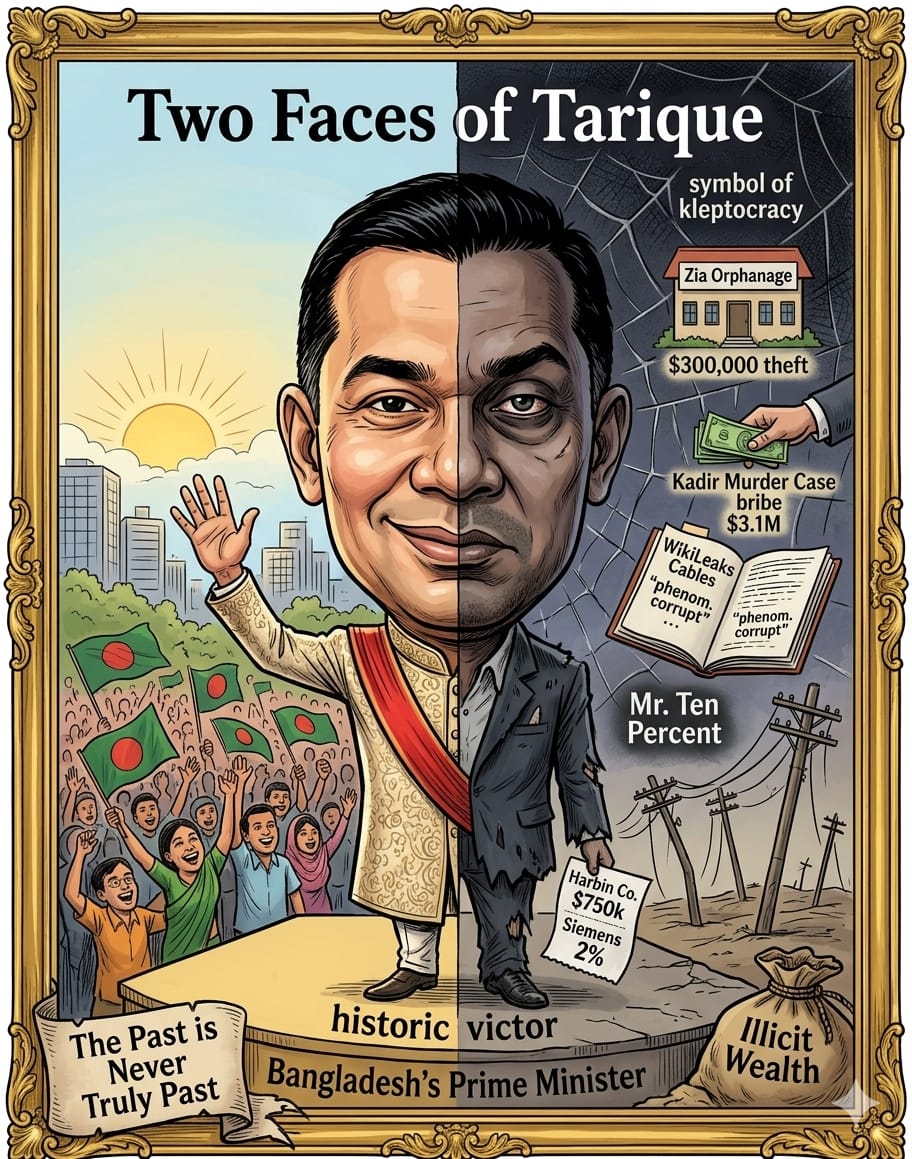
    Eighty-four cases. That is how many were filed against Tarique Rahman between 2007 and 2024 — cases involving money laundering, arms trafficking, murder conspiracy, and corruption on a scale that made US Embassy diplomats in Dhaka use the phrase “symbol of kleptocratic government” in classified cables later published by WikiLeaks.

    As of March 2025, every single one has been acquitted.

    The process was not slow. It was not gradual. It was a single, coordinated legal event — a cascade of acquittals that began within months of the July 2024 uprising and the fall of the Awami League government. Courts that had once sentenced men to death and decades of imprisonment now declared, one after another, that the evidence was insufficient, the trials were flawed, the convictions were unsafe. By September 2025, the Supreme Court of Bangladesh had put its seal on the entire process, dismissing the last remaining petition for retrial in the August 21 grenade attack case.

    The accused did not walk free into obscurity. They walked into power.

    The Charge Sheet: What Was Proven, Then Unproven

    To understand what the Great Acquittal erased, you have to understand what was on the record.

    August 21, 2004: The Grenade Massacre

    On the evening of August 21, 2004, thirteen Arges grenades rained down on a crowd of 20,000 at an Awami League rally on Bangabandhu Avenue in Dhaka. Twenty-four people were killed. More than 500 were injured. Ivy Rahman, the party’s Women’s Affairs Secretary, died three days later from her wounds.

    The trial, which concluded in October 2018 after 14 years, convicted 49 people — including Tarique Rahman, then-senior minister Lutfozzaman Babar, and HuJI-B chief Mufti Abdul Hannan. Several were sentenced to death. Tarique, tried in absentia after fleeing to London, received a life sentence.

    The evidence was extensive. Prosecutors presented intercepted communications, witness testimony from military intelligence officers, and forensic analysis matching the grenades to military stockpiles. The trial court’s 4,000-page verdict detailed how the attack was orchestrated through the Prime Minister’s Office and Hawa Bhaban — Tarique’s unofficial power center.

    On December 1, 2024 — barely four months after the fall of the Awami League — the High Court acquitted all 49 accused. The court found that the trial had been conducted improperly, that witness testimony was unreliable, and that the prosecution had failed to establish guilt beyond reasonable doubt.

    “The High Court annulled the trial court verdict and acquitted all convicts including Tarique Rahman.” — Attorney General’s Office spokesman, December 2024

    In September 2025, when the Appellate Division dismissed a petition for retrial, the acquittal became final. The 24 Martyrs of August 21: Who They Were, How They Died, and Why the State Tried to Erase Them

    The Chittagong Arms Haul: 4,930 Guns and a Cover-Up

    On the night of April 1, 2004, police and Coast Guard intercepted the loading of ten trucks at the Chittagong Urea Fertilizer Limited jetty on the Karnaphuli River. What they found remains the largest arms seizure in Bangladesh’s history: 4,930 firearms, 27,020 grenades, 840 rocket launchers, 300 rockets, and over 1.1 million rounds of ammunition.

    The weapons were destined for ULFA — the United Liberation Front of Asom — a militant group fighting for Assam’s independence from India. Indian intelligence confirmed the connection. Two witnesses later told the court that the operation was conducted with the knowledge of NSI and DGFI, Bangladesh’s military intelligence agencies, and that government officials had threatened them with death to keep them silent.

    In January 2014, a special court sentenced 14 people to death, including ULFA military chief Paresh Baruah and former minister Lutfozzaman Babar.

    In December 2024, the High Court acquitted Babar and five others. In January 2025, it acquitted them in the parallel Arms Act case as well. Paresh Baruah’s death sentence was reduced to 14 years. The Chittagong Arms Haul: 4,930 Guns, 840 Rocket Launchers, and a State-Sponsored Cover-Up

    Tarique Rahman’s Money Laundering: $2.5 Million Washed Clean

    In June 2007, the Anti-Corruption Commission filed a case against Tarique Rahman and his business partner Giasuddin Al Mamun for laundering Tk 20.41 crore — approximately $2.5 million at the time. The case detailed how Tarique, while serving as the de facto power behind his mother’s government, used his influence to help Mamun acquire and then launder the money through Singapore bank accounts.

    A trial court acquitted Tarique in November 2013. But in July 2016, the High Court overturned that acquittal, sentencing him to seven years’ imprisonment and a fine of Tk 20 crore. The court was direct:

    “Tarique Rahman influenced political power to help his close friend, Giasuddin Mamun, to get and then launder 200 million taka ($2.5m).” — Deputy Attorney General Moniruzzaman Kabir to AFP, July 2016

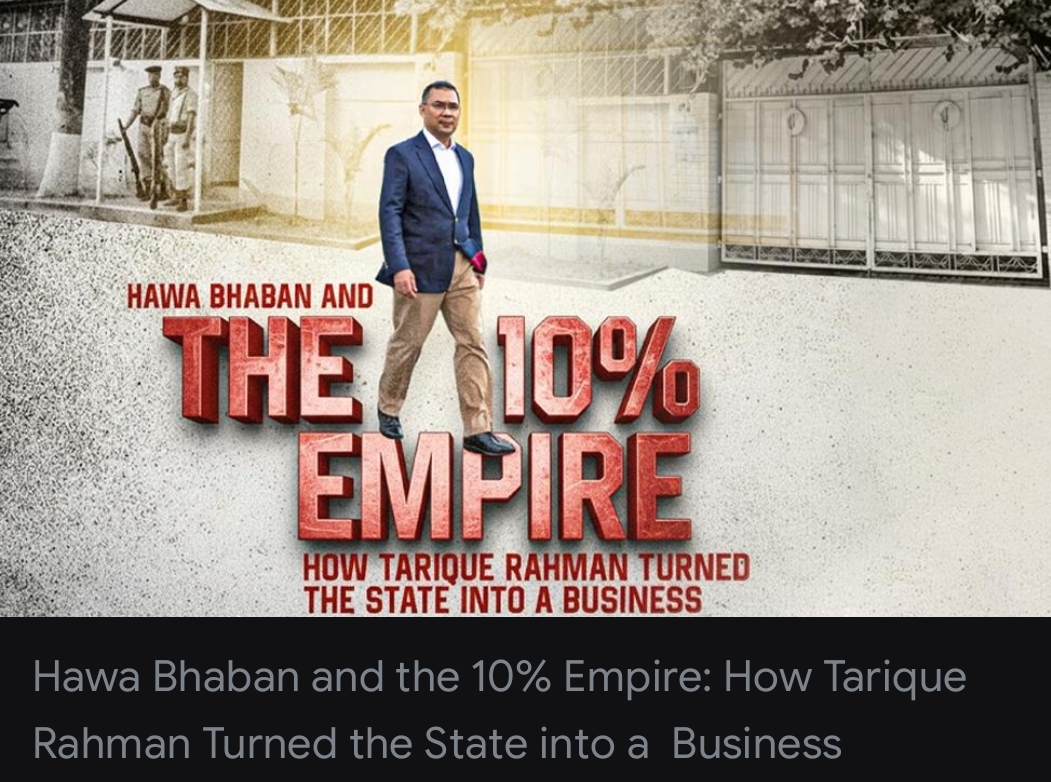
    That conviction stood for eight years. In December 2024, the Supreme Court stayed the sentence. In March 2025, the Appellate Division acquitted both Tarique and Mamun entirely. “Mr. Ten Percent” — How Tarique Rahman Ran a Parallel Government from Hawa Bhaban (2001-2006)

    Khaleda Zia’s Orphanage Trust: Stealing From Children

    The Zia Orphanage Trust case was among the most damning. The ACC alleged that Khaleda Zia, through the trust named after her late husband, embezzled funds meant for orphans. In February 2018, a special court convicted Khaleda and sentenced her to five years. By October 2018, the High Court had enhanced the sentence to ten years. Tarique, also convicted, received ten years.

    In November 2024, the High Court acquitted Khaleda, declaring the verdict null and void. In January 2025, the Supreme Court acquitted both Khaleda and Tarique in this case and the parallel Zia Charitable Trust case.

    Khaleda Zia died on December 30, 2025, having outlived every conviction against her.

    Shamim Iskander: The Brother Who Bled Biman Airlines

    Khaleda Zia’s younger brother, Shamim Iskander, was a former flight engineer at Biman Bangladesh Airlines who exploited his position as the Prime Minister’s brother to control the airline’s commercial operations. The ACC documented at least Tk 40 crore in commissions from aircraft leases during the BNP tenure, with 36 witnesses lined up to testify.

    In March 2025, a Dhaka court simply discharged Shamim Iskander and his wife from the case. The 36 witnesses never testified. By March 2026, Shamim Iskander was sitting in the VIP gallery at the maiden session of the 13th Parliament.

    The Pattern: How It Happened

    Look at the timeline, and a pattern becomes impossible to ignore.

    July 2024: The Awami League government falls. A caretaker administration takes over. Within weeks, the legal machinery begins to reverse.

    December 2024: The High Court acquits all 49 accused in the August 21 grenade attack case. The same month, it acquits Babar and others in the Chittagong arms haul. The Supreme Court stays Tarique’s money laundering sentence.

    January 2025: The Supreme Court acquits Khaleda and Tarique in the Orphanage Trust and Charitable Trust cases.

    March 2025: Tarique and Mamun acquitted in the money laundering case. Shamim Iskander discharged from the Biman corruption case.

    September 2025: The Supreme Court dismisses the last petition for retrial in the grenade attack case, making the acquittals final.

    February 2026: Tarique Rahman is sworn in as Prime Minister.

    There is no independent judiciary in this sequence. There is a judiciary that responded to a political earthquake by undoing every legal consequence of the previous political era. The cases were not retried with new evidence. They were not subjected to fresh scrutiny. They were reversed — comprehensively, rapidly, and with a uniformity that defies coincidence.

    What International Observers Said

    Human Rights Watch, which documented many of the original crimes under BNP rule, has not issued a formal statement on the acquittals. But their earlier reports provide context that the courts chose to disregard.

    Transparency International’s Corruption Perceptions Index ranked Bangladesh as the most corrupt country on earth for five consecutive years during BNP rule (2001-2005) — a record no other nation has matched. The scores were not marginal: Bangladesh scored 0.4 out of 10 in 2001, a figure so low that TI itself noted the “very different results” across surveys while still confirming the composite finding.

    The International Crisis Group, in its Asia Report No. 121 (October 2006), documented that the BNP-led coalition government “did not target radical Islamist groups” despite religious extremism arising under its watch — the same extremism that culminated in the August 17, 2005 nationwide bombings and the August 21 grenade attack.

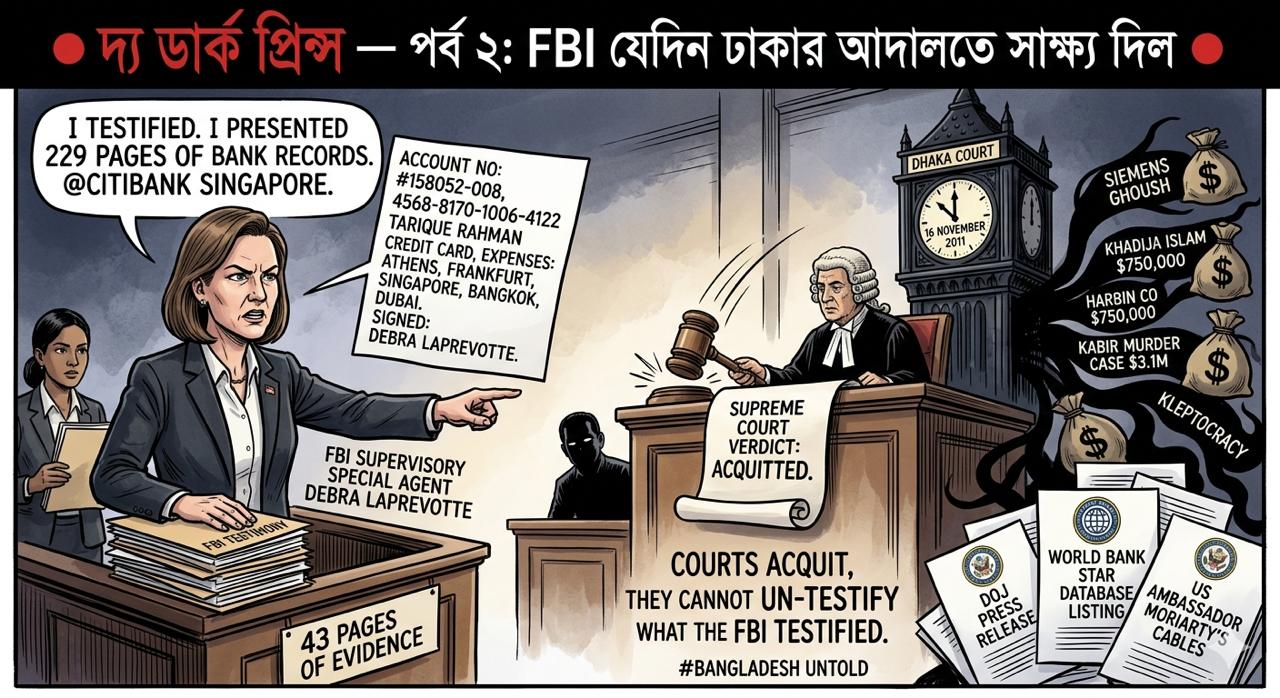
    US Embassy cables published by WikiLeaks described Tarique Rahman as a “symbol of kleptocratic government” and the “Dark Prince” of Bangladeshi politics. These were not opposition propaganda. They were the assessments of American diplomats stationed in Dhaka, writing in classified communications they never expected to see published.

    None of this evidence was presented as new argument in the acquittal proceedings. It was simply ignored.

    The Questions Nobody Is Asking

    When every conviction from an era is overturned after a regime change, and when those acquitted then assume power, the question is not whether the original trials were fair. The question is whether the acquittals were.

    The August 21 grenade attack killed 24 people. The victims’ families spent 14 years waiting for justice. They watched 49 people convicted. Then, in a single court session, they watched all 49 walk free. Nobody has explained to them why the evidence that sustained a 4,000-page verdict was suddenly insufficient.

    The Chittagong arms haul put 4,930 military-grade weapons and 27,020 grenades on ten trucks at a government jetty. The connection to Indian insurgents was confirmed by Indian intelligence. The involvement of Bangladesh’s own intelligence agencies was testified to by witnesses who said they were threatened with death. These facts did not change between 2014 and 2024. What changed was the government.

    Tarique Rahman’s money laundering was documented in Singapore court records — not Bangladeshi ones. Singapore’s courts convicted his associate, Giasuddin Al Mamun, in a parallel case. The $2.5 million was real. The bank accounts were real. The paper trail crossed international borders. None of this was disputed in the acquittal. It was simply set aside.

    The Accused Now Run the Country

    There is a word for what has happened in Bangladesh since July 2024, though it is a word that legal scholars prefer to avoid: impunity.

    Not the impunity of a single pardon or a single acquittal. The impunity of a system — a legal system that has demonstrated, in case after case, that political power determines legal outcomes. That convictions are provisional. That justice is temporary. That the courts answer to whoever sits in Bangabhaban.

    The ICT Is Now a BNP Weapon: How a Party Lawyer Became Chief Prosecutor of the Tribunal That Prosecutes BNP’s Enemies The pattern extends beyond acquittals. In the same month that Shamim Iskander was discharged from his corruption case, the BNP government appointed a party lawyer as the new chief prosecutor of the International Crimes Tribunal — the body that had once prosecuted crimes against humanity during the 1971 Liberation War. The tribunal, repurposed, now targets BNP’s political opponents.

    12.1 Million Ghost Voters: How Bangladesh’s Voter Rolls Were Stuffed Before the 2007 Election And before the 2026 election, the same electoral rolls that had been stuffed with 12.1 million fake names before 2007 were quietly reformed — though nobody has been held accountable for the original fraud.

    The $300 million ghost company that channeled oil contracts to shell firms with no website, no experience, and political connections? The investigation has been shelved.

    The man US diplomats called the “Dark Prince” is now the Prime Minister. His mother’s corruption cases are cleared. His brother-in-law sits in Parliament’s VIP gallery. The arms haul conspirators are free. The grenade massacre convicts are free. Every single case — 84 of them — has been wiped clean.

    There is no mechanism in Bangladesh to appeal these acquittals. The Supreme Court has spoken. The legal system considers the matter closed. The victims of August 21, 2004 — the 24 dead, the 500 injured, the families who waited 14 years for accountability — have no further court to approach.

    That is not justice. That is its absence.

    Sources

    • Human Rights Watch, “Bangladesh: Events of 2004-2006,” World Report chapters
    • International Crisis Group, Asia Report No. 121, “Bangladesh Today,” October 2006
    • Transparency International, Corruption Perceptions Index, 2001-2005
    • US Embassy Cable (Dhaka), “Tarique Rahman: Symbol of Kleptocratic Government,” published by WikiLeaks
    • Bangladesh High Court, August 21 Grenade Attack Case, Acquittal Order, December 2024
    • Bangladesh Supreme Court, Appellate Division, Dismissal of Retrial Petition, September 2025
    • Bangladesh High Court, Chittagong Arms Haul Case, Acquittal Order, December 2024
    • Bangladesh Supreme Court, Appellate Division, Money Laundering Case Acquittal, March 2025
    • Bangladesh High Court, Zia Orphanage Trust Case Acquittal, November 2024
    • Bangladesh Supreme Court, Zia Charitable Trust Case Acquittal, January 2025
    • Dhaka District Court, Shamim Iskander Discharge Order, March 2025
    • Deputy Attorney General Moniruzzaman Kabir, statement to AFP, July 2016
    • Attorney General’s Office spokesman, statement on grenade attack acquittal, December 2024
    • NBC News, coverage of August 21 acquittals, December 2024
    • Dhaka Tribune, “Shamim Iskander in Parliament VIP Gallery,” March 2026
    • The Business Standard, Khaleda Zia case coverage, 2024-2025
  • 12.1 Million Ghost Voters: How Bangladesh’s Voter Rolls Were Stuffed Before the 2007 Election

    12.1 Million Ghost Voters: How Bangladesh’s Voter Rolls Were Stuffed Before the 2007 Election

    Twelve point one million. That is not a typo. That is the number of fraudulent names that an audit found crammed onto Bangladesh’s voter rolls ahead of the 2007 parliamentary election — a figure so staggering it exceeded the entire population of Greece at the time.

    The discovery did not come from a whistleblower or a leak. It came from simple arithmetic. When researchers cross-referenced the voter list with census data, the numbers refused to align. The rolls contained roughly 1.23 crore (12.3 million) more names than there were eligible voters in the country. Ghosts, duplicates, children, the deceased — all of them registered to vote in a system that had no photographs, no biometrics, and no reliable mechanism to verify identity at the polling station.

    The Aziz Commission and the Partisan Voter List

    At the center of this fraud sat Chief Election Commissioner M.A. Aziz, appointed by the BNP-Jamaat alliance government. Aziz oversaw the preparation of the voter list that would be used for the scheduled January 2007 election. Under his supervision, the rolls swelled with millions of phantom entries — names that corresponded to no living, eligible citizen.

    The Awami League and opposition parties raised the alarm repeatedly. Their objections were dismissed. Aziz’s commission showed no interest in investigating the discrepancies. When independent analysts compared the voter rolls against population data, the gap was enormous and unmistakable: 12.1 million names that should not have been there.

    “The BNP-Jamaat alliance government even prepared the voter list with about 1.23 crores (12.3 million) fake voters in order to win the next election.”

    — Awami League Official Documentation

    How the Fraud Worked

    The manipulation was not subtle. It operated across several dimensions simultaneously:

    Ghost voters. Names of people who did not exist, had died, or were below voting age were added to the rolls en masse. In a country with no photo voter ID, there was no way for polling agents to verify whether the person standing before them was actually the registered voter.

    Duplicate entries. The same individual was registered multiple times — under slight variations of their name, under different addresses, or across different constituencies. A single person could theoretically vote in several locations.

    Territorial manipulation. Voters were registered in constituencies where they did not reside, padding the rolls in strategically important districts. This was gerrymandering by registration rather than by boundary.

    The scale of the operation was industrial. 12.1 million fake names represented roughly 10% of the entire voter roll — a margin wide enough to swing any election in a country where contests are frequently decided by single-digit percentages.

    The Constitutional Rig That Accompanied the Fraud

    The fake voters were not an isolated scheme. They were one component of a comprehensive effort to rig the electoral infrastructure from top to bottom.

    In June 2003, the BNP government appointed Justice K.M. Hasan as Chief Justice. In 2004, they amended the constitution to raise the retirement age of Supreme Court justices from 65 to 67 — a change timed precisely so that Hasan would be the last retired Chief Justice when the caretaker government needed to form before the next election. Under Bangladesh’s system, the immediate past Chief Justice automatically becomes Chief Advisor of the caretaker government that oversees elections.

    “In 2004, the BNP deliberately changed the constitution to increase the retirement age of Supreme Court judges from 65 to 67 years.”

    — Dhaka Tribune

    The plan was elegant in its audacity: stuff the voter rolls with millions of fake names, then install a Chief Advisor with known BNP connections to oversee the election conducted on those compromised rolls. The structure of the rig went all the way down to the ballot box itself — opaque containers that made ballot stuffing undetectable.

    The Collapse

    It did not work. The scale of the fraud was too visible, and the opposition’s response was too fierce.

    Justice K.M. Hasan, facing massive street protests and the threat of a boycott, declined the Chief Advisor position on October 27, 2006, citing health reasons. The Logi Boitha movement of October 28 — violent clashes between AL and BNP supporters that killed at least 12 people — made it clear that a Hasan-led caretaker government would not be accepted.

    President Iajuddin Ahmed then assumed the dual role of President and Chief Advisor — an arrangement that placed a BNP-appointed head of state in charge of overseeing an election already compromised by 12 million fake voters. The Awami League saw the writing on the wall.

    January 3, 2007: The Awami League formally withdrew from the election, declaring a boycott over the compromised voter list and partisan arrangements. Without the participation of the major opposition party, the election had no legitimacy.

    Eight days later, on January 11, the military intervened. President Iajuddin declared a state of emergency and resigned as Chief Advisor. The 1/11 caretaker government under Fakhruddin Ahmed took power — and one of its first priorities was the voter roll.

    The Fix: A Photo Voter ID for the First Time

    The discredited Aziz Commission was forced out. In its place, ATM Shamsul Huda was appointed Chief Election Commissioner on February 5, 2007, serving alongside commissioners Muhammad Sohul Hossain and M. Sakhawat Hossain.

    What they built was revolutionary for Bangladesh:

    • A photo-based voter list — national voter ID cards with photographs — created for the first time in the country’s history
    • Transparent ballot boxes replacing the opaque containers that had enabled stuffing
    • Electronic voting machines piloted for the first time
    • Comprehensive biometric data collection
    • Party registration requirements formalizing political accountability

    “Under his leadership, the Election Commission, assisted by the military, prepared a photo-based voter list, initiated dialogues for electoral law reforms, introduced party registration requirements, and piloted the use of electronic voting machines.”

    — bdnews24.com, on ATM Shamsul Huda’s legacy

    The new system was not merely a technical upgrade. It was a structural rebuke to the old one. Every ghost voter on the old rolls became a ghost — unphotographed, unverified, and unable to materialize at a polling station where agents could now check faces against ID cards. The duplicate entries collapsed because biometric registration made it impossible to register twice. The territorial manipulation ended because addresses were now tied to verifiable residence.

    The photo voter ID became the de facto national identity document for all Bangladeshis — a system so fundamental that its origins in a corruption scandal are often forgotten. It eliminated, permanently, the possibility of the type of mass voter fraud attempted under the BNP-Jamaat alliance.

    The Proof: December 2008

    The ultimate vindication came on December 29, 2008. The election held under the new system — with photo voter IDs, transparent ballot boxes, and a reconstituted Election Commission — was recognized domestically and internationally as free and fair.

    “To their credit, the caretakers were eventually able to take a decent way out of power through presiding over — and credit here goes to ATM Shamsul Huda and his team at the Election Commission — a free and fair election in December 2008.”

    — Dhaka Tribune

    The Awami League and Grand Alliance won by a two-thirds majority. The result was accepted by all parties. It remains one of the most credible elections in Bangladesh’s history — precisely because the system that produced it had been rebuilt from the ashes of the 12.1 million phantom voters.

    Why This Matters Now

    The 12.1 million fake voters are not ancient history. They are the reason Bangladesh has a photo voter ID system at all. They are the reason the 2008 election was credible. And they are a case study in what happens when electoral infrastructure is captured by a ruling party — the voter rolls become a weapon, the election commission becomes a tool, and the constitutional framework becomes a mechanism for entrenching power.

    The BNP-Jamaat alliance did not try to win an election. They tried to make winning unnecessary — by stuffing the rolls so thoroughly that the result was predetermined. The 1/11 intervention, for all its controversies, destroyed that infrastructure and replaced it with one that could not be rigged the same way.

    That replacement — the photo voter ID, the transparent ballot boxes, the biometric registration — is the most durable positive legacy of the 1/11 period. It was built because 12.1 million ghosts demanded it.

    Read more about Bangladesh’s electoral crisis and the 1/11 intervention:

  • 600 Hindu Women of Bhola: The Mass Rapes Bangladesh Tried to Bury

    600 Hindu Women of Bhola: The Mass Rapes Bangladesh Tried to Bury

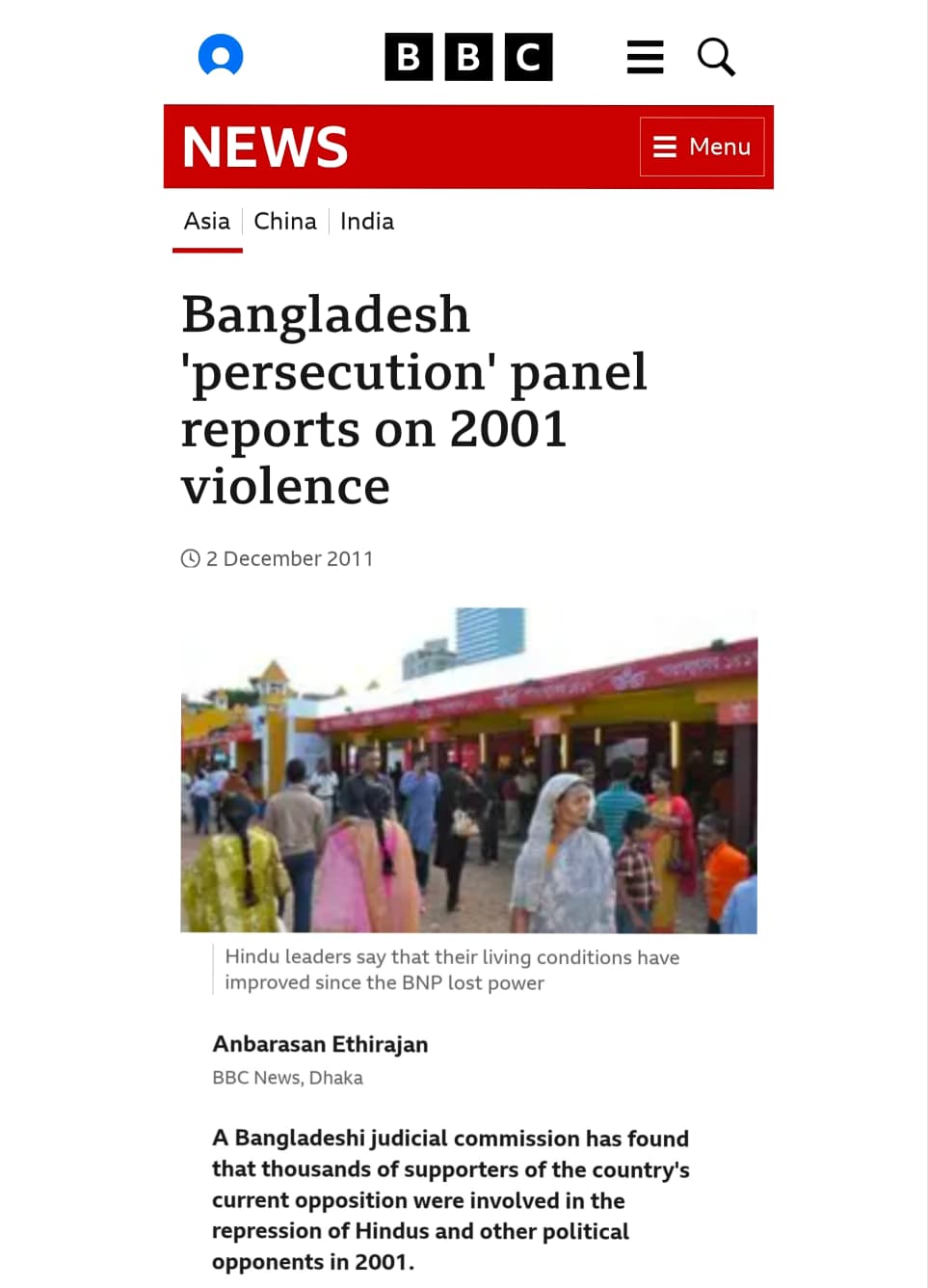
    On October 1, 2001, Bangladesh held its eighth general election. The BNP-led four-party alliance — which included the Islamist Jamaat-e-Islami — won a landslide. Within days, a wave of targeted violence swept across the country’s Hindu-majority villages. In Char Fasson Upazila, Bhola District, approximately 600 Hindu women were gang-raped. The youngest victim was 8 years old. The oldest was 70.

    This is not a story Bangladesh’s government wanted told. But the evidence — from Amnesty International, the US State Department, Bangladeshi courts, and survivors themselves — is overwhelming.

    What Happened in Bhola

    Char Fasson is a remote upazila in Bhola District, an island district in the Bay of Bengal. Its Hindu communities were predominantly poor, politically marginalized, and — after October 1, 2001 — utterly defenseless.

    The Daily Star reported on November 16, 2001 that BNP activists had gang-raped approximately 600 Hindu women in Char Fasson alone. The scale was staggering. Entire villages were overrun. Women were dragged from their homes. Temples were destroyed. Homes were looted and burned.

    The victims ranged from an 8-year-old child to a 70-year-old grandmother. This was not random violence. It was systematic. It was designed to punish Hindus for their perceived support of the Awami League — and to ensure they would never vote again.

    “The current wave of attacks against the Hindu community in Bangladesh began before the general elections of 1 October 2001 when Hindus were reportedly threatened by members of the BNP-led alliance not to vote.”

    — Amnesty International, “Bangladesh: Attacks on members of the Hindu minority” (ASA 13/006/2001, December 2001)

    Before the Vote: A Campaign of Intimidation

    The violence didn’t begin after the election. It began before it.

    Amnesty International documented that Hindu communities were threatened by BNP alliance members in the weeks leading up to the vote. The message was clear: don’t vote for the Awami League, or face the consequences. For Hindu Bangladeshis — who had historically supported the secular Awami League — this was a direct threat against their democratic participation.

    When the BNP won anyway, the threats became action. The gloves came off. And in district after district, Hindu communities paid the price.

    Lalmohan Upazila: The Terror Next Door

    The horrors of Char Fasson were replicated in Lalmohan Upazila, also in Bhola District. BNP supporters carried out coordinated attacks:

    • Houses looted — Hindu homes stripped of everything of value
    • Muslim allies targeted — Muslims who sheltered Hindus had their homes looted too
    • Women and children raped — Sexual violence used as a weapon of terror
    • Property destroyed — Trees cut down, homes vandalized, temples desecrated
    • Complete economic devastation — Hindu economic resources deliberately targeted

    This wasn’t a riot. It was a pogrom — organized, directed, and designed to drive an entire community out of the political process.

    Purnima Rani Shil: The Face of the Atrocity

    Among the hundreds of victims, one case became internationally documented. Purnima Rani Shil served as a polling agent for the Awami League candidate during the 2001 elections. For the crime of standing at a polling booth and facilitating democratic participation, she was gang-raped by members of the opposing party.

    “Purnima Rani, who served as a polling agent for the Awami League candidate during the 2001 national elections, was gang-raped by members of the opposing party. This horrific incident not only instilled fear among minorities but also sent shockwaves.”

    — Devpolicy Blog, Development Policy Centre, August 2024

    Justice, when it came, was a decade late. In 2011, a court in Sirajganj District sentenced 11 individuals to lifetime imprisonment for the rape of Purnima Rani. But for the other hundreds of victims in Bhola, no such justice ever came.

    We documented Purnima Rani’s story in detail in a previous article: She Stood at a Polling Booth. They Destroyed Her for It.

    Jessore District: The Violence Spreads

    Bhola was the epicenter, but it was not alone. In Tuniaghara, Manirampur Upazila, Jessore District, six Hindu families were forced to flee the area entirely. Two women were raped. The Asian Tribune documented the attacks, but the pattern was the same across the country: BNP supporters targeting Hindu communities with violence designed to displace, terrorize, and silence.

    Temple Destruction: Erasing Sacred Space

    The attacks targeted more than bodies. They targeted identity. Hindu temples and sacred sites were destroyed across the affected districts. Homes were burned. The message was unmistakable: you do not belong here.

    This wasn’t incidental damage from communal clashes. Temples don’t catch fire by accident in multiple districts simultaneously. The destruction of religious sites was a deliberate act of cultural erasure — a way of telling Hindu Bangladeshis that their presence in the country was conditional, revocable, and ultimately unwelcome.

    The International Response

    Amnesty International

    Amnesty International issued a major report in December 2001: “Bangladesh: Attacks on members of the Hindu minority” (AI Index: ASA 13/006/2001). The report documented systematic attacks, named the BNP-led alliance as responsible, and called on the Government of Bangladesh to investigate and prosecute.

    The government did not comply.

    US State Department

    The US State Department’s International Religious Freedom Report 2002 documented the attacks:

    “According to a human rights organization, at least 10 Hindu women were raped and a number of Hindu homes were looted by low-level BNP workers a few days before the BNP took power from the non-partisan caretaker government.”

    — US State Department, International Religious Freedom Report 2002

    The State Department’s figure of “at least 10” represents only documented cases — a fraction of the true number, which Bangladeshi media placed at 600 in Char Fasson alone.

    Fair Election Monitoring Alliance (FEMA)

    The Fair Election Monitoring Alliance, a Bangladeshi election observation body, confirmed the political nature of the violence:

    “Most of the violence was committed by BNP activists.”

    — Fair Election Monitoring Alliance (FEMA), as cited in Refworld/UNHCR documentation

    UCAN News

    “The worst violence followed the 2001 election, which BNP and their Jamaat alliance won. Their supporters unleashed a months-long reign of terror, which included killings, rapes and destruction of homes.”

    — UCAN News

    The Hindu Exodus

    The violence achieved its intended effect. Hundreds of Hindus fled Bangladesh, crossing the border into India. Amnesty International reported the exodus in December 2001. Gulf News confirmed it in February 2002.

    This was not a new phenomenon. The Hindu population of Bangladesh has been in continuous decline — from approximately 28% in 1941 to roughly 8% by 2011. Each wave of targeted violence accelerates the exodus. The 2001 post-election attacks were among the most devastating single drivers of this demographic collapse.

    Year Hindu Population (%) Context
    1941 ~28% Pre-Partition
    1951 ~22% Post-Partition exodus
    1974 ~13% Post-Liberation War
    2001 ~9.6% Pre-election
    2011 ~8% After 2001 violence, continued emigration

    Every percentage point represents hundreds of thousands of people — families who decided that survival meant leaving the only home they had ever known.

    The Judicial Inquiry Commission: 25 Leaders Named

    A Judicial Inquiry Commission was eventually formed to investigate the post-election violence. Its findings were damning: 25 Ministers and Members of Parliament from the BNP-Jamaat alliance were identified as complicit in the attacks.

    “Supporters and leaders of the BNP-led coalition and its Jamaat allies [were linked] with targeted violence against religious minorities, including killings, rape, arson and looting.”

    — Fair Observer, February 2026

    Twenty-five elected officials. Named by a judicial commission. And yet — no mass prosecutions followed. No accountability. No justice for the 600 women of Bhola.

    The New York Times Covered It

    On October 4, 2001, the New York Times ran a story headlined “Post-Election Violence in Bangladesh Kills 3”. The article covered the eruption of violence between political supporters, noting police complicity. It was a brief mention in a distant corner of the international news cycle — but it confirmed that the world knew. The world simply didn’t care enough to act.

    What the Numbers Don’t Capture

    Six hundred women. That number — staggering as it is — barely scratches the surface of what happened. It doesn’t count:

    • The women who never reported their rapes out of shame, fear, or knowledge that justice would never come
    • The children born of those rapes
    • The families destroyed — husbands who couldn’t cope, parents who buried their grief, communities that shattered
    • The psychological trauma that echoes across generations
    • The Hindus who fled to India and never returned
    • The temples that were never rebuilt

    The number 600 is a floor, not a ceiling. The true scale of what happened in Bhola in October 2001 will never be fully known.

    Why This Matters Now

    The BNP returned to power in 2025-26. The same party whose activists gang-raped 600 Hindu women now governs Bangladesh again. The same alliance that included Jamaat-e-Islami — the party whose 1971 war crimes against Hindus are well documented — is back in the halls of power.

    When a state refuses to prosecute mass rape, it doesn’t just deny justice to the victims. It tells every future perpetrator that impunity is guaranteed. The 2001 attacks were possible because the perpetrators of earlier anti-Hindu violence — in 1964, 1971, 1990, 1992 — were never held accountable.

    And now, the cycle risks repeating.

    Sources

    • Amnesty International — “Bangladesh: Attacks on members of the Hindu minority” (ASA 13/006/2001), December 2001. [Link]
    • US State Department — International Religious Freedom Report 2002, Bangladesh section. [Link]
    • The Daily Star — “Rape, loot, arson stalk Char Fasson Hindus,” November 16, 2001.
    • BBC News — “Bangladesh gang-rape case verdict due,” May 4, 2011. [Link]
    • Fair Election Monitoring Alliance (FEMA) — As cited in Refworld/UNHCR documentation.
    • UCAN News — Coverage of post-2001 election violence against minorities.
    • New York Times — “Post-Election Violence in Bangladesh Kills 3,” October 4, 2001.
    • Gulf News — Reportage on Hindu exodus, February 12, 2002.
    • Asian Tribune — Reporting on Jessore District attacks.
    • IRIN News — “Minorities targeted in Bangladesh political violence,” January 31, 2014.
    • Devpolicy Blog, Development Policy Centre — Analysis of Purnima Rani Shil case, August 2024.
    • Fair Observer — “Bangladesh: Minorities Under Siege,” February 2026.

    Related Articles

  • She Stood at a Polling Booth. They Destroyed Her for It. — The Purnima Rani Shil Story

    She Stood at a Polling Booth. They Destroyed Her for It. — The Purnima Rani Shil Story

    She Stood at a Polling Booth. They Destroyed Her for It.

    On October 1, 2001, Purnima Rani Shil did what citizens in a democracy are supposed to do. She showed up at her local polling station in Sirajganj District and served as a polling agent for the Awami League candidate. She believed her vote mattered. She believed her presence at the ballot box was a right, not a crime.

    The BNP-Jamaat coalition thought otherwise.

    That night, after the election results came in and the BNP-led Four-Party Alliance declared victory, Purnima Rani was gang-raped by members of the opposing party. Her crime was not personal. It was political. She had stood in the wrong place, represented the wrong party, and — most dangerously of all — she was Hindu in a country where minorities had just been taught what happens when you participate in democracy.

    Her case would become the most documented instance of the 2001 post-election violence against minorities. It took ten years to get a conviction. And it revealed a system designed not to protect victims, but to shield the powerful.

    The Night Bangladesh’s Democracy Broke

    To understand what happened to Purnima Rani Shil, you have to understand what happened across Bangladesh in the days following October 1, 2001. The violence was not random. It was not spontaneous. It was organized, targeted, and systematic — a coordinated campaign of terror against the Hindu minority, orchestrated from the highest levels of the BNP-Jamaat government.

    A judicial inquiry commission, ordered by the Bangladesh High Court in 2009 and reporting in 2011, documented the scale:

    “The commission reported that the number of rapes committed exceeded 18 thousand. The report also notes incidents of violence, arson, looting, and torture against the minority Hindu community of Bangladesh.”

    — bdnews24.com, April 24, 2011, citing judicial inquiry commission findings

    The commission identified 25 Ministers and Members of Parliament from the BNP-Jamaat alliance as complicit in orchestrating the violence. 25,000 people participated. Over 10,000 cases of human rights abuses were documented against minorities.

    And the BNP’s response? They rejected the investigation findings, calling it “partisan.”

    Scale of the 2001 Post-Election Violence

    • 18,000+ rapes reported against Hindu women and girls
    • 25 MPs and Ministers identified as orchestrators
    • 25,000+ participants in targeted violence
    • 20+ districts affected across southwestern Bangladesh
    • 600 Hindu women gang-raped in Bhola District alone (The Daily Star, November 16, 2001)
    • Hundreds of Hindu families fled to India (Amnesty International, December 2001)

    What Happened to Purnima Rani Shil

    The details of Purnima Rani’s case are among the most thoroughly documented of any individual victim of the 2001 violence — precisely because it eventually reached a courtroom, something most cases never did.

    Purnima Rani had served as a polling agent for the Awami League during the October 1 election. In Bangladesh’s electoral system, polling agents represent their party at individual voting centers, monitoring the process and ensuring fairness. It is a legal, recognized role. She was exercising a democratic right.

    After the BNP-Jamaat victory was declared, local BNP supporters targeted her specifically. She was not caught in random communal violence. She was deliberately punished for her political participation.

    “Purnima Rani, who served as a polling agent for the Awami League candidate during the 2001 national elections, was gang-raped by members of the opposing party. This horrific incident not only instilled fear among minorities but also sent shockwaves…”

    — Devpolicy Blog, Development Policy Centre, August 2024

    The message was clear: Hindus who participate in Bangladesh’s democracy will be destroyed. Not just politically. Physically. Sexually. Completely.

    The Systematic Targeting of Minorities

    Purnima Rani’s rape was not an isolated incident. It was part of a deliberate, organized campaign that began before the election and escalated dramatically after.

    Before the Election: Intimidation

    Amnesty International documented that the violence started before polling day itself:

    “The current wave of attacks against the Hindu community in Bangladesh began before the general elections of 1 October 2001 when Hindus were reportedly threatened by members of the BNP-led alliance not to vote.”

    — Amnesty International, “Bangladesh: Attacks on members of the Hindu minority” (AI Index: ASA 13/006/2001, December 2001)

    The US State Department’s International Religious Freedom Report 2002 confirmed:

    “According to a human rights organization, at least 10 Hindu women were raped and a number of Hindu homes were looted by low-level BNP workers a few days before the BNP took power from the non-partisan caretaker government.”

    — US State Department, International Religious Freedom Report 2002

    After the Election: Terror

    Once the BNP-Jamaat coalition won, the retribution was swift and devastating. Across 20+ districts in southwestern Bangladesh — areas with large Hindu populations — BNP supporters unleashed a months-long campaign of violence:

    • Bhola District: 600 Hindu women gang-raped in Char Fasson Upazila. The youngest victim was 8 years old. The oldest was 70. (The Daily Star, November 16, 2001)
    • Jessore District: Six Hindu families forced to flee, two women raped (Asian Tribune)
    • Lalmohan Upazila, Bhola: Houses looted, women and children raped, properties stripped bare
    • Across affected districts: Hindu temples destroyed, homes burned, economic resources deliberately targeted

    The Fair Election Monitoring Alliance (FEMA) concluded bluntly: “Most of the violence was committed by BNP activists.”

    The Long Road to Justice: 10 Years to a Conviction

    It took a decade for Purnima Rani’s case to reach a verdict. In 2011, a court in Sirajganj District sentenced 11 individuals to lifetime imprisonment for the gang rape of Purnima Rani Shil (BBC News, May 4, 2011).

    Ten years. For a case with identified perpetrators and documented evidence. This is the reality of justice for minority victims in Bangladesh.

    And Purnima Rani’s case was the exception. The vast majority of the 18,000+ documented rapes never resulted in any legal action whatsoever. Most victims never filed reports — they knew the futility. Local police were often complicit. The political will to prosecute simply did not exist under the BNP government, and even under subsequent administrations, the cases gathered dust.

    Why Purnima Rani’s Case Succeeded Where Others Failed

    • High-profile documentation: Her case was taken up by international human rights organizations, making it impossible to quietly bury
    • Clear identification of perpetrators: Unlike mass attacks where perpetrators are anonymous, the individuals who attacked Purnima Rani were identified
    • Judicial inquiry commission pressure: The 2009 High Court order and subsequent commission findings created pressure for accountability
    • Political transition: The Awami League government that came to power in 2009 was more willing to pursue cases related to BNP-era violence

    But even with all these factors, it still took ten years. Imagine what happens to the cases that lack even one of these advantages.

    The BNP’s Response: Deny, Dismiss, Deflect

    The BNP’s response to the 2001 post-election violence follows a pattern that continues to this day:

    1. Deny the scale: Dismiss reports as exaggerated or fabricated
    2. Attack the investigators: Call the judicial inquiry commission “partisan”
    3. Blame the victims: Suggest minorities provoked the violence by their political choices
    4. Rely on impunity: Knowing that the judicial system is too slow and too compromised to hold powerful people accountable

    This is the same playbook the BNP deployed after the August 21, 2004 grenade attack, the Hawa Bhaban corruption network, and every other documented atrocity of the 2001–2006 era. When the evidence is overwhelming, attack the evidence-gatherers.

    The Hindu Exodus: A Demographic Crime

    The violence of 2001 wasn’t just about that election. It was part of a longer campaign to drive Hindus out of Bangladesh entirely. And it has been devastatingly effective.

    Bangladesh’s Hindu population has declined from approximately 28% in 1941 to roughly 8% by 2011. Post-election violence events like 2001 are significant drivers of this emigration. After the 2001 attacks, hundreds of Hindu families fled across the border to India (Amnesty International, December 2001; Gulf News, February 2002).

    “The worst violence followed the 2001 election, which BNP and their Jamaat alliance won. Their supporters unleashed a months-long reign of terror, which included killings, rapes and destruction of homes.”

    — UCAN News

    Each wave of violence accelerates the exodus. Each family that flees tilts the demographic balance further. Each election where minorities are too afraid to vote consolidates political power for those who use terror as a tool.

    Why This Story Matters Now

    The 2001 post-election violence is not ancient history. It is a living wound — one that the current BNP government under Prime Minister Tarique Rahman has no intention of healing.

    The judicial inquiry commission that documented 18,000+ rapes and identified 25 complicit MPs was established under the Awami League government. Its findings were rejected by the BNP. Now that the BNP is back in power, there is zero prospect of accountability for any of these crimes.

    The same political machinery that organized the 2001 violence now controls the state. The same figures named in the commission report hold positions of power or are protected by those who do. And the same minorities who were terrorized into silence then are being told, implicitly, that the same consequences await them if they step out of line again.

    Purnima Rani Shil survived. She got a conviction — rare, precious, and ten years late. But her story is not just about one woman’s suffering. It is about what happens when a political party uses sexual violence as a weapon of democratic suppression, and faces no consequences for it.

    Sources and Further Reading

    • Amnesty International — “Bangladesh: Attacks on members of the Hindu minority” (AI Index: ASA 13/006/2001, December 2001)
    • US State Department — International Religious Freedom Report 2002
    • BBC News — “Bangladesh poll violence rapists jailed” (May 4, 2011)
    • bdnews24.com — Judicial inquiry commission findings (April 24, 2011)
    • The Daily Star — Bhola District mass rapes report (November 16, 2001)
    • Devpolicy Blog, Development Policy Centre — “The cycle of violence against minorities” (August 2024)
    • Hindu American Foundation — “Diminishing Hindu Population” report (September 2020)
    • New York Times — “Post-Election Violence in Bangladesh Kills 3” (October 4, 2001)
    • Fair Observer — Coverage of BNP-linked violence against minorities (February 2026)
    • Refworld/UNHCR — Bangladesh situation documentation

    Related Articles on Bangladesh Untold

  • The $300 Million Ghost Company: How Bangladesh’s Oil Contracts Were Handed to Shell Firms With No Website, No Experience, and Political Connections

    The $300 Million Ghost Company: How Bangladesh’s Oil Contracts Were Handed to Shell Firms With No Website, No Experience, and Political Connections

    A company with $100 in paid-up capital. No website. No track record. No experience in energy infrastructure. Yet it was chosen — over qualified international firms — to receive a stake in a $305 million government oil contract in Bangladesh.

    This is not a hypothetical. It happened. It was documented. And the company had one thing the other bidders did not: a hidden connection to the man who controlled Bangladesh’s entire energy sector.

    His name is Nasrul Hamid Bipu. For over a decade — from 2009 to 2024 — he served as Bangladesh’s State Minister for Power, Energy and Mineral Resources under the Awami League government. During that time, Bangladesh spent over Tk 1.66 trillion (approximately $15 billion USD) on energy imports. Nasrul Hamid was the gatekeeper for every major contract.

    And hiding inside some of those contracts — holding shares, collecting commissions, absorbing millions — was a network of shell companies tied directly to his family.


    How the Playbook Works: A Ghost Company in Singapore

    In March 2021, the Bangladesh Petroleum Corporation (BPC) — the government’s sole petroleum import and distribution agency — signed a Memorandum of Understanding with a three-company consortium to build Bangladesh’s largest-ever LPG terminal at Matarbari deep-sea port.

    The consortium was made up of:

    • Marubeni Corporation — Japanese trading giant with $1+ billion in existing contracts from Nasrul Hamid’s ministry
    • Vitol Asia — Singapore-based trading arm of Dutch-Swiss energy giant Vitol, previously fined $164 million by the US Department of Justice for bribing officials in Brazil, Ecuador, and Mexico
    • PowerCo International — a Bangladeshi company registered in Singapore with a paid-up capital of exactly $100

    The deal: the consortium would build a one-million-tonne LPG terminal at a cost of $305 million on a Build, Own, Operate and Transfer (BOOT) model. Vitol and PowerCo would together hold a 30% combined stake — meaning PowerCo, a company with $100 to its name, would theoretically need to contribute $45.75 million in capital.

    PowerCo had no prior experience in energy infrastructure. No known track record in commodity trading. No public presence. When a journalist visited its head office in Banani, Dhaka, they found three employees — including a receptionist — who could not name their own managing director.

    “He did not know about BPC’s decision. When asked about the company’s share and investment in the consortium, he sought more time to comment. He also failed to name the company’s managing director.”

    — The Business Standard, February 2021, reporting on PowerCo’s Chief Operating Officer Murad Hassan

    Industry insiders immediately flagged the absurdity: How does a company with $100 in capital hold a stake in a $305 million project?

    The answer, as journalists would discover, was that PowerCo wasn’t there to provide capital. It was there to collect.


    Follow the Ownership Documents

    Registered with Singapore’s Accounting and Corporate Regulatory Authority (ACRA), PowerCo International listed its principal activities as “management consultancy services and wholesale trade in a variety of goods.” Its principal shareholder was one Md Kamruzzaman Chowdhury.

    Investigators cross-referenced Kamruzzaman’s identity documents and social media. The finding: Kamruzzaman Chowdhury is the maternal uncle of Nasrul Hamid Bipu.

    Netra News — a Bangladeshi investigative outlet — obtained a recorded conversation with Kamruzzaman, in which he openly admitted he had no idea what he had signed:

    “They are my relatives. I am their maternal uncle. They asked me to sign [the documents], I signed. I didn’t even read closely what I was signing.”

    “I don’t know the details. In fact, I don’t know anything. I was told, ‘You have some shares in this company, sign here’ — I signed. Then, they told me, ‘You no longer have shares, sign here’ — I signed. That’s it. I don’t know anything beyond that.”

    — Kamruzzaman Chowdhury, in recorded conversation with Netra News

    A classic frontman. Signed in, signed out. The real controlling interest remained hidden.

    The company’s link to Nasrul Hamid ran even deeper. PowerCo’s alternative director listed in Singapore filings was Md Murad Hassan — who simultaneously served as CEO of Delco Business Associate Ltd, a sister concern of the Hamid Group, the family conglomerate of which Nasrul Hamid had previously served as Managing Director.

    PowerCo’s managing director, Nabil Khan, was an Indian national running a Dubai-based investment company — and a Facebook friend of Nasrul Hamid’s younger brother, Enthekhabul Hamid.

    In total, the web connecting PowerCo to the minister controlling the contract included:

    • His maternal uncle as founding shareholder (later swapped out)
    • A CEO who simultaneously ran his family’s business
    • A managing director who was a personal friend of his brother
    • No declared disclosure of any conflict of interest

    When the Story Broke — The Minister’s Response Was Threats

    In February 2021, a month before the BPC-PowerCo MoU was formally signed, The Business Standard (TBS) published a report headlined: “$100 co, disputed Vitol chosen for largest LPG terminal.”

    The report did not directly name Nasrul Hamid. It didn’t need to. The minister clearly understood what it meant.

    His response was to mount intense pressure on TBS to unpublish the article — and to harass the journalist who wrote it, labelling him a “Shibir man” (a deeply damaging accusation in Bangladesh, implying affiliation with Islamist militants).

    The reporter’s professional reputation was attacked. The story was suppressed under pressure. The MoU was signed one month later anyway.

    This is how Bangladesh’s energy sector corruption operated for fifteen years: not in secret back rooms, but in the open — because the people doing the exposing could be silenced, threatened, and professionally destroyed.


    The Broader Syndicate: Vitol, Gunvor, and the LNG Pipeline

    PowerCo was not an isolated incident. It was part of a systematic pattern across Bangladesh’s entire fuel import infrastructure.

    Bangladesh began importing LNG (liquefied natural gas) from the spot market in 2020. From that point until 2024, four companies dominated virtually all spot-market LNG contracts:

    1. Vitol Asia (Singapore) — 30 of 74 cargoes procured as of October 2024
    2. Gunvor Singapore — 15 cargoes
    3. TotalEnergies (Switzerland) — 14 cargoes
    4. Excelerate Energy (USA) — 10 cargoes

    Vitol and Gunvor alone supplied over 60% of all LNG to Bangladesh during this period.

    Both companies have been sanctioned by the United States Department of Justice for bribery:

    • Vitol: Fined $130 million in 2013 and a further $164 million in December 2020 for bribing officials in Brazil, Ecuador, and Mexico
    • Gunvor: Fined $660 million in March 2024 for securing contracts in Ecuador with bribes

    Both companies operated in Bangladesh through a single local representative: Ejazur Rahman. The same man served as the Bangladesh representative for both Vitol Asia and Gunvor — the two suppliers that dominated the market. Petrobangla sources noted that Ejazur’s commercial office was located directly opposite Petrobangla’s own headquarters.

    According to Prothom Alo investigations, Ejazur reportedly went into hiding after the August 2024 fall of the Awami League government. He could not be reached for comment.

    All roads led to the same minister. All commissions passed through the same network. All accountability was absent.


    The Scale: Tk 1.66 Trillion Over Six Years

    To understand the magnitude of what was happening, consider the numbers:

    Fiscal Year LNG Import Spend
    2018-19 to 2024-25 (cumulative) Tk 1.66 trillion (~$15 billion)
    FY 2024-25 alone Tk 426.43 billion (~$3.9 billion)
    Total fuel imports FY 2024-25 Tk 1.43 trillion (~$13 billion)
    Refined oil: Tk 529.64 billion | Crude oil: Tk 133.8 billion
    LNG + LPG: Tk 599.06 billion | Coal: Tk 170.14 billion

    This is Bangladesh’s largest single category of government expenditure. It dwarfs education, health, and infrastructure combined. And for fifteen years, the allocation of these contracts ran through a single political gatekeeper and his family network.

    Bonikbarta reported in January 2026 that industry insiders believe “large sums were paid as kickbacks under the guise of commissions or fees, with much of the money settled overseas.”


    After the Revolution: Did Anything Change?

    Sheikh Hasina fled Bangladesh on August 5, 2024 following a student-led mass uprising. The interim government of Muhammad Yunus took power. Nasrul Hamid — one of the architects of the energy syndicate — fled the country.

    Bangladeshis in the energy sector expected a reckoning.

    What they got instead was complicated.

    The interim government’s adviser for the Power, Energy and Mineral Resources Ministry, Muhammad Fouzul Kabir Khan, claimed the old syndicate had been dismantled:

    “The syndicate that existed in the energy sector has been completely dismantled. Previously there were six or seven suppliers; now there are 25. Costs may have risen but LNG import volumes have also increased.”

    But when asked directly whether relatives of Nasrul Hamid — who were embedded in the LNG supply chain — were still receiving contracts under the new government, the adviser gave a telling answer:

    “We have no such documents.”

    Not a denial. A claim of ignorance.

    Meanwhile, Prothom Alo reported that despite Vitol Asia not receiving fresh contracts after August 2024, both TotalEnergies and Gunvor were awarded two new contracts each in October 2024 — meaning companies that supplied Bangladesh for years under Nasrul Hamid’s watch continued supplying Bangladesh after his fall. The syndicate’s preferred vendors simply kept winning.

    Bonikbarta’s January 2026 investigation found a darker conclusion: despite the change in government, “industry insiders allege that syndicate activity by various vested interests has intensified and import costs have risen.”


    The Systematic Problem: How Bangladesh’s Energy Sector Was Structurally Corrupted

    What happened with PowerCo and the LNG syndicate was not an accident. It was the product of deliberate structural design over 15 years:

    1. The Approved Vendor List Was Engineered

    Petrobangla maintains a list of 23 companies approved to supply LNG from the spot market. According to insiders, this list was deliberately constructed to exclude genuine competition. Companies not connected to the syndicate would participate in tenders, win nothing, and eventually stop bidding — having concluded the game was rigged against them.

    2. The Single Representative Model

    Having one man (Ejazur Rahman) represent both the two largest suppliers (Vitol and Gunvor) eliminated any real competition between them. They effectively coordinated through the same agent to divide Bangladesh’s LNG market between themselves.

    3. G2G Contracts as Cover

    Some contracts were structured as “Government-to-Government” (G2G) deals — meaning they bypassed competitive tender entirely. G2G arrangements with countries like India, Qatar, and Oman provided legitimate cover for the overall import system, while spot market contracts were distributed through the syndicate.

    4. The Price Never Fell When Global Prices Did

    Throughout the Awami League era, when global fuel prices dropped, Bangladeshi consumers saw no corresponding relief. BPC consistently cited import costs as justification for maintaining high retail prices. The gap between global market prices and what BPC paid its syndicate suppliers — and the downstream kickbacks that disappeared offshore — is where billions vanished.

    5. Domestic Gas Was Deliberately Neglected

    Bangladesh has significant domestic gas reserves. A 2017 Gas Sector Master Plan recommended major investment in domestic gas exploration. Instead of implementing it, the government turned to LNG imports — creating the demand that the syndicate then profited from.

    By 2024, Bangladesh had spent over Tk 2 trillion on LNG imports since 2019. Investment in domestic gas exploration remained negligible. The Yunus interim government’s own master plan now projects $25-30 billion in LNG infrastructure spending through 2050 — potentially the next generation of the same systemic trap.


    The Legal Standard: What Experts Said

    When Netra News shared their findings on the PowerCo deal with James S. Henry, an anti-corruption expert and fellow at Yale University’s Global Justice Program, his assessment was unambiguous:

    “The allegation here is that we have a classic case of a consortium that gets awarded a major contract, and one of the key minority players in the consortium turns out to be directly related, in corporate ownership, to close family members of a minister sitting in power. If that’s substantiated and holds up, that’s a pretty clear cut conflict of interest — potentially a violation of Bangladesh’s own anti-corruption laws.”

    “This is a typical case of influence peddling that I have seen time and time again while investigating corruption cases in developing countries. There is a strong prima facie case for a much more substantial anti-corruption investigation by law enforcement agencies.”

    That investigation never came — not under the Awami League government, and not yet under the interim government that replaced it.


    The Pattern Bangladesh Must Recognize

    The PowerCo story is not unique to the energy sector. It is the model of how Bangladesh’s state machinery was captured under fifteen years of AL rule — and potentially continues to operate under new management:

    • Step 1: Place political loyalist or family member in a key ministry or regulatory role
    • Step 2: Create or designate an “approved” vendor list that artificially limits competition
    • Step 3: Insert a shell company connected to the political figure into winning consortiums
    • Step 4: Use international companies with bribery records (Vitol, Gunvor, Marubeni) as the professional cover — they provide legitimacy; the shell company provides the extraction mechanism
    • Step 5: Suppress any journalism that exposes the arrangement, using threats, professional attacks, and legal pressure
    • Step 6: When exposed, flee the country — and watch the same vendors continue winning contracts under the new government

    Bangladesh’s foreign currency reserves bled for years. Consumers paid inflated fuel prices. Domestic gas exploration was suppressed to maintain import dependency. And a minister’s uncle’s company — with $100 to its name and three employees who couldn’t name their own CEO — held a stake in a $305 million national infrastructure project.


    What Accountability Looks Like

    The questions that demand answers from Bangladesh’s Anti-Corruption Commission (ACC) and the interim government:

    1. Has the BPC-PowerCo-Vitol-Marubeni MoU been formally cancelled?
    2. Has Nasrul Hamid been charged with corruption offences related to the energy sector?
    3. Have the kickback flows through Vitol, Gunvor, and other suppliers been forensically audited?
    4. Is Ejazur Rahman — the shared representative of Vitol and Gunvor — being investigated?
    5. Have the 23 approved LNG suppliers been independently reviewed for political connections to the current government?
    6. What happened to the Tk 25 crore already spent on feasibility studies for the PowerCo-linked LPG terminal?

    A country that spent $15 billion on energy imports in six years deserves answers to every single one of these questions.

    So far, the silence has been deafening.


    Sources

  • The ICT Is Now a BNP Weapon: How a Party Lawyer Became Chief Prosecutor of the Tribunal That Prosecutes BNP’s Enemies

    The ICT Is Now a BNP Weapon: How a Party Lawyer Became Chief Prosecutor of the Tribunal That Prosecutes BNP’s Enemies

    Six days after Tarique Rahman was sworn in as Prime Minister, the Bangladesh government cancelled the appointment of the International Crimes Tribunal’s chief prosecutor and replaced him with a card-carrying BNP party lawyer — a man who had represented Khaleda Zia in her corruption case, served as central vice president of the BNP lawyers’ forum, and sought the party’s own nomination to run for parliament. This is not a coincidence. It is a blueprint.


    The Swap That Shocked International Legal Observers

    On February 23, 2026 — just six days after Tarique Rahman took oath as Prime Minister following BNP’s landslide election victory — Bangladesh’s Law Ministry issued a notification signed by Solicitor Md Manjurul Hossain: Mohammad Tajul Islam, the sitting Chief Prosecutor of the International Crimes Tribunal (ICT), was out. In his place: Md Aminul Islam, Supreme Court lawyer and senior member of BNP’s Habiganj district committee.

    The speed was breathtaking. Six days.

    Not six weeks to conduct a search. Not a judicial committee to assess qualifications. Six days — the time it took the new government to identify which of its own party lawyers should now control the prosecution of crimes against humanity in Bangladesh.

    “The new chief prosecutor, advocate Aminul Islam, previously served as central vice president of the BNP lawyers’ forum and reportedly sought the party’s nomination for a parliamentary constituency in the recent elections. He also represented Khaleda Zia — mother of the new prime minister — in the corruption case that led to her conviction in 2018.”

    — JusticeInfo.net, Bangladesh: A New Prosecutor Under Pressure, February 27, 2026

    Read that again. The man now in charge of prosecuting crimes against humanity in Bangladesh:

    • Is a member of the BNP party committee in Habiganj
    • Served as central vice president of Jatiyatabadi Ainjibi Forum — BNP’s lawyers’ wing
    • Defended Khaleda Zia (the Prime Minister’s own mother) in her criminal corruption case
    • Applied for BNP’s own party ticket to run for parliament in February 2026
    • Previously served as a special public prosecutor at Dhaka Speedy Trial Tribunal-4 during BNP’s 2001–2006 government

    This is not an independent prosecutor. This is a party official in a prosecutor’s robe.


    What the ICT Is — And What It Was Supposed to Be

    The International Crimes Tribunal was established in 2009 under the Awami League government to prosecute war crimes committed during Bangladesh’s 1971 Liberation War. Over the years, it became politically controversial — its early years marked by fair trial concerns, its later years by hard-won convictions of Jamaat-e-Islami war criminals.

    When the Yunus-led interim government took power in August 2024 following the student uprising that ousted Sheikh Hasina, it reconstituted the ICT with a new mandate: prosecute crimes against humanity committed during Hasina’s crackdown on protesters in July-August 2024, which killed approximately 1,400 people. This was a legitimate and internationally recognized mission.

    In November 2025, the reconstituted ICT delivered its most significant verdict: Sheikh Hasina was sentenced to death in absentia for crimes against humanity. Her former Home Minister was also sentenced to death. A former police chief, in custody, received five years after testifying for the prosecution.

    Then BNP won the election. And everything changed.


    The Pattern: From Justice Institution to Political Weapon

    Human Rights Watch’s World Report 2026 — the definitive annual accounting of human rights conditions globally — documented what was happening to the ICT even before BNP took power:

    “The tribunal had been fraught with violations of fair trial standards, and while the interim government amended the law that establishes the court, introducing some improvements, it still lacks important due process protections and includes the death penalty, in violation of international human rights law. The interim government also gave the tribunal broad powers to prosecute and dismantle political organizations.

    — Human Rights Watch, World Report 2026: Bangladesh

    “Prosecute and dismantle political organizations.” That is the critical phrase. The ICT — a crimes against humanity tribunal — was quietly granted the power to not just try individuals, but to legally destroy entire political parties.

    The Awami League was already banned in May 2025 under the interim government. Hundreds of its leaders were in custody, held without trial and routinely denied bail.

    Now BNP controls the ICT prosecution. And the ICT has the power to dismantle political parties.

    The geometry of this should not be lost on anyone.


    Who Is Aminul Islam? A Profile

    New Age Bangladesh — one of the country’s most respected English-language newspapers — headlined its coverage of the appointment bluntly: “BNP leader Aminul made ICT chief prosecutor, Tajul removed.” Not “lawyer Aminul.” Not “advocate Aminul.” BNP leader Aminul.

    Here is what is publicly known about Md Aminul Islam:

    CredentialDetail
    Party affiliationBNP, Habiganj district committee member
    Lawyers’ wingCentral Vice President, Jatiyatabadi Ainjibi Forum (BNP lawyers’ forum)
    Electoral ambitionSought BNP nomination for Habiganj-4 seat, February 2026 elections
    Client historyRepresented Khaleda Zia in corruption case (BNP chairperson, mother of the PM)
    Government serviceSpecial Public Prosecutor, Dhaka Speedy Trial Tribunal-4, during BNP government (2001–2006)
    Date of ICT appointmentFebruary 23, 2026 (6 days after Tarique Rahman became PM)

    Upon taking charge, Aminul Islam told journalists he would work “according to the aspirations of the martyrs who sacrificed their lives in the July 2024 Uprising” and promised that “real offenders” would receive “the punishment they deserve.”

    What he did not address was the obvious structural question: How can a party lawyer — who sought that party’s electoral nomination — serve as an independent prosecutor of cases that politically benefit that same party?


    The Rushed Verdicts and the Review

    Among Aminul Islam’s first statements as Chief Prosecutor was an announcement that the three verdicts delivered by Tajul Islam — including the death sentences against Sheikh Hasina — would be “re-examined.”

    “New Chief Prosecutor Aminul Islam told the media that during the rule of Muhammad Yunus’s interim government, the case files and verdict documents of the three judgments — including death sentences — issued against the ousted Prime Minister Sheikh Hasina by the International Crimes Tribunal will be re-examined.”

    — NE News, Bangladesh ICT: Will the Trial Continue While Legal Questions Remain Unresolved?, March 9, 2026

    This matters for two reasons:

    First: Hasina’s death sentence — however controversial — was the product of a tribunal process that investigated the killing of approximately 1,400 protesters. BNP’s own new prosecutor announcing he will “re-examine” those verdicts signals the possibility that accountability for those killings could be quietly unwound.

    Second: If the ICT is powerful enough to deliver death sentences against former prime ministers, it is powerful enough to be used as a weapon against anyone BNP designates as an enemy. The question is not whether the tool works — the question is who is holding it, and for what purpose.


    A History of Weaponized Justice: BNP’s 2001–2006 Playbook

    This is not the first time Bangladesh has seen a justice institution transformed into a political instrument. During BNP’s previous government (2001–2006), the pattern was well-documented:

    The current ICT situation is not an aberration. It is the continuation of a pattern: BNP seizes institutions that were designed for justice and reconfigures them for political enforcement.

    As we documented in “When Victims Become Perpetrators”: the party that once positioned itself as the victim of political persecution is now deploying the same architecture of persecution against its opponents.


    International Alarm Bells: HRW, Fair Trial Standards, and the Disappearing Safeguards

    Human Rights Watch has raised consistent concerns about the ICT’s compliance with international fair trial standards. These concerns predate BNP’s return to power — but they become significantly more acute when the prosecution is now controlled by a party operative:

    • The ICT still lacks critical due process protections required under international law
    • The death penalty — a violation of international human rights law — is built into the tribunal’s sentencing framework
    • Trials were conducted in absentia, without adequate mechanisms for defendants to contest charges
    • Key trials proceeded with limited access for international observers
    • The law governing the tribunal was amended rapidly, without adequate consultation or time for review

    These were problems when an interim government ran the tribunal. Under a party-controlled prosecution, every one of these gaps becomes a potential weapon.

    “Hundreds of Awami League leaders, members, and supporters are in custody as murder suspects, held without trial and routinely denied bail.”

    — Human Rights Watch, World Report 2026: Bangladesh

    Those hundreds of people are now awaiting prosecution by a tribunal led by a BNP party official. They will face a process that HRW has documented as lacking basic due process protections. They will be tried under laws that include the death penalty.


    The Tarique Connection: Dismissed Corruption Charges, Now Controlling the Tribunal That Charges Others

    There is a profound irony in who is now running Bangladesh — and whose man now leads the ICT.

    Tarique Rahman — now Prime Minister — was convicted by Bangladesh’s High Court in 2016 of money laundering, sentenced to 7 years and fined Tk 20 crore. He had faced 84 criminal cases, including charges connected to the August 21, 2004 grenade attack that killed 24 people at an Awami League rally.

    All of those cases were acquitted after the July 2024 uprising swept away the political system that had produced them. As we documented in “Follow the Money”, the FBI and Singapore courts had found evidence of money laundering. A US diplomatic cable called him a “symbol of kleptocratic government” and “Dark Prince.”

    The man the US once called a kleptocrat now leads a government whose appointed prosecutor controls Bangladesh’s most powerful justice institution.

    And Aminul Islam — who defended Tarique’s mother Khaleda Zia in her criminal case — is now the prosecutor who decides who gets charged with crimes against humanity.


    The Bigger Picture: A Tribunal With the Power to Erase Parties

    The most dangerous element of the current ICT framework is the one least discussed: the power to “prosecute and dismantle political organizations,” as documented by Human Rights Watch.

    The Awami League was already banned administratively. If the ICT — now under BNP’s prosecution control — moves to formally dismantle the Awami League as an organization through criminal proceedings, it would represent something extraordinary in Bangladesh’s political history: the legal annihilation of the country’s oldest and largest political party by a tribunal controlled by that party’s opponents.

    This is not speculation. This is the logical extension of the institutional powers that have been assembled.

    Bangladesh has watched BNP cherry-pick constitutional reforms to entrench its own power. It has watched 28 judges punished for speaking up while the judiciary was reshaped. It is now watching the prosecutor of the country’s crimes against humanity tribunal be replaced, six days into a new government, with a party lawyer.

    Each step, in isolation, can be rationalized. Together, they describe a government systematically eliminating the institutional checks that could constrain it.


    Conclusion: When the Tribunal Becomes the Weapon

    The International Crimes Tribunal was created to deliver justice for mass atrocities. It has delivered some — imperfect, contested, sometimes rushed, but real. Sheikh Hasina’s government killed 1,400 people in three weeks. Someone should answer for that.

    But justice institutions derive their legitimacy from independence. A prosecutor who owes his position to the party whose political opponents he will prosecute is not independent. He is, regardless of his personal intentions, a political instrument.

    Six days. That’s how long BNP waited before placing one of its own in charge of Bangladesh’s most powerful criminal justice institution.

    In that speed lies the answer to every question about what this appointment means, and what it is for.


    Sources

    Bangladesh Untold is an independent documentation project. All articles are sourced from international human rights organizations, court records, and verified news reporting.

  • Where Does Zaima Rahman’s Money Come From?

    Where Does Zaima Rahman’s Money Come From?

    People in Bangladesh are criticizing NCP leaders for going out to eat duck. Counting their taka. Questioning every plate of food.

    Nobody asks where Zaima Rahman’s wardrobe comes from.

    The Prime Minister’s daughter steps out in a different saree at every event — silk, muslin, Banarasi, hand-woven Jamdani — each one worth tens of thousands of taka. In London she built a life of expensive education, upscale living, and the quiet comfort of someone who has never had to worry about money. She returned to Dhaka in December 2025 and the country fell over itself praising her “simplicity.”

    Simplicity. In sarees that cost more than a garment worker’s monthly salary.

    Nobody is asking the question. So we will.

    Where does the money come from?


    A Family That Courts Said Was Laundering Money

    Start with what’s documented.

    In 2007, the Anti-Corruption Commission filed a money laundering case against Tarique Rahman and his close friend Giasuddin Al Mamun. The allegation: Tarique used his political position — as the de facto power behind his mother Khaleda Zia’s government — to direct government contracts to Mamun, who then laundered the proceeds abroad. The amount: Tk 20.41 crore.

    In 2016, the High Court convicted Tarique. Sentenced him to seven years in prison. Fined him Tk 20 crore. The court found that “Tarique Rahman influenced political power to help his close friend, Giasuddin Mamun, to get and then launder 200 million taka.”

    The laundered money — Tk 20 crore returned by the Singapore government — was sitting at Bangladesh Bank. The ACC also filed a case against Tarique and his wife Zubaida Rahman for amassing wealth beyond known sources of income.

    Then the July 2024 uprising happened. By 2025, every case was acquitted. Tarique became Prime Minister on February 17, 2026.

    The wealth didn’t disappear. Just the accountability.


    17 Years in London: On What Income?

    Tarique Rahman left Bangladesh in 2008. He landed in London. He stayed for seventeen years.

    London is not cheap. A comfortable flat in a decent London neighborhood runs £2,000–£4,000 per month in rent. A house in areas favored by wealthy South Asian diaspora costs far more.

    Zaima went to International School Dhaka before the family relocated. In London, she enrolled at Queen Mary University of London — a Russell Group institution — for her law degree. Then Lincoln’s Inn, one of England’s four Inns of Court, for her Bar-at-law certification, received in 2019.

    Queen Mary tuition for international students: approximately £20,000 per year. Lincoln’s Inn qualification fees and living expenses: tens of thousands of pounds more.

    The family’s declared income during those seventeen years? Tarique was in exile, a convicted criminal in Bangladesh, with assets allegedly frozen under court order. His wife Zubaida is a doctor and may have practiced in the UK. But the lifestyle they maintained does not come from an NHS salary.

    Barrister Zaima was called to the Bar in 2019. A newly called barrister in London typically earns between £30,000 and £60,000 in early years — before London living expenses. Zaima does not appear to have been in active practice; she has spent recent years representing her father at political events, not clients in court.

    So: Queen Mary education. Lincoln’s Inn. Seventeen years in London. Luxury sarees at every public appearance in Dhaka. On what income?


    The Wardrobe Nobody Is Talking About

    Since returning to Bangladesh in December 2025, Zaima Rahman has appeared at dozens of public events — political meetings, diplomatic receptions, state functions, media appearances.

    The sarees are not Aarong. They are not off-the-rack from New Market.

    A handwoven Dhakai Jamdani muslin saree of quality can run Tk 20,000–80,000 and up. A Banarasi silk saree for formal events: Tk 30,000–150,000. An embroidered designer piece: easily Tk 1,00,000 or more. Zaima has attended multiple events per week since arriving. She has not worn the same saree twice in public photographs.

    Calculate that math.

    Her father spent years being called “Mr. Ten Percent” — the nickname for the commission allegedly extracted from every government contract through Hawa Bhaban. A US Embassy cable described him as a “symbol of kleptocratic government.” The ACC, the FBI, and Singapore courts all found evidence of money laundering.

    The question is not whether there is wealth in the Rahman family. There clearly is. The question is: where did it come from, and why is nobody asking?


    The Double Standard Is Glaring

    NCP leaders eat duck and Bangladesh erupts. The Prime Minister’s daughter wears a different designer saree to every event — in a country where the average monthly income is under Tk 15,000 — and the commentary is about how elegant she looks.

    The same people who screamed about Awami League corruption are not asking about the source of this wealth. The same media that hunted down every receipt for Sheikh Hasina’s foreign trips is not asking how a family that spent seventeen years in London exile, with assets allegedly frozen, managed to sustain and apparently grow significant wealth.

    This is not about Zaima personally. She did not choose who her father is. Attacking her personally, or her clothing choices in isolation, is not the point. The point is accountability. The same accountability that Bangladeshis — rightly — demand of every public figure who accumulates unexplained wealth.

    Zaima Rahman is now effectively a public political figure. She attended the US National Prayer Breakfast in Washington on behalf of her father. She meets foreign dignitaries. She appears at state functions. She has stepped into the political arena. That means her family’s finances are a legitimate public question.


    What Nobody Has Declared

    Bangladesh law requires public officials to declare their assets. Tarique Rahman’s asset declarations were the basis for the ACC’s wealth-beyond-means case. That case is now acquitted. But the wealth is still there. The question is still unanswered.

    How much is the Rahman family worth? What assets do they hold in the UK? What accounts exist in Singapore, where courts once found evidence of laundered funds? What is the source of the income that funded seventeen years of comfortable London exile, a Lincoln’s Inn legal education, and a wardrobe that costs more per event than most Bangladeshis earn in a month?

    These are not opposition talking points. These are accounting questions. The kind that should follow any family that moves from a corruption conviction to the Prime Minister’s residence without stopping to explain how.


    The Duck Eaters and the Saree Wearers

    If a junior politician eating duck deserves national outrage, the Prime Minister’s daughter’s unexplained luxury wardrobe deserves at minimum a question. A financial disclosure. A press conference where someone actually asks.

    Instead, Bangladesh’s media has published dozens of articles about Zaima’s “simple” and “graceful” presence. Her suits. Her demeanor. Her “dignity.”

    Nobody asked: on whose money?

    Until now.


    Sources: Anti-Corruption Commission case records (2007); High Court verdict, Tarique Rahman money laundering case (July 21, 2016); Al Jazeera — “Bangladesh: Tarique Rahman jailed for money laundering” (July 21, 2016); Prothom Alo — “Tarique Rahman, Zubaida Rahman acquitted in ACC case” (May 28, 2025); US Embassy WikiLeaks cable (2005); Wikipedia — Zaima Rahman; BBC News Bangla (February 20, 2026); Times Now (December 27, 2025).